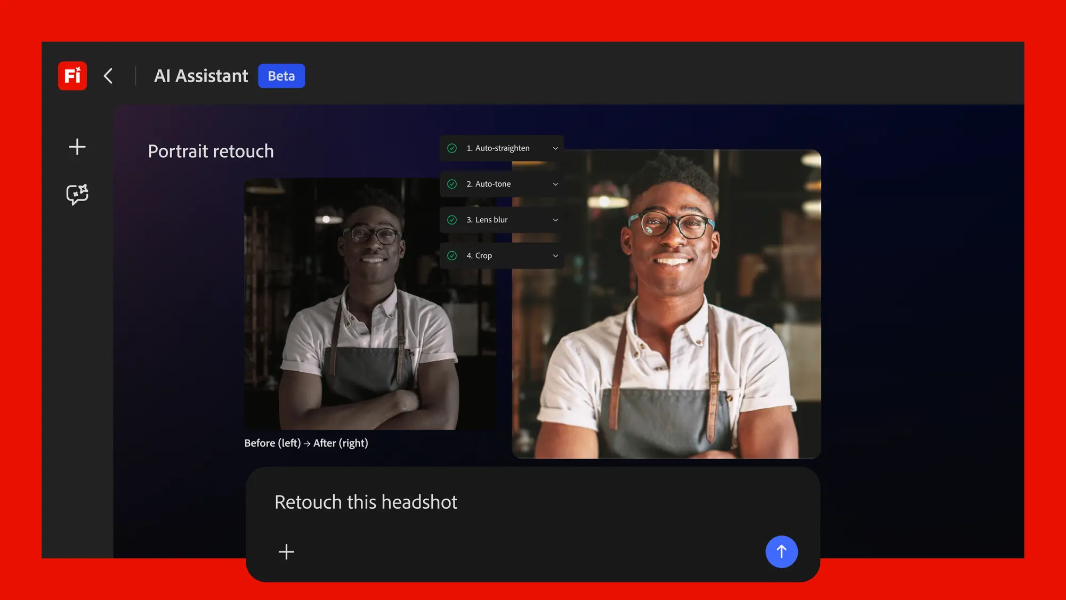
Adobe has introduced Firefly AI Assistant, a new agentic AI tool designed to coordinate complex, multi-step creative workflows across its entire Creative Cloud suite from a single conversational interface.
The launch is part of what the company is positioning as its most aggressive AI push so far, pairing the assistant with new video, image and collaboration capabilities. Together, these updates signal Adobe’s intent to sit at the centre of AI-driven content creation rather than be displaced by newer, AI-native rivals.
Firefly AI Assistant is built to act as a creative agent that understands and works across Adobe’s professional and generative tools. Instead of users manually jumping between apps, the assistant is meant to interpret a creator’s goal in natural language and then bring the right tools into the conversation.
The assistant sits within the broader Firefly ecosystem, which already includes Adobe’s own generative models and integrations across Creative Cloud. Today’s announcement highlights Adobe’s view that so-called “agentic AI” is not just another feature layer, but a way to reshape how creative work is organized and executed.
Alongside Firefly AI Assistant, Adobe is rolling out additional updates that further lean on AI and cloud infrastructure:
New Colour Mode for Premiere Pro: Adobe is adding a Colour Mode to its Premiere Pro video editing software. While specific technical details are not included in the source material, the feature is part of the same release package as Firefly AI Assistant and is framed as one of several enhancements aimed at modern video workflows.
Kling 3.0 video models in Firefly: Firefly is expanding its roster of third-party AI engines with the addition of Kling 3.0 video models from Higgsfield. This broadens the range of underlying models available inside Firefly for AI-powered video-related tasks.
Frame.io Drive virtual filesystem: Adobe is introducing Frame.io Drive, described as a virtual filesystem that lets distributed teams work with media stored in the cloud as if it were located on their local machines. The intent is to smooth remote collaboration and media access for creative teams working across locations.
These elements collectively form what Adobe is presenting as a step-change in how professionals might use Creative Cloud moving from manually managed, app-by-app workflows to orchestrated, AI-assisted flows that span video, imaging, and team collaboration.
The company’s strategy is unfolding against a tense backdrop. Adobe is under pressure to demonstrate to investors, long-time creative professionals, and a wave of AI-first competitors that its established software business can not only weather the generative AI shift but also lead it.
Framing Firefly AI Assistant as a central “creative agent” and coupling it with new capabilities like the updated Premiere Pro Colour Mode, Kling 3.0 integration, and Frame.io Drive, Adobe is sending a clear message that it sees AI agents as foundational to the future of creative work, not peripheral add-ons.
The centrepiece of today’s news remains Firefly AI Assistant itself, which Adobe describes as a way to connect many tools and operations potentially spanning more than a hundred different capabilities across Creative Cloud through a single conversational experience. While the underlying implementation details are not fully outlined in the available material, the direction is clear: Adobe wants creators to specify outcomes in plain language and let the assistant orchestrate the necessary steps across its ecosystem.
Related Reading
More contextual TechBooky stories selected from tags, categories and article context.
Paul Femi Balo is the founder and publisher of TechBooky. He covers artificial intelligence, African technology, digital infrastructure, enterprise technology and the global digital economy.
We use cookies to ensure that we give you the best experience on our website. If you continue to use this site we will assume that you are happy with it.