At a global summit meant to showcase cooperation in artificial intelligence, the most talked-about moment was not a speech, policy announcement, or product launch it was a photograph.
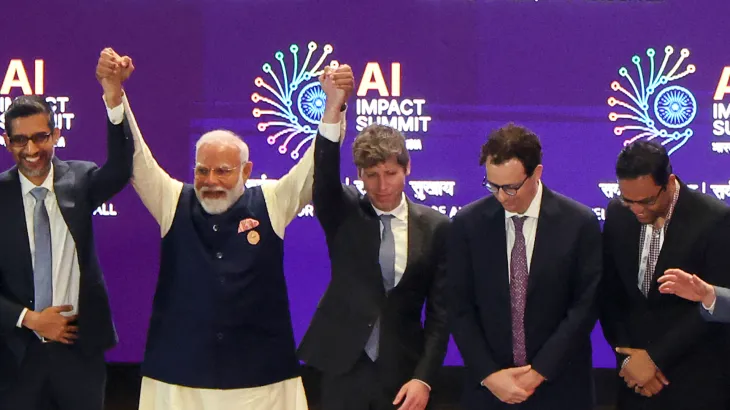
During the India AI Impact Summit in New Delhi, world leaders and top technology executives gathered on stage for a ceremonial group photo alongside Indian Prime Minister Narendra Modi. Executives linked hands in a symbolic gesture of unity. But two of the most important figures in modern AI, OpenAI CEO Sam Altman and Anthropic CEO Dario Amodei did not.
Instead, the pair hesitated and raised their fists, standing awkwardly apart as cameras rolled. The moment quickly went viral online.
Altman later described the incident bluntly; he said he was “sort of confused” and unsure what he was supposed to do during the staged photo opportunity.
This is so hilarious.
Nothing can make Sam and Dario hold hands, not even the Prime Minister of India! pic.twitter.com/aRKsjSFXM9
Amodei once worked at OpenAI before leaving in 2021 over disagreements about safety, commercialisation and leadership direction eventually founding rival AI company Anthropic.
Today the two men lead companies at the centre of the global AI boom, competing for the same enterprise customers, government partnerships and research leadership. Analysts often describe the relationship as one of the defining rivalries in modern technology less Apple vs Microsoft, and more a philosophical split over how powerful AI should be deployed.
The New Delhi moment reflected that tension in real time. While most executives complied with the unity gesture, the gap between Altman and Amodei stood out immediately and became a widely shared image online.
The summit itself was intended to demonstrate global cooperation on AI governance and development. India positioned the gathering as a major international forum, hosting leaders from OpenAI, Google, DeepMind, and others to discuss the future of the technology.
Instead, the brief hesitation on stage became a metaphor for something bigger: the AI industry’s quiet fragmentation.
OpenAI and Anthropic represent two competing visions of artificial intelligence. One emphasizes rapid deployment and integration into consumer and enterprise products; the other stresses safety-focused scaling and careful release cycles. Their rivalry has intensified recently amid competition for funding, customers and influence over future regulation.
Even a staged unity gesture couldn’t mask that divide.
In previous tech eras, corporate rivalries were mostly expressed through products and marketing. Today’s AI competition carries geopolitical and economic weight shaping national policy, infrastructure investment and global regulation.
The summit itself secured massive investment pledges and policy commitments, but the image people remember is two CEOs declining to hold hands.
That’s because the stakes are no longer just commercial.
Governments want safe AI. Companies want powerful AI. And researchers disagree on how fast the world should move.
The Altman-Amodei moment captured that tension better than any keynote speech could.
To casual viewers, the incident looked like an awkward social interaction but to many techies, it looked like the AI cold war visible for a split second.
The next decade of technology may be shaped less by who builds AI first and more by who decides how it should behave. And as the world races toward more autonomous systems, that philosophical divide is widening, not shrinking.
Paul Balo is the founder of TechBooky and a highly skilled wireless communications professional with a strong background in cloud computing, offering extensive experience in designing, implementing, and managing wireless communication systems.
We use cookies to ensure that we give you the best experience on our website. If you continue to use this site we will assume that you are happy with it.