Elon Musk’s Starlink is currently leading the orbital mobile communication industry, but Amazon is entering the fray. The business announced in the early hours on Tuesday that it had reached an agreement to pay $11.57 billion in cash to acquire Globalstar, the satellite company that powers Apple’s “Emergency SOS” feature. This calculated action is meant to support Amazon’s low Earth orbit (LEO) satellite network, Amazon Leo (previously Project Kuiper), in its escalating rivalry with SpaceX’s Starlink.
Amazon will acquire all of Globalstar’s satellite operations, infrastructure, and mobile satellite services spectrum licenses through the $90-per-share acquisition, allowing the larger corporation to expand its fledgling satellite business, Amazon Leo, with direct-to-device services before its launch later this year.
The news was made a few days after Amazon CEO Andy Jassy boasted about Amazon Leo’s clientele, which includes NASA, Delta Airlines, AT&T, Vodafone, and Australia’s National Broadband Network. On Monday, the business also unveiled a new satellite internet antenna designed for commercial aircraft that guarantees fast internet while in flight.
Due to delays, the company has only launched roughly 200 of the more than 3,200 satellites it plans to deploy into low-Earth orbit. In the end, Amazon was forced to request an extension from the Federal Communications Commission to meet the deadline of having roughly 1,600 satellites in orbit by July of this year.
In contrast, the much bigger Starlink presently uses more than 10,000 satellites to provide internet services to businesses and consumers in roughly 150 nations, including those in the aviation and maritime sectors.
More than 24 of Globalstar’s satellites are in low-Earth orbit, and the company has contracts to purchase more than 50 additional spacecraft. Additionally, the firm and SpaceX have a deal in place for the company to launch replacement satellites for its existing constellation this year.
The $90 per share offer is a 31%+ premium over GlobalStar’s April 1, 2026 closing price. The deal is also subject to FCC approval and Globalstar’s operational milestones and is expected to close in 2027.
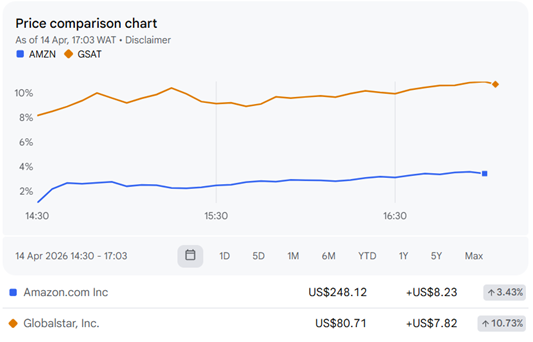
Below is the prize comparison chart for Amazon and Globalstar, as of today.
Alongside this transaction, Amazon announced that it had reached a contract with Apple to continue offering satellite connectivity services for the Apple Watch and iPhone. Currently available on Apple’s iPhone 14 and later smartphones in some areas, Globalstar offers satellite services like location sharing, roadside assistance requests, and emergency text messaging.
Additionally, starting in 2028, Amazon Leo plans to implement a direct-to-device satellite system that will work with its existing satellite and broadband infrastructure. According to the business, their goal is to create a network of “thousands of advanced satellites in low-Earth orbit” that will “support hundreds of millions of customer endpoints around the world.”
We use cookies to ensure that we give you the best experience on our website. If you continue to use this site we will assume that you are happy with it.