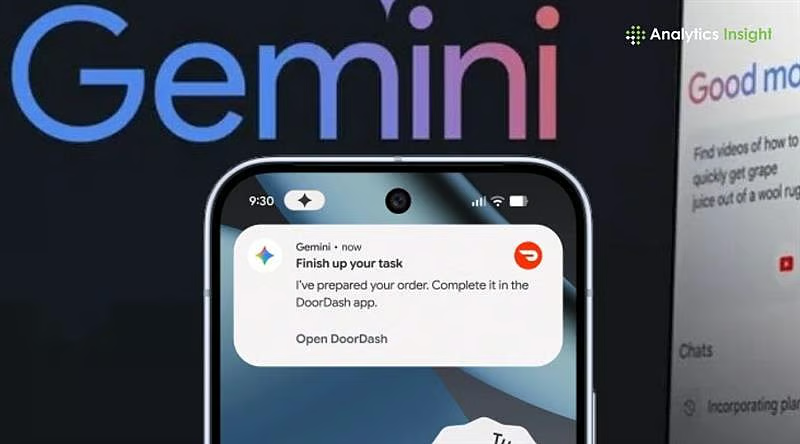
Google revealed on Wednesday for its Gemini AI-powered capabilities for the Android operating system is a new method for using the AI to manage multi-step processes like booking food delivery or an Uber. These automations come along with other Gemini enhancements that are being shipped today, such as an extension of scam detection for phone calls and Circle to Search updates that enable you to recognise every item on your phone’s screen.
A new task automation feature from Google’s Gemini AI will enable the assistant to perform multi-step operations on Android devices instead of just responding to enquiries. It is a significant step toward more independent, “agent-style” AI for mobile devices.
Along with better Circle to Search capabilities and improved scam detection, this upgrade is a part of a broader Android AI push.
According to Google, the automations enable users to effectively delegate their to-do list to Gemini. But in reality, Geminis are still only able to handle a small number of situations.
The tool, which is now in beta, will first enable a few apps in the grocery, ridesharing, and food categories, according to the business.
Additionally, it will only work with the Gemini app on specific smartphones, such as the Samsung Galaxy S26 series, Pixel 10, and Pixel 10 Pro. Additionally, it will only be accessible in Korea and the United States at first. This is where it was initially launched.
Naturally, there is a chance that AI-powered automations could go awry, so Google has included certain safeguards. To begin with, the owner of the device must give a clear command for the automations to begin. You may monitor their progress in real time while they run and halt the task if it errs or becomes stuck. Additionally, Google observes that the automations occur within a safe, virtual window on your phone, where they can only access a select few apps and not the rest of your device’s data.
The functionality contributes to the expanding trend of automating more personal duties with AI. For example, ChatGPT offers an agent that can perform a range of computer-based tasks, such as accessing a calendar, creating a slideshow, or running code, and allows users to build tasks that may be run on schedules or at specific times. Meanwhile, Anthropic’s Cowork enables non-developers to automate routine file and task management by extending the capabilities of its Claude AI for non-coding jobs. Naturally, OpenClaw, an AI tool, recently gained popularity due to its capacity to handle routine chores like scheduling, emailing, booking flights, and more.
The introduction of a Scam Detection feature for phone conversations, which is now accessible for Samsung Galaxy S26 series handsets in the United States, is another Gemini upgrade that is on the way. (Pixel phones in the United States, Australia, Canada, India, Ireland, and the United Kingdom already have this capability.) On Pixel 10 series handsets and shortly on the Galaxy S26 series phones, Google is also employing its Gemini on-device model to identify fraudulent SMS in the United States, Canada, and the United Kingdom.
Last but not least, Google claims that its Circle to Search function, which enables you to start searches using motions like scribbles and circles, can now look for everything on your phone screen, not just a single item. This implies that you can look for every piece of apparel and accessory in an ensemble that appeals to you or discover more about a collection of items and the associated subject on the screen.
Through new operating system updates and frequent updates known as Pixel Drops, Google has been systematically pushing Gemini updates to its Android ecosystem at regular intervals. These updates are specifically aimed at the Google Pixel, the company’s flagship phone. In the meantime, Apple has been having trouble releasing a more complete set of AI features, including an AI-powered Siri, the launch of which was recently rescheduled for later in the year.
We use cookies to ensure that we give you the best experience on our website. If you continue to use this site we will assume that you are happy with it.