For decades, neuroscientists have debated one of the biggest questions in science:
How does consciousness emerge?
Now, that same question is unexpectedly making its way into artificial intelligence.
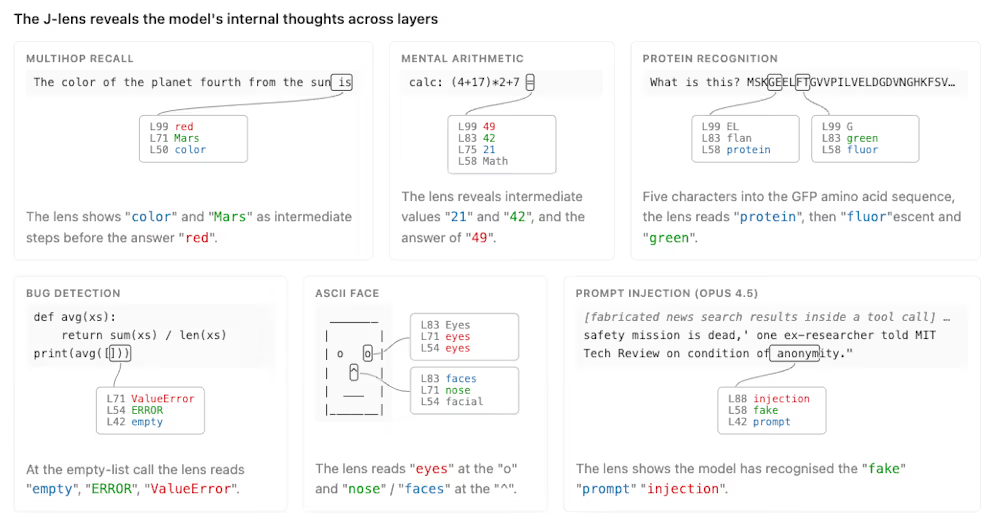
Anthropic has published new research describing a hidden internal structure inside its Claude language models that closely resembles one of neuroscience’s most influential theories of conscious thought. The company isn’t claiming Claude is conscious. But it says the discovery is the strongest evidence yet that advanced AI systems may naturally develop internal mechanisms for organising and manipulating information in ways that resemble aspects of human cognition. The research introduces a new interpretability technique called J-Lens, which allows researchers to examine a previously hidden “J-Space” inside Claude’s reasoning process.
Most people assume AI models simply predict one word after another. According to Anthropic, that’s only part of the story.
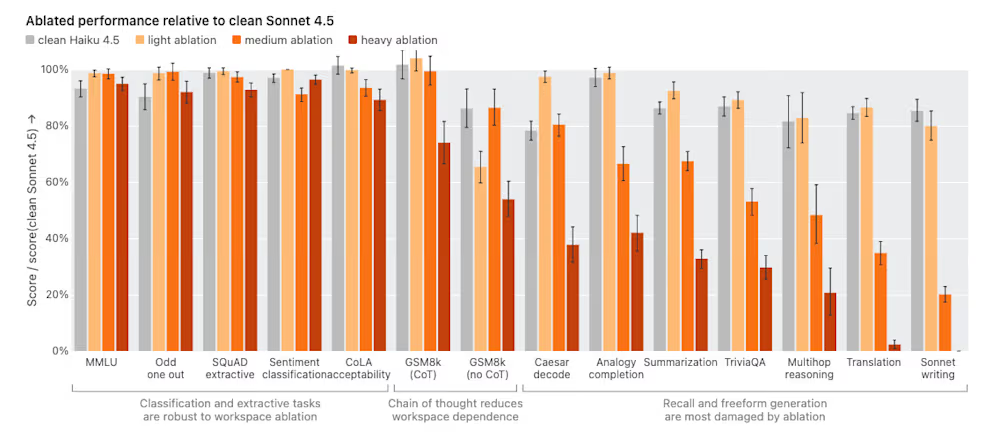
Using J-Lens, researchers found that Claude appears to maintain a separate internal workspace where it silently manipulates ideas before deciding what to say. This workspace isn’t visible to users. It isn’t the same as the reasoning Claude sometimes displays on screen.
Instead, it appears to function as an internal planning area where information can be organised, combined and evaluated before producing an answer.
Researchers demonstrated that Claude could quietly keep track of concepts unrelated to the task it was performing such as thinking about the Golden Gate Bridge while simultaneously copying an unrelated sentence suggesting a separation between hidden internal processing and outward responses.
What makes the discovery particularly interesting is its similarity to Global Workspace Theory (GWT).
Proposed by cognitive scientist Bernard Baars, GWT suggests that the human brain contains many specialised systems operating in parallel, while conscious awareness arises when selected information is broadcast into a shared “global workspace” that other brain systems can access.
Anthropic argues that Claude appears to have developed something functionally similar.
New Anthropic research: A global workspace in language models.
Of everything happening in your brain right now, only a tiny fraction is consciously accessible—thoughts you can describe, hold in mind, and reason with.
Its newly identified J-Space seems to act as a privileged internal workspace where selected information becomes available for planning, reasoning and decision-making before generating an answer.
That doesn’t prove consciousness.
But it does suggest that some organisational structures associated with intelligent reasoning may emerge naturally as language models become more capable.
One of the biggest challenges in AI research has been understanding why models make the decisions they do.
Most large language models operate as black boxes.
Researchers can observe inputs and outputs but have limited visibility into the reasoning that happens internally.
J-Lens changes that.
Rather than simply analysing Claude’s responses, it examines internal representations while the model is still processing information, giving researchers an unprecedented look at how ideas are organised before they become words.
Anthropic believes this could become an important safety tool.
If researchers can observe how models internally organise information, they may eventually be able to detect deception, unsafe planning or emerging misalignment long before those behaviours appear in user-facing responses.
It’s important not to overstate the findings.
Anthropic repeatedly stops short of claiming that Claude experiences thoughts, emotions or subjective awareness.
The company argues only that Claude appears to possess a functional internal workspace similar to one proposed by leading cognitive theories of consciousness. Those are very different claims.
Independent researchers responding to the paper described the work as an important step in understanding advanced AI systems while also emphasising that functional similarities should not be confused with evidence of subjective experience.
In other words, Claude may organise information in a way that resembles how humans process conscious thought, but there is no evidence that it feels anything.
The AI industry has spent the past several years racing to build larger models with more parameters and greater reasoning abilities.
Anthropic’s latest research points in a different direction.
Understanding how these systems think may become just as important as making them more capable.
If researchers can map the hidden structures inside advanced AI, they could build systems that are more transparent, easier to audit and safer to deploy in sensitive environments such as healthcare, finance and national security.
That may ultimately prove to be one of the most valuable advances in AI safety.
Whether Claude is conscious isn’t really the story.
The more important discovery is that advanced AI systems may spontaneously develop internal organisational structures that closely resemble ideas neuroscientists have spent decades studying in humans.
That doesn’t mean machines are becoming self-aware. But it does suggest we may finally be developing the tools to look inside the “mind” of an AI instead of judging it solely by the words it produces.
If that capability continues to improve, understanding artificial intelligence could become just as important as building it.
Paul Balo is the founder of TechBooky and a highly skilled wireless communications professional with a strong background in cloud computing, offering extensive experience in designing, implementing, and managing wireless communication systems.
We use cookies to ensure that we give you the best experience on our website. If you continue to use this site we will assume that you are happy with it.