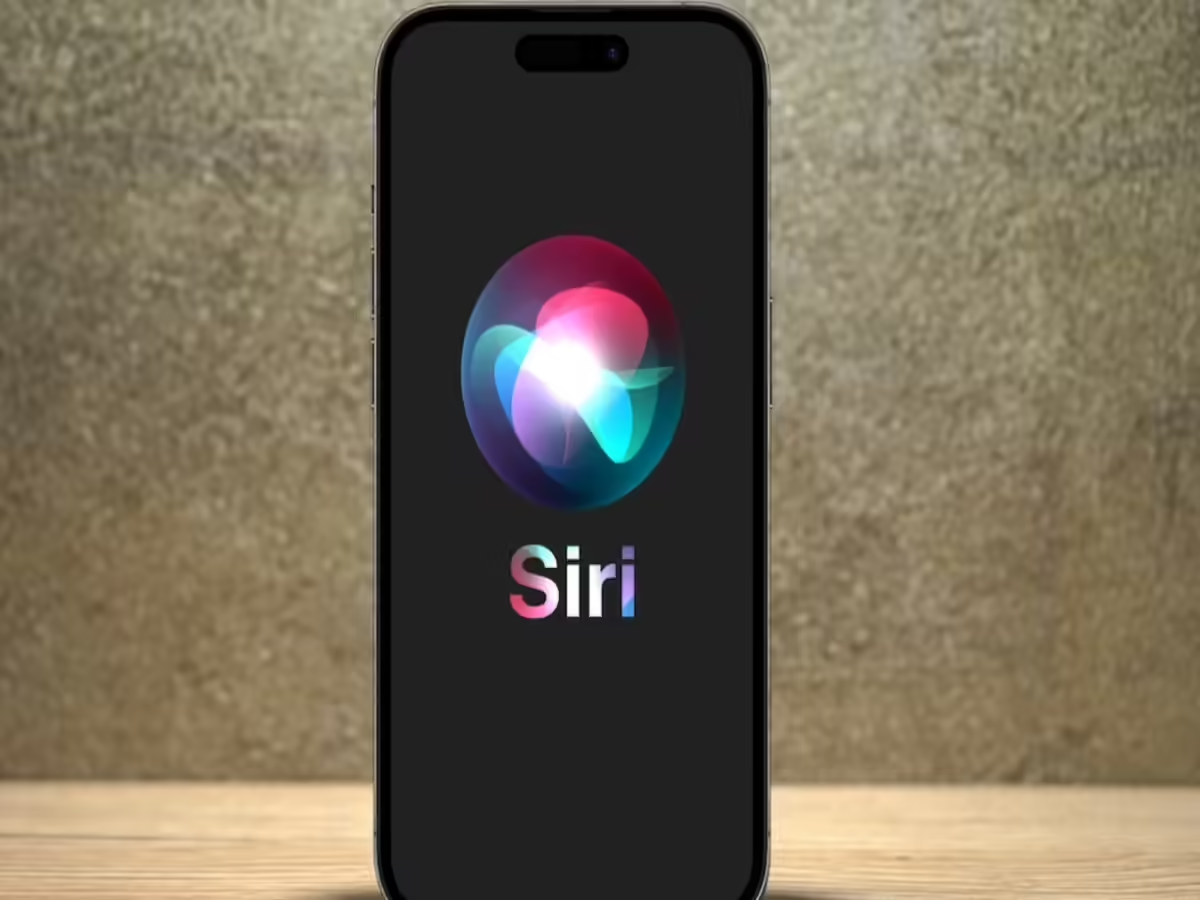
Apple plans to significantly revamp its Siri digital assistant later this year by transforming it into a full-fledged artificial intelligence chatbot deeply embedded across iPhone, iPad and Mac devices, according to people familiar with the company’s plans. The move represents a major shift in strategy as Apple seeks to regain ground in the generative AI race led by OpenAI’s ChatGPT and Google’s Gemini.
The project, code-named “Campos,” will replace the legacy Siri interface with a conversational AI system integrated into the core of iOS 27, iPadOS 27 and macOS 27. Users will be able to summon the chatbot the same way they currently activate Siri by speaking the “Siri” command or holding down the side button on supported devices but the underlying experience is expected to be far more capable and interactive.
Unlike the current Siri, which primarily responds to basic commands and queries, the new assistant will support both voice and text input and deliver more natural, contextual conversational experiences, mirroring features seen in popular AI chat services. The chatbot is expected to offer richer interactions that include complex question answering, content generation, on-device analysis and deeper integration with built-in apps.
Apple’s initial foray into large-language-model-powered features branded as Apple Intelligence debuted in 2024, offering users AI-assisted suggestions and context-aware tools across iPhones and Macs. However, that rollout received mixed reviews, with some users and developers saying it lagged behind generative AI rivals and lacked the seamless conversational feel of standalone chat apps.
The upcoming chatbot initiative signals a more aggressive push into generative AI, a technology area that has become central to competition among Big Tech. Apple has reportedly entered into a multi-year agreement with Google to use the latter’s Gemini AI models as part of the foundation for the revamped assistant, giving Apple access to cutting-edge language-model capabilities without developing them entirely in-house.
Bloomberg’s report suggests Apple could unveil the new Siri at its Worldwide Developers Conference (WWDC) in June 2026, with a broader rollout planned for later in the year alongside iOS 27 and related operating system updates. The broader software releases are expected to focus on this AI integration, with fewer major visual changes compared with prior OS upgrades.
Experts say this represents Apple’s most dramatic rethink of Siri since its introduction in 2011. By embedding a powerful chatbot directly into the operating systems, Apple hopes to offer users a more capable assistant that can handle multi-step tasks, understand context and interact across apps in ways current voice assistants cannot. This includes integrating AI tools into apps such as Photos, Mail, Messages and more to help with complex tasks like drafting content, summarizing information, generating creative assets and executing system commands.
The move also reflects broader market dynamics. Competitors such as Google, Samsung and various Android manufacturers have already woven conversational AI deeply into their device ecosystems, and consumer expectations for AI-driven assistance continue to rise. Apple’s decision to pivot toward a chatbot experience underscores pressure to keep its platforms competitive as generative AI becomes a mainstream computing paradigm.
Despite the ambitious plan, some questions remain around privacy and data handling. Apple has long promoted on-device processing and strong privacy protections as differentiators for its products. How these principles will be balanced with server-side AI model processing and conversational memory features will be closely watched once the new Siri is unveiled.
After all said and done, it is a welcome development that Apple plans to finally revamp Siri even though it is now entering the AI race at really later time. But then they’ve got the device market to as an advantage, the same advantage that Google has capitalised on to promote its Gemini.
Apple did not immediately respond to requests for comment on the reported overhaul.
Paul Balo is the founder of TechBooky and a highly skilled wireless communications professional with a strong background in cloud computing, offering extensive experience in designing, implementing, and managing wireless communication systems.
We use cookies to ensure that we give you the best experience on our website. If you continue to use this site we will assume that you are happy with it.