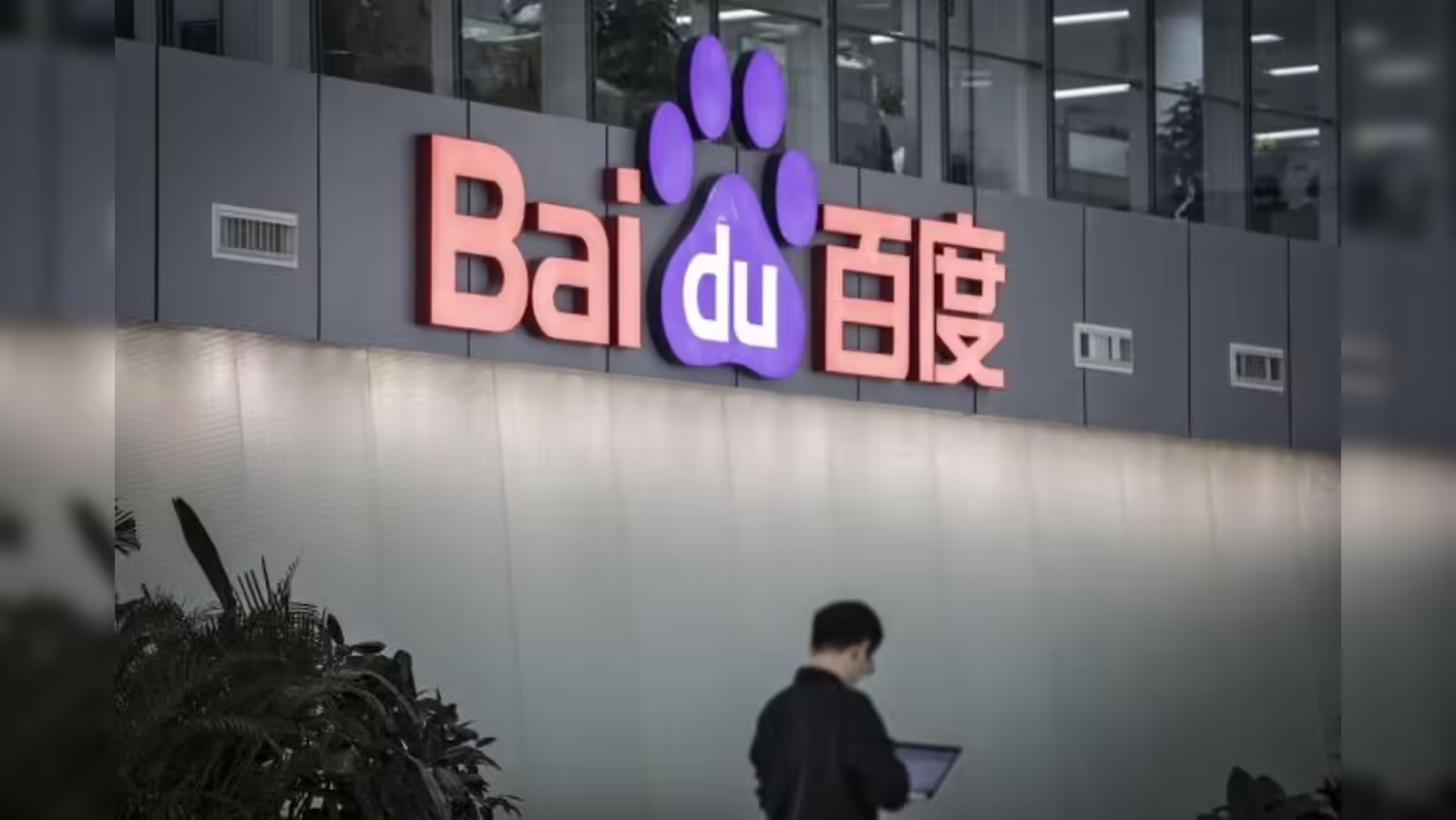
China’s biggest technology companies are accelerating efforts to bring artificial intelligence into everyday use, with Baidu and Tencent leading a nationwide push powered by OpenClaw-style AI agents, according to recent reports.
The companies are taking an unusually hands-on approach organizing community meetups, tutorials, and onboarding sessions to help ordinary users install and use AI assistants, marking a shift toward mass-market adoption rather than enterprise-only deployments.
The strategy reflects how seriously Chinese tech firms are taking the next phase of AI competition, where success may depend not just on building powerful models, but on getting millions of people to actually use them.
OpenClaw, an open-source AI agent platform, has quickly become one of the most talked-about technologies in China, triggering what analysts describe as an AI “gold rush.”
Unlike traditional chatbots, AI agents built on platforms like OpenClaw are designed to perform tasks autonomously from managing emails and scheduling meetings to conducting research and executing workflows across apps.
Chinese companies have moved rapidly to capitalize on the trend. Firms including Tencent, Baidu, Alibaba, and ByteDance are rolling out their own versions or integrations of AI agents to capture users early.
Baidu has already embedded AI agent capabilities into its search ecosystem, exposing the technology to hundreds of millions of users, while Tencent is leveraging its vast WeChat platform to distribute similar tools at scale.
What stands out in China’s approach is the grassroots nature of adoption.
Instead of waiting for developers or enterprises to lead adoption, companies are directly engaging everyday users — from tech enthusiasts to older, less tech-savvy individuals helping them install and experiment with AI assistants.
This bottom-up strategy marks a departure from how AI has typically been rolled out globally, where adoption often starts with developers and enterprise customers before reaching consumers.
The approach is already showing results, with usage of AI agents growing rapidly as more people gain hands-on exposure to the technology.
The surge in AI agent adoption has intensified competition among China’s tech giants.
Tencent has recently launched multiple products aimed at tapping into the growing demand for agent-based AI services, leveraging its ecosystem of apps and more than a billion users to gain an edge.
Meanwhile, Baidu continues to expand its AI capabilities through its Ernie models and AI-powered search tools, positioning itself as a key player in China’s AI infrastructure and application layers.
At the same time, a new generation of startups often referred to as China’s “AI tigers” is also competing aggressively, backed by major investors including Tencent and Alibaba.
Despite the rapid growth, the OpenClaw boom has raised concerns around security and data privacy.
Chinese authorities have already issued warnings about potential risks, including vulnerabilities, excessive system permissions, and the possibility of data leaks when AI agents are deployed improperly.
In some cases, restrictions have even been placed on the use of such tools within government systems as regulators attempt to balance innovation with security.
The push by Baidu and Tencent highlights a broader shift in the global AI landscape from building models to driving real-world usage at scale.
As companies compete to define how AI is used in everyday life, the ability to onboard millions of users quickly may become just as important as technical breakthroughs.
In China, that race is already underway, with AI agents emerging as one of the key battlegrounds shaping the future of artificial intelligence.
Paul Balo is the founder of TechBooky and a highly skilled wireless communications professional with a strong background in cloud computing, offering extensive experience in designing, implementing, and managing wireless communication systems.
We use cookies to ensure that we give you the best experience on our website. If you continue to use this site we will assume that you are happy with it.