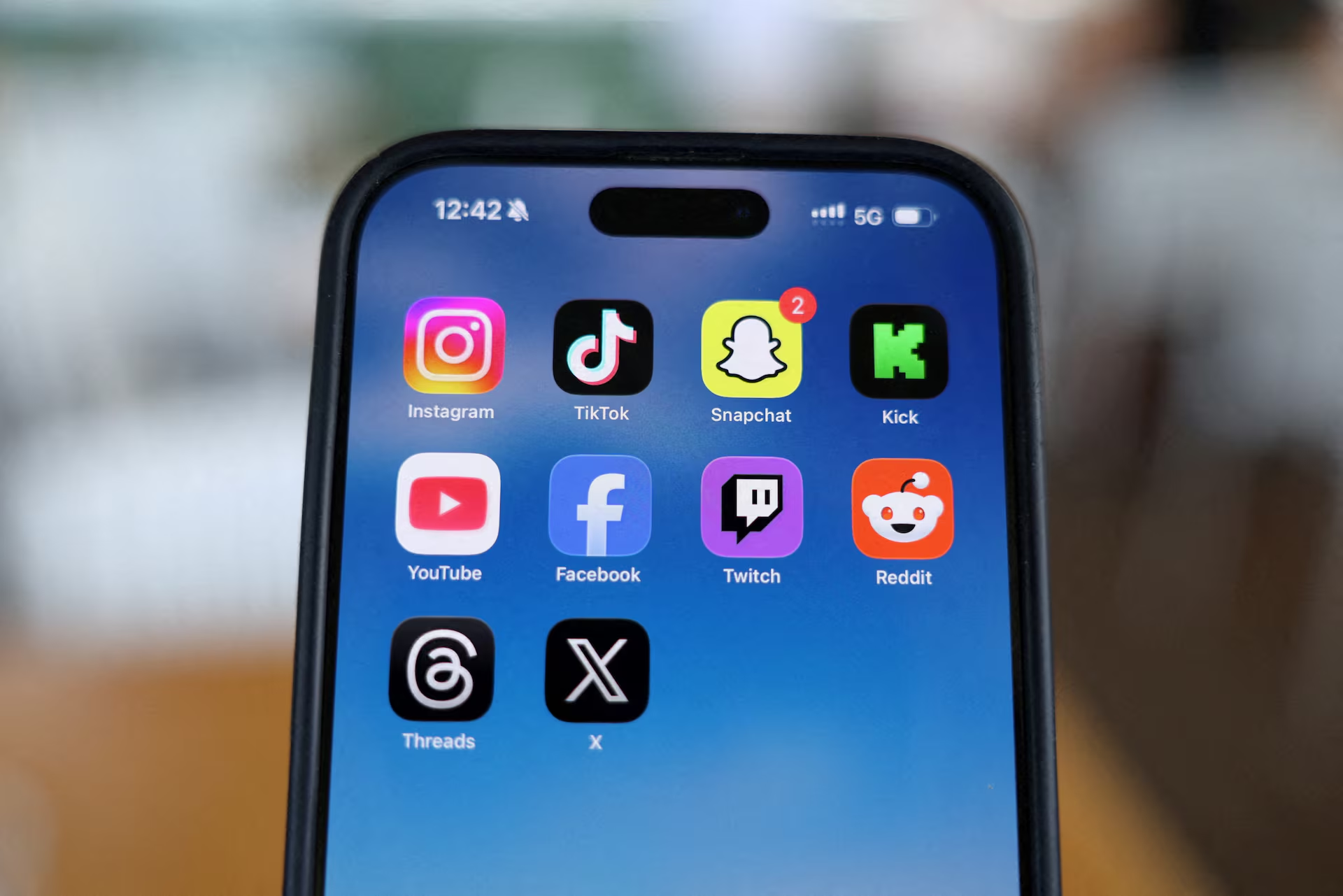
As the national conversation around children’s screen usage moves into a new phase, big tech firms like Meta Platforms, TikTok, and YouTube will be under investigation in court this week over claims that their platforms are contributing to a teenage mental health crisis.
In a legal assault that could undermine Big Tech’s long-standing legal defence, the trial in California Superior Court, Los Angeles County, is a test case for thousands of additional cases seeking damages for social media injuries.
The first U.S. jury trial for Meta Platforms, TikTok, and YouTube is scheduled to take place in response to allegations that their platforms are made to be addictive and have contributed to a mental health crisis among young people.
Court documents claim that the plaintiff, a 19-year-old California woman named K.G.M., claims that the attention-grabbing design of the corporations’ platforms caused her to develop an addiction to them at a young age. She wants to hold the firms accountable because she claims the applications contributed to her despair and suicidal thoughts. The case’s jury selection process starts on Tuesday.
Her claim is the first of several instances involving what the plaintiffs refer to as “social media addiction” in children that are anticipated to go to trial this year. According to Matthew Bergman, the plaintiff’s lawyer, this will be the first time the tech companies have to defend themselves in court over claims that their products have caused injury.
A federal regulation that mainly shields social media sites like Instagram and TikTok from legal responsibility for content posted by their users is a consideration in the case. In K.G.M.’s lawsuit, the tech corporations have claimed the law protects them.
That defence, which has shielded the social media giants from lawsuits for decades, would be weakened by a decision against them. It would demonstrate that jurors are prepared to hold the platforms accountable. “We are writing on a legal tabula rasa,” Bergman told Reuters, adding that the matter is likely to make its way to the Supreme Court through K.G.M.’s lawsuit or another.
The CEO of Meta, Mark Zuckerberg, opens a new tab and is anticipated to testify. Meta’s attorneys informed Reuters prior to the trial that the firm will contend in court that K.G.M.’s mental health issues were not caused by its goods.
Since Snap was named as a defendant in the lawsuit, CEO Evan Spiegel was also anticipated to testify. In order to resolve K.G.M.’s lawsuit, Snap opened a new tab on January 20. A representative for the corporation declined to comment on the deal’s details.
A YouTube executive stated prior to the trial that the business will contend that its platforms are essentially distinct from social media sites like Instagram and TikTok and should not be grouped together in court.
Regarding the company’s upcoming legal claims, TikTok declined to comment.
The same tech corporations are launching a statewide campaign to persuade sceptics that their products are safe for teenagers as the trial gets underway. They have spent millions of dollars marketing solutions that they claim give parents more control over how their children use the platforms.
Meta has supported parent workshops on teen internet safety at dozens of American high schools since at least 2018. One of the courses, called Screen Smart, was held by the firm in Los Angeles in 2024. Yvonne Johnson, the president of the National PTA, and Antigone Davis, the head of Meta safety, participated. A nonprofit organisation called National PTA promotes child welfare.
According to the company’s website, TikTok has sponsored similar events and launched a new tab called Create with Kindness, which is led by 100 local and regional PTAs. According to the curriculum, the programme offered parents lectures on TikTok’s features, such as the ability to restrict screen usage at night.
In an effort to persuade the public that it cares about children’s online safety, Google, the parent firm of YouTube, has opened a new tab in recent years. According to the Girl Scouts website, girls who complete lessons about secure passwords, being kind online, and digital privacy can earn a patch that features Google’s logo and opens a new tab to adhere to their uniform.
Additionally, the businesses have employed solicitors who have defended corporations in well-known cases regarding addiction.
According to the attorneys’ public biographies, Meta has retained Covington & Burling lawyers who represented McKesson in extensive litigation pertaining to the opioid crisis. Meanwhile, Activision Blizzard and Microsoft were sued by TikTok’s legal team for video game design and addiction. According to Julie Scelfo, founder of Mothers Against Media Addiction, an organisation that advocates for smartphone bans in schools, these companies are using every lever of influence that you can imagine. “It can be very confusing for parents who to trust.”
More details about the trial location and schedule is the California Superior Court in Los Angeles, which will begin jury selection for the historic bellwether trial on Tuesday, January 27, 2026. It is anticipated that the experiment will run roughly six weeks.
The core allegation is the plaintiff, 19-year-old K.G.M., claims that features like unlimited scrolling and algorithms, which are intended to maximise engagement, caused her to develop an addiction to the applications as a kid. She claims that this resulted in suicidal ideation, body dysmorphia, and sadness.
Important witnesses like Mark Zuckerberg, the CEO of Meta, are anticipated to testify throughout the proceedings.
Snap deal: On January 20, 2026, Snap, the parent company of Snapchat, negotiated a deal with the plaintiff in this case, averting a trial.
The Legal Shield Test is a trial that will determine whether claims pertaining to a platform’s internal product design are covered by Section 230 of the Communications Decency Act, which normally shields platforms from liability for user-generated content.
The wider impact is approximately 1,500 comparable personal injury cases filed by families nationwide are based on this case.
“These are our generation’s tobacco trials, and for the first time, large tech CEOs will speak directly to families across the nation about how they purposefully created their products to addict our children.”
We use cookies to ensure that we give you the best experience on our website. If you continue to use this site we will assume that you are happy with it.