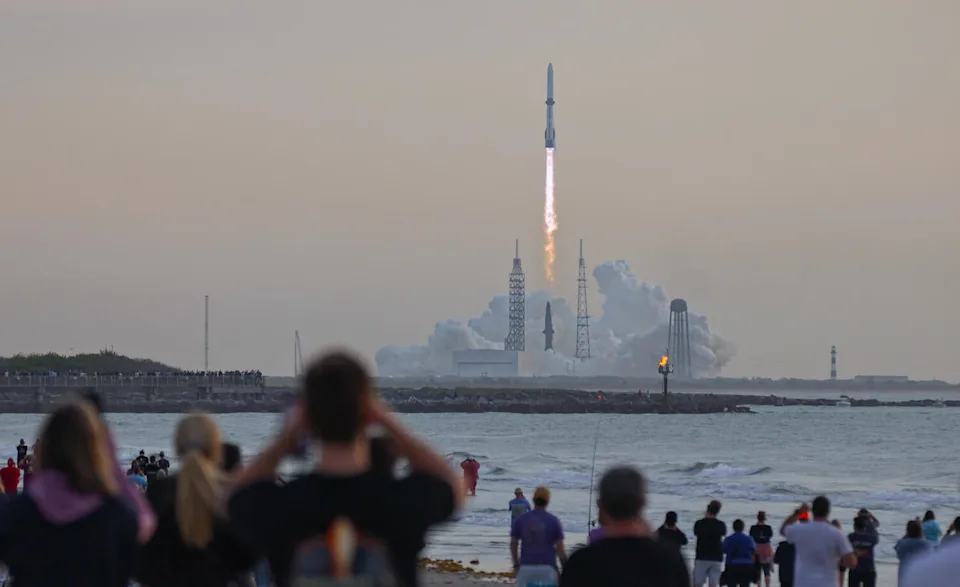
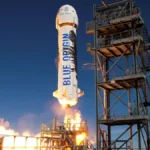
Blue Origin’s New Glenn heavy-lift rocket has suffered its first major mission failure after placing a customer satellite into the wrong orbit during the vehicle’s third flight.
The launch, which took place on Sunday, marked the first time Blue Origin successfully re-used a New Glenn booster. But the mission’s primary objective which was deploying a communications satellite for AST SpaceMobile was not achieved as planned.
AST SpaceMobile said the New Glenn upper stage inserted its BlueBird 7 satellite into an orbit “lower than planned.” The spacecraft separated from the rocket and powered on, but the company concluded that the altitude is too low to support normal operations. Instead, BlueBird 7 will be de-orbited and allowed to burn up in Earth’s atmosphere.
According to AST SpaceMobile, the financial loss is covered by its insurance policy. The company also noted that additional BlueBird satellites are in the pipeline, with successive spacecraft expected to be completed in about a month. AST SpaceMobile works with more than one launch provider and said it still expects to send 45 more satellites to space by the end of 2026.
Blue Origin acknowledged the anomaly roughly two hours after liftoff, saying in a brief post that the New Glenn upper stage placed the AST SpaceMobile payload into an “off-nominal orbit.” The company has not yet provided further technical details and did not immediately respond to requests for comment, according to the original report.
NG-3 Update: We have confirmed payload separation. AST SpaceMobile has confirmed the satellite has powered on. The payload was placed into an off-nominal orbit. We are currently assessing and will update when we have more detailed information.
The incident is a significant setback for New Glenn, a rocket that finally debuted in January 2025 after more than a decade of development. This was only the vehicle’s third launch and its second mission carrying a customer payload. In November, New Glenn flew twin spacecraft to Mars on behalf of NASA, a milestone that underscored Blue Origin’s intention to compete at the high end of the launch market.
The apparent failure of the second stage on this flight could have implications beyond near-term commercial missions. Blue Origin is positioning New Glenn as a core part of its pitch to become one of NASA’s primary launch providers for Artemis missions to the Moon and beyond. Both NASA and the Trump administration have been pressing Blue Origin and SpaceX to demonstrate they can deliver lunar landers to the Moon before the end of President Donald Trump’s second term, as part of a broader push to return humans to the lunar surface.
Blue Origin CEO Dave Limp has publicly pledged that the company will “move heaven and Earth” to help NASA accelerate its return to the Moon. The company recently completed testing of the first version of its own lunar lander, which is expected to launch without crew at some point this year. Blue Origin had previously floated the idea of flying that lander on New Glenn’s third mission, but ultimately chose to fly AST SpaceMobile’s BlueBird 7 on this flight instead.
The decision to place a paying customer on such an early mission had been seen as a vote of confidence in New Glenn’s readiness. Blue Origin’s approach contrasts with that of SpaceX’s Starship program, which has focused recent test flights on carrying dummy payloads while the company works through technical issues on its super-heavy launch system.
SpaceX has, however, experienced its own failures later in a rocket’s life cycle. The Falcon 9 program lost an entire International Space Station cargo mission in 2015 when a rocket broke apart in flight on its 19th mission. In 2016, another Falcon 9 exploded on the pad during testing, destroying an internet satellite that had been slated to serve Meta. Those incidents are a reminder that even comparatively mature launch systems can suffer major setbacks years into operations.
For now, the focus turns to what Blue Origin learns from the off-target orbit and how quickly it can return New Glenn to flight. The outcome will matter not just for future commercial customers like AST SpaceMobile, but also for U.S. lunar exploration plans that increasingly depend on new heavy-lift vehicles proving they can reliably hit their marks.
Related Reading
More contextual TechBooky stories selected from tags, categories and article context.
Paul Femi Balo is the founder and publisher of TechBooky. He covers artificial intelligence, African technology, digital infrastructure, enterprise technology and the global digital economy.
We use cookies to ensure that we give you the best experience on our website. If you continue to use this site we will assume that you are happy with it.