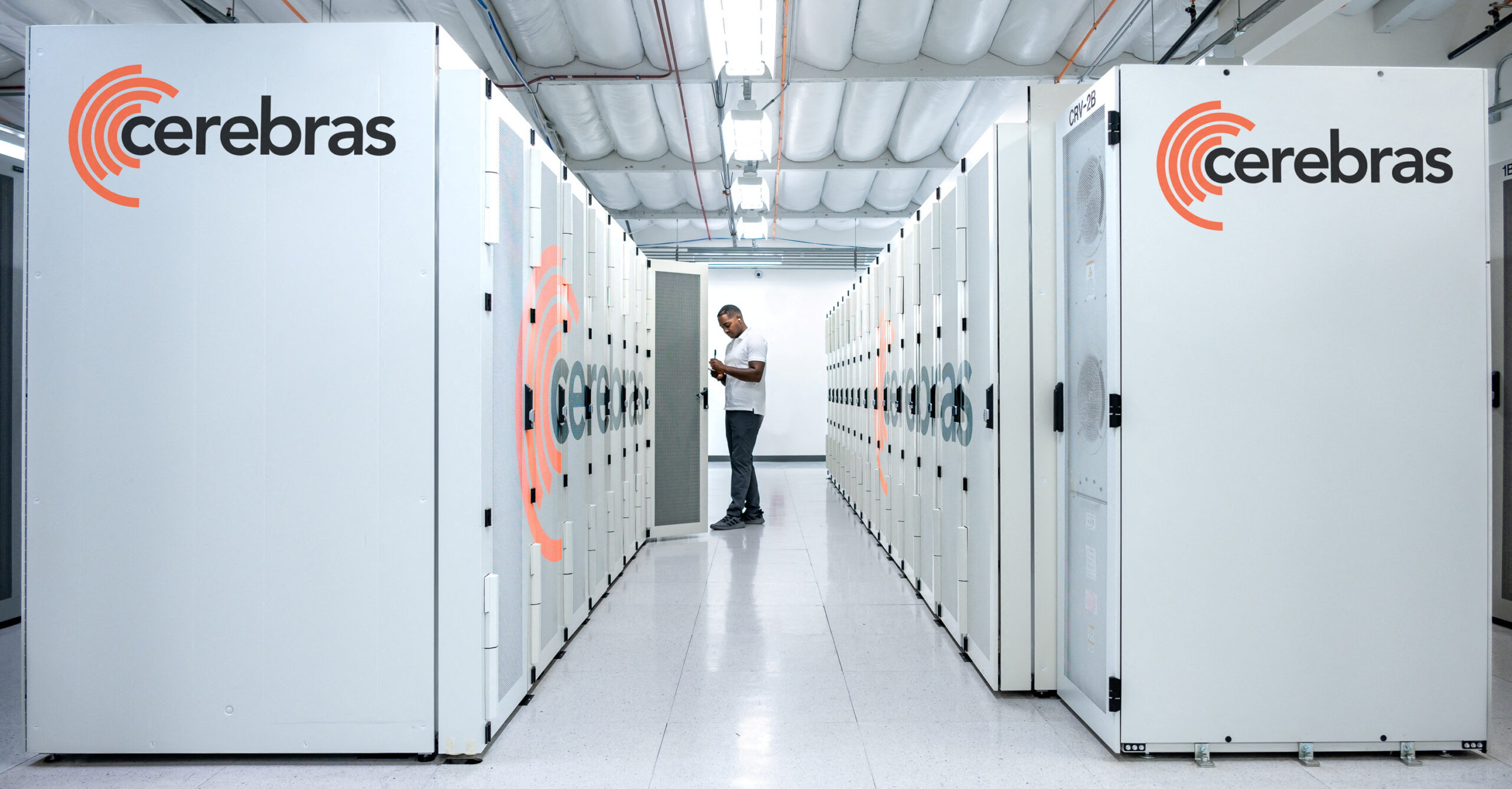
Startup Cerebras System’s new AI supercomputer Andromeda is seen at a data center in Santa Clara, California, U.S. October 2022. Rebecca Lewington/Cerebras Systems/Handout via REUTERS
In a key milestone for the AI infrastructure landscape, Cerebras Systems, a company specialising in purpose‑built chips for large‑scale AI training and inference has raised an eye‑watering $1 billion in a late‑stage funding round that lifts its valuation to $23.1 billion.
The round, led by Tiger Global and backed by a consortium including Benchmark, Coatue, and 1789 Capital with support from Donald Trump Jr. shows strong investor confidence in AI hardware diversity at a time when demand for compute power is exploding worldwide.
At the centre of the generative AI boom is one critical piece of infrastructure: compute chips. The hardware that trains and runs models is as strategically important as the models themselves. So far, Nvidia has been the dominant player, with its GPUs powering the majority of AI systems in the world from research labs to cloud data centres.
But the AI arms race is expanding, and Cerebras is positioning itself as a viable alternative by offering massively scaled AI accelerators including its signature wafer‑scale engines designed specifically for training large language models and other high‑demand AI workloads.
This fresh infusion of capital nearly triples Cerebras’ valuation from roughly $8.1 billion just four months ago. Its success comes after the company abandoned plans for an IPO in late 2025, instead opting to double down on private capital to fund growth and expansion.
Beyond fundraising, Cerebras has also struck commercial agreements with some of AI’s biggest names including a recent partnership with OpenAI that bypassed earlier acquisition talks with Nvidia. This move underscores a broader trend among model developers and tech firms seeking to diversify their hardware supply and reduce reliance on a single provider.
Industry analysts see the rise of Cerebras as part of a larger shift: companies increasingly want multiple sources of cutting‑edge AI compute to hedge against supply bottlenecks, pricing pressures, and geopolitical tensions that can disrupt global semiconductor flows.
Cerebras’ success is also inspiring a broader competitive landscape where others including startups and even hyperscalers like Google and Microsoft invest in custom silicon strategies for AI. These efforts reflect a shared understanding: as models become more complex, specialized hardware matters more than ever.
Tech firms and cloud providers are already racing to meet surging demand from enterprises deploying generative AI services from virtual assistants to real‑time analytics engines. In this context, hardware that accelerates both training and deployment becomes a linchpin for competitive advantage.
As AI systems proliferate across industries healthcare, finance, autonomous vehicles, and content creation, the infrastructure supporting them must scale accordingly. Cerebras’ funding round isn’t just a financial milestone it’s a statement that the AI compute landscape is maturing into a multi‑player economy rather than a monopoly dominated by one supplier.
Paul Balo is the founder of TechBooky and a highly skilled wireless communications professional with a strong background in cloud computing, offering extensive experience in designing, implementing, and managing wireless communication systems.
We use cookies to ensure that we give you the best experience on our website. If you continue to use this site we will assume that you are happy with it.