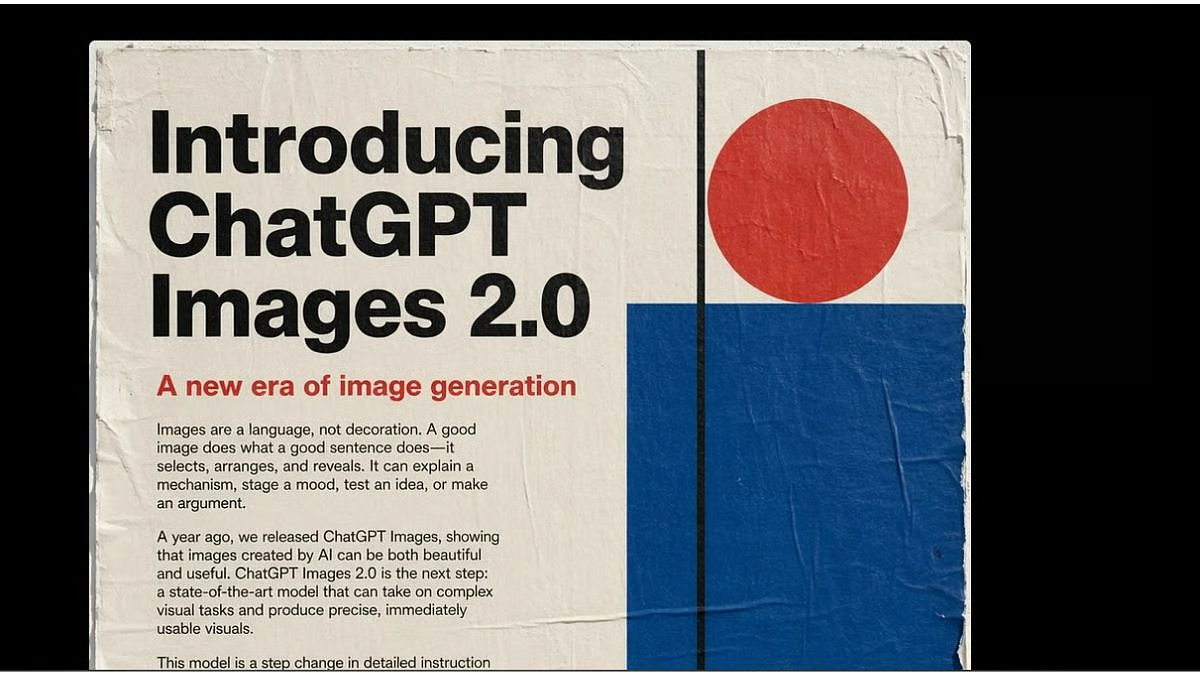
OpenAI has just taken a major step forward in generative AI and this time, it’s not just about making images look better, it’s about making them think.
The company has launched a new image generation system, ChatGPT Images 2.0, powered by its latest model, GPT-Image-2, marking one of the biggest upgrades to AI visual generation in years.
At a glance, the improvements are obvious. The new system produces sharper visuals, more realistic compositions, and significantly better handling of text inside images — an area where previous models consistently struggled.
But the real shift is deeper than quality.
For the first time, OpenAI is introducing what it calls “thinking capabilities” into image generation meaning the system doesn’t just generate visuals from prompts, it reasons through what it’s creating before producing the output.
That changes everything.
Instead of simply translating text into images, the model can now:
Break down complex instructions
Structure scenes logically
Maintain consistency across multiple images
Integrate context from files or even external data
In practice, that means users can generate not just single images, but entire visual workflows from multi-panel comics to marketing assets, UI mockups, and infographics — all from a single prompt.
And importantly, those outputs are no longer just creative, they’re usable.
OpenAI is positioning Images 2.0 less as a novelty tool and more as a production-grade system for designers, developers, and businesses. The model supports flexible aspect ratios, high-resolution outputs (up to 2K), and significantly improved multilingual text rendering, enabling use cases that range from presentations and ads to technical diagrams and product design.
That’s a big shift from earlier generations of image AI, which often produced impressive visuals but struggled with precision, especially when it came to text, layout, and consistency.
Now, those limitations are starting to disappear.
The model can accurately render small text, icons, and interface elements, making it viable for real-world applications like UI design and branded content — something that previously required heavy manual editing.
At the same time, OpenAI has integrated this system across its entire ecosystem.
Because it signals that image generation is no longer a standalone feature, it’s becoming part of a broader multimodal AI stack, where text, images, reasoning, and tools all work together seamlessly.
And that’s where the competitive angle comes in.
The launch puts OpenAI in direct competition with image models from Google, Microsoft, and others, but with a notable difference: OpenAI is emphasizing reasoning-driven generation, not just visual fidelity.
In other words, the goal is not just to create better images.
It’s to create images that understand what they’re supposed to represent.
That distinction matters more than it sounds.
Because as AI-generated visuals become more realistic sometimes indistinguishable from real photos, the challenge is no longer just generation, but intent, control, and reliability.
OpenAI is betting that adding reasoning into the process will make outputs more accurate, more predictable, and more useful especially in professional environments.
Still, the technology raises familiar concerns.
As realism improves, so do risks around misinformation, deepfakes, and misuse. The ability to generate convincing images including fake screenshots, documents, and media is advancing rapidly, blurring the line between what’s real and what’s synthetic.
And like many AI advances, the lead may be temporary.
The image generation space is evolving quickly, with competitors racing to match or surpass each new release.
But for now, OpenAI has clearly raised the bar.
What started as a tool for generating fun images has evolved into something much bigger — a system that can participate in creative, technical, and professional workflows with a level of structure and intelligence that wasn’t possible before.
And that points to a broader shift happening across AI.
The future of generative tools isn’t just about output quality.
It’s about systems that can think, plan, and execute across multiple formats at once.
With Images 2.0, OpenAI isn’t just improving image generation.
Paul Balo is the founder of TechBooky and a highly skilled wireless communications professional with a strong background in cloud computing, offering extensive experience in designing, implementing, and managing wireless communication systems.
We use cookies to ensure that we give you the best experience on our website. If you continue to use this site we will assume that you are happy with it.