Healthcare as been a great concern to everyone and a reason why OpenAI had thought it to be a wise decision to launch the ChatGPT Health to Power AI-Driven Healthcare. It is also the business’s idea for 2026. OpenAI has also thought about the need to extend the service to hospitals and doctors at large to use the ChatGPT Health.
A new set of artificial intelligence (AI) tools for physicians, hospitals, and other healthcare facilities was unveiled on Thursday under the name OpenAI for Healthcare. The primary product is ChatGPT for Healthcare, a specially created version of its chatbot. According to the San Francisco-based AI giant, the technologies would allow the organisations to provide patients with more reliable and superior care while adhering to privacy and national security regulations. Interestingly, the company unveiled the consumer-focused ChatGPT Health function just one day before the enterprise suite.
With the introduction of OpenAI for Healthcare, a specialised suite of AI tools created especially for hospitals and physicians, OpenAI formally moved from consumer health tools to clinical solutions.
The AI giant described its hospitals’ and physicians’ toolkit in a post. OpenAI has made it apparent that it wants to go into the healthcare industry ever since the GPT-5 model was released. An internal HealthBench benchmark was used to test the model’s enhanced healthcare capabilities before it was released. ChatGPT Health, the company’s first consumer-focused tool, was launched on Wednesday. It provides a specific area and unique security features for any medical questions.
OpenAI for Healthcare is the company’s current enterprise offering. A collection of resources targeted at physicians and hospitals that will support professionals in patient care are part of the umbrella branding. The OpenAI application programming interface (API) and ChatGPT for Healthcare are the two primary products. Right now, it’s solely accessible in the United States.
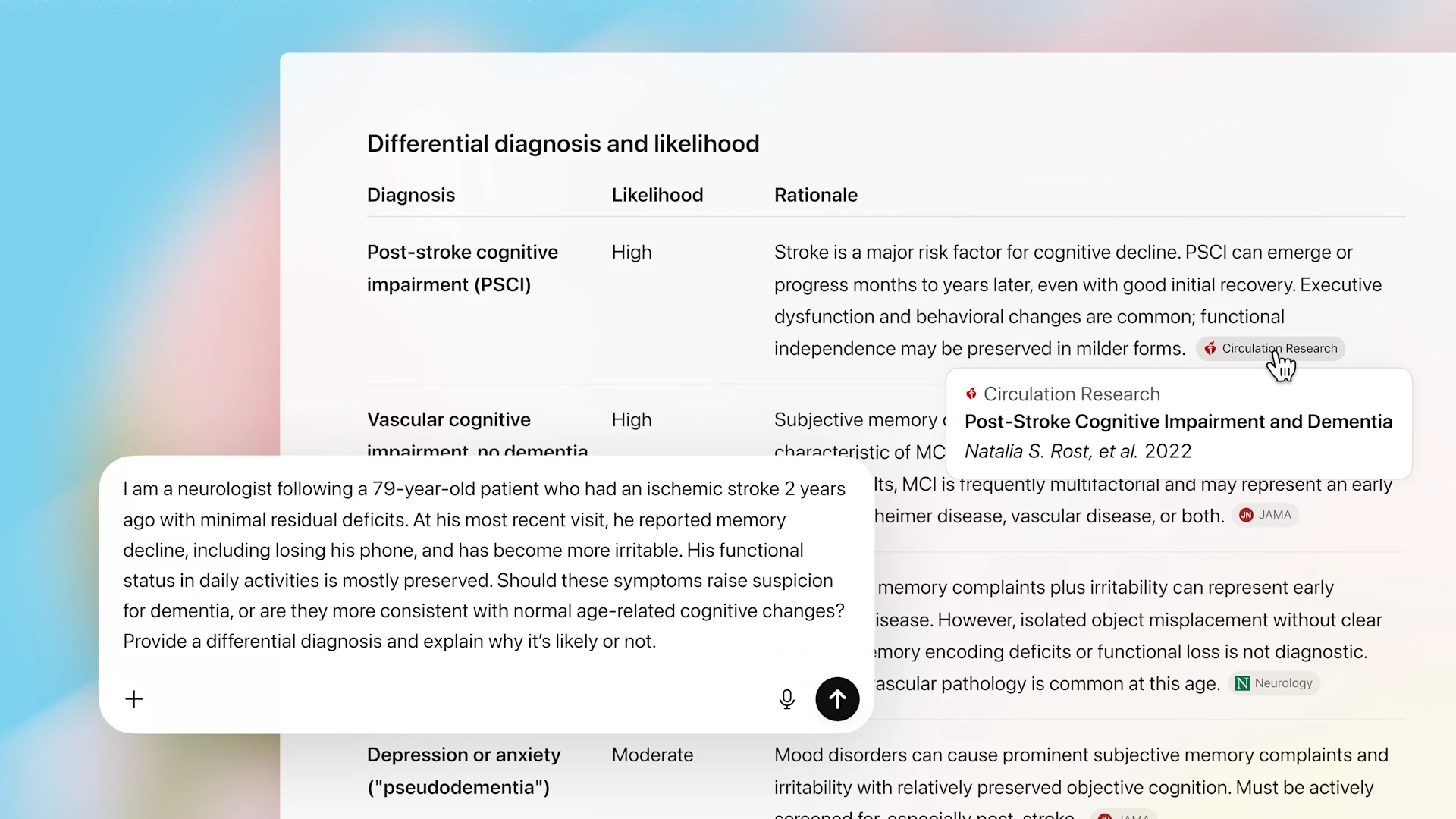
ChatGPT for Healthcare is defined as an evidence-based reasoning workspace that lessens administrative burden and assists professionals in patient care. Custom GPT-5 models are used, providing “high-quality responses for clinical, research, and operational work.” Additionally, the chatbot’s responses are based on clinical guidelines, public health recommendations, and peer-reviewed research papers. To facilitate rapid source-checking, OpenAI stated that every response has clear citations, including titles, journals, and publication dates.
Hospitals can create route alignment by integrating the bespoke chatbot with enterprise solutions like Microsoft SharePoint and other platforms. Additionally, healthcare workers will have a centralised workspace with role-based access controls and shared templates for routine activities.
Additionally, in order to comply with the US Health Insurance Portability and Accountability Act (HIPAA), patient data and protected health information adhere to all security and privacy regulations. A number of organisations, including AdventHealth, Baylor Scott & White Health, Boston Children’s Hospital, Cedars-Sinai Medical Centre, HCA Healthcare, Memorial Sloan Kettering Cancer Centre, Stanford Medicine Children’s Health, and the University of California, are among the early adopters, the company noted.
With the company’s proprietary AI models, such as GPT-5.2, developers may now create healthcare-focused solutions and products using the OpenAI API. According to the AI behemoth, the API supports features including discharge procedures, care team collaboration, and patient chart summarisation.
According to OpenAI, businesses like Abridge, Ambience, and EliseAI are developing tools for automated clinical recordkeeping, ambient listening, and patient and clinician appointment scheduling utilising the API.
To access these healthcare features, the healthcare professionals need to subscribe for the enterprise-level offering, which comes with the following core features;
1. ChatGPT for Healthcare – This version of the chatbot is specifically tailored for clinical situations and is available at institutions.
Clinical Decision Support: It competes with well-known medical platforms like UpToDate and Doximity by offering real-time advice on diagnoses and treatment options.
Institutional Alignment: By obtaining data from safe internal sources like SharePoint, the solution can be based on a hospital’s internal regulations and procedures.
Administrative Workflows: It is best suited for producing clinical letters, patient instructions, and discharge summaries, as well as managing requests for prior authorisation.
2. Infrastructure for Safety and Evaluation – OpenAI established new benchmarking and governance guidelines to address medical security and accuracy:
HealthBench is a new evaluation standard that was created with more than 260 doctors from 60 nations to assess AI performance in more than 5,000 real-world clinical scenarios.
A platform that gives healthcare organisations insight and control over the usage of AI throughout their institutions is known as AI Governance as a Service.
HIPAA Compliance: By guaranteeing that patient data is protected and kept separate from generic training sets, the healthcare suite is designed to facilitate HIPAA compliance.
3. Strategic Collaborations with Hospitals – In order to incorporate these AI technologies into actual processes, OpenAI has started rollouts with significant medical institutions.
Early Adopters: Cedars-Sinai, Stanford Medicine Children’s Health, Cleveland Clinic, and Memorial Sloan Kettering Cancer Centre are partners.
Integration Goals: Physicians now spend about two hours on EHR paperwork for every hour spent with patients, therefore the goal is to lessen the administrative burden.
4. Consumer-Level Equivalent: ChatGPT Health
ChatGPT Health, which was introduced the day before the provider suite, enables patients to easily link their test results, wearables (such as Apple Health), and personal medical records to ChatGPT for tailored health insights. Although this tool provides “guidance,” OpenAI makes it clear that it is not intended for official diagnosis; clinicians should utilise the professional ChatGPT for Healthcare.
We use cookies to ensure that we give you the best experience on our website. If you continue to use this site we will assume that you are happy with it.