For an industry built on intelligence, the latest mishap at Anthropic feels oddly human.
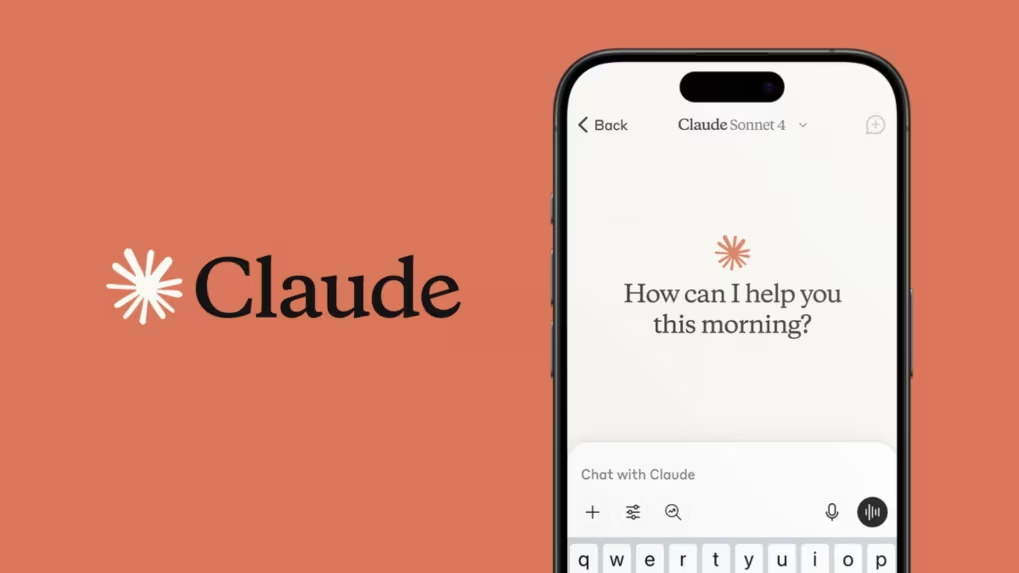
The company behind the fast-rising Claude AI assistant has accidentally leaked a significant portion of the source code for its coding tool, Claude Code offering the public, and more importantly competitors, a rare look under the hood of one of the most advanced AI developer tools on the market.
And it didn’t take long for that code to spread.
More than 500,000 lines of internal code were exposed through a packaging error during a routine software release, quickly copied, analysed, and even forked across developer platforms before Anthropic could contain it.
Anthropic insists this wasn’t a hack. No customer data was compromised, no credentials leaked. Just a mistake.
But that distinction may not matter as much as it used to.
Because in the AI era, the product is the intelligence and leaking how it works changes everything.
For years, software leaks were embarrassing but manageable. Code gets exposed, patches get issued, life goes on.
AI is different.
The leaked Claude Code repository reportedly includes insights into internal architecture, unreleased features, and how the system manages memory, reasoning, and autonomous workflows.
That’s not just code, it’s competitive advantage.
Rival developers now have a blueprint of how one of the most sophisticated AI coding assistants is built. And in a market where companies are racing to build better AI agents, that kind of visibility can accelerate competitors overnight.
In other words, this isn’t just a leak. It’s a shortcut. But there’s a deeper issue emerging—and it’s uncomfortable.
AI companies are positioning themselves as the future of security, automation, and reliability. Yet incidents like this raise a fundamental question; If AI firms can’t secure their own systems, how do they secure everyone else’s?
Anthropic has built much of its brand around AI safety. That’s part of what makes this moment significant. A simple packaging error exposing half a million lines of internal logic cuts against that narrative and gives critics ammunition.
It also highlights something the industry is still grappling with: operational risk.
As AI systems grow more complex, the attack surface and the potential for internal mistakes expands dramatically. From prompt injection attacks to misuse in real-world cyber incidents, Claude itself has already been linked to scenarios where AI tools were manipulated for data theft or exploitation.
Now, the risk isn’t just external misuse. It’s internal exposure. And then there’s the strategic angle.
This leak comes at a time when AI companies are no longer just building tools, they’re building platforms.
Claude Code competes directly with tools from OpenAI, Microsoft, and a growing ecosystem of AI-first developer platforms. By exposing internal design decisions, Anthropic may have unintentionally accelerated that entire ecosystem.
Features discovered in the leak like always-on agent behaviour and experimental interfaces hint at where AI tooling is heading: toward autonomous systems that act, not just assist.
That’s the real prize. And now, more people have a map.
To be clear, this isn’t catastrophic for Anthropic.
But it is revealing.
It shows how fragile the edge can be in AI how quickly differentiation can erode, and how even small operational mistakes can have outsized strategic consequences.
And more importantly, it reinforces a growing reality: In the AI race, it’s not just about building smarter systems. It’s about protecting them.
Because if your intelligence leaks, so does your advantage.
Paul Balo is the founder of TechBooky and a highly skilled wireless communications professional with a strong background in cloud computing, offering extensive experience in designing, implementing, and managing wireless communication systems.
We use cookies to ensure that we give you the best experience on our website. If you continue to use this site we will assume that you are happy with it.