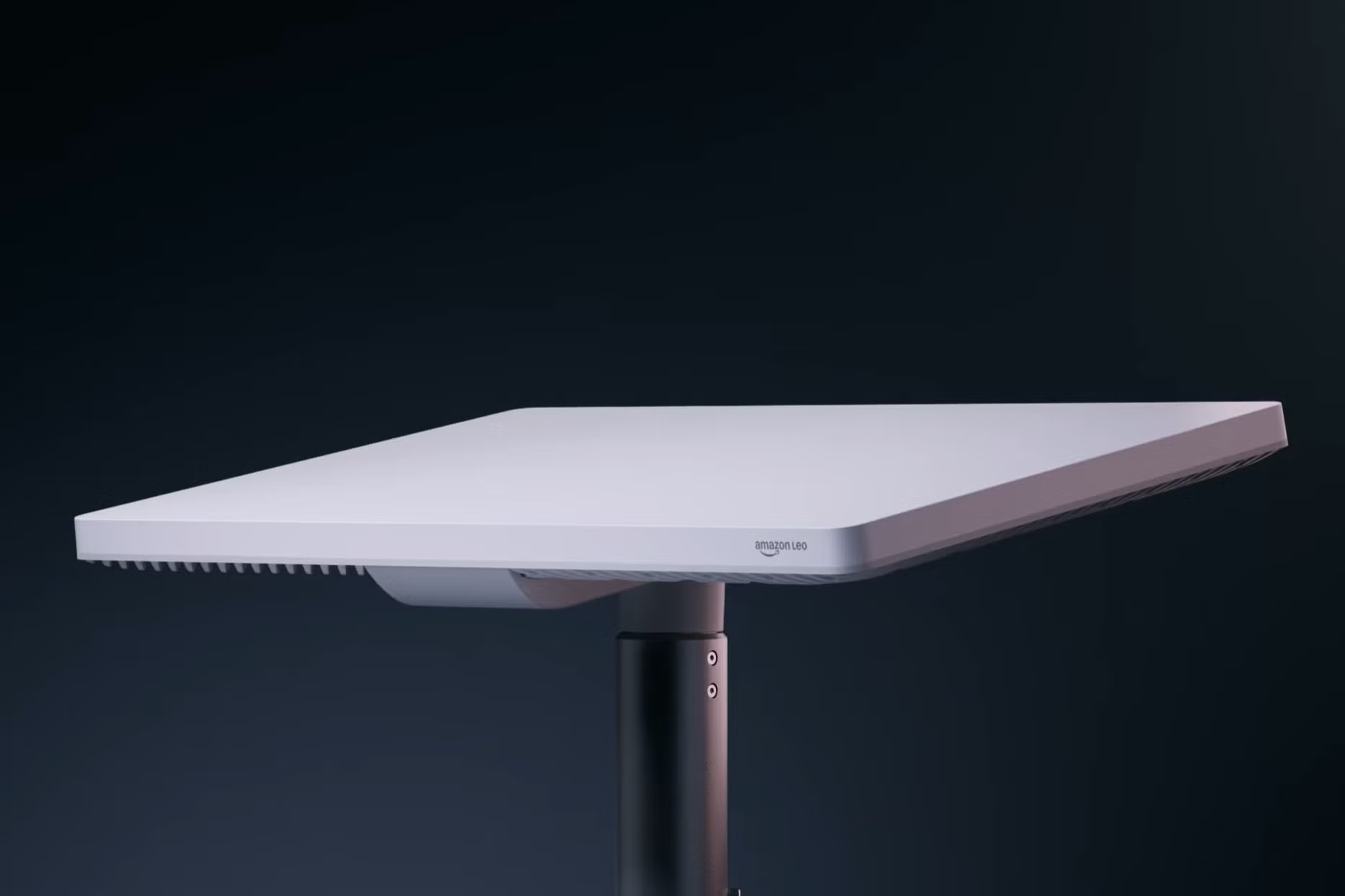
Delta Air Lines is backing Amazon’s low Earth orbit (LEO) satellite ambitions over SpaceX’s market-leading Starlink service, and CEO Ed Bastian is making it clear he thinks the choice will pay off.
“Amazon brings a lot more than just satellite technology,” he said. “They bring great retailing capability and Amazon Prime and video gaming technologies, which Starlink does not have.”
The comments land at a sensitive moment for SpaceX. The company, now a merged entity that combines Elon Musk’s space operations, his AI startup xAI, and social platform X, is preparing for a major IPO expected to list on Nasdaq in June. The IPO prospectus was made public this week, underscoring how central Starlink is to the company’s story.
According to a recent Reuters report cited in the source material, Starlink doubled its operating income last year to $4.42 billion. The AI division accounted for 61% of the combined $20.74 billion in capital spending in 2025, and those costs are expected to rise as Musk pushes ahead with plans for space-based data centers.
By scale, Starlink has no real peer today. SpaceX has more than 10,000 satellites in orbit and over 10 million active customers across 160 markets worldwide. In aviation, Starlink is already the leading provider of in-flight connectivity, with deals in place with airlines including Lufthansa, United, Air France, Southwest, British Airways, and Emirates.
Amazon’s LEO effort, by contrast, is still early. The company has roughly 300 satellites in orbit and, so far, no commercial satellite internet service in the market. Yet Amazon is assembling pieces that go beyond raw capacity, positioning its network as part of a broader services bundle.
Delta’s decision is one of the most visible wins yet for Amazon’s satellite push. Before its deal with Delta in March, Amazon’s LEO connectivity work on the aviation side had only one airline customer: JetBlue.
Under the new agreement, Amazon will begin providing internet access on 500 Delta aircraft starting in 2028. Bastian told Bloomberg he’s confident the partnership will deliver better economics and performance for the airline and its passengers.
“I think the opportunities, in terms of the improved bandwidth with a much lower price point than what we’ve ever seen from Starlink, will make a big difference,” he said.
For Delta, Amazon’s value proposition extends beyond connectivity pipes. Bastian highlighted Amazon’s retail, Prime, and gaming capabilities as differentiators—assets that can be tied into in-flight experiences, loyalty programs, or entertainment offerings in ways a pure connectivity provider may find harder to match.
Amazon has also been building its space footprint through acquisitions. Last month, it announced a deal to acquire Louisiana-based satellite telecommunications company Globalstar, best known today as the network behind Apple’s “Emergency SOS” features on recent iPhones and the Apple Watch Ultra 3.
As part of that transaction, Amazon is set to gain Apple as a client for satellite connectivity. Once the deal closes in 2027, Amazon would provide satellite links for Apple’s Emergency SOS, Find My, and Roadside Assistance features in current and future iPhones and Apple Watches, according to the source material. That gives Amazon an immediate, high-profile customer and a clear commercial use case for its satellite infrastructure.
Taken together, the Delta agreement and the Globalstar acquisition suggest Amazon is less focused on matching Starlink’s current footprint and more on integrating satellite links into established consumer and enterprise services.
The Delta–Amazon deal has not gone unnoticed at SpaceX. Musk took to X to attack the airline’s choice, responding to a post that claimed Delta had picked Amazon’s LEO offering over Starlink because it did not want passengers accessing the internet through a Starlink portal instead of Delta’s own Delta Sync system.
“Delta wanted to make it painful, difficult and expensive for their customers,” Musk wrote.
He also defended Starlink’s approach to user experience, saying, “SpaceX requires that there be no annoying ‘portal’ to use Starlink. Starlink WiFi must just work effortlessly every time, as though you were at home.”
Bastian, for his part, indicated he wasn’t surprised to see Starlink fight back publicly. He told Bloomberg he expected Starlink “to be warning people that we’re going to go with an inferior product,” but made clear he was not concerned about the Amazon partnership.
The exchange underscores the strategic threat Amazon poses. While Starlink today enjoys overwhelming scale in satellite broadband and in-flight connectivity, Amazon is leveraging its content, commerce, cloud, and consumer-device relationships to mount a challenge that doesn’t look like a one-to-one clone of Starlink’s model.
With SpaceX’s IPO around the corner and Amazon only beginning to turn its LEO constellation into commercial services, the Delta deal is unlikely to move the market on its own. But it signals that some major customers are prepared to bet on Amazon’s long game in orbit, even when Starlink is the incumbent technology leader.
Related Reading
More contextual TechBooky stories selected from tags, categories and article context.
Paul Femi Balo is the founder and publisher of TechBooky. He covers artificial intelligence, African technology, digital infrastructure, enterprise technology and the global digital economy.
We use cookies to ensure that we give you the best experience on our website. If you continue to use this site we will assume that you are happy with it.