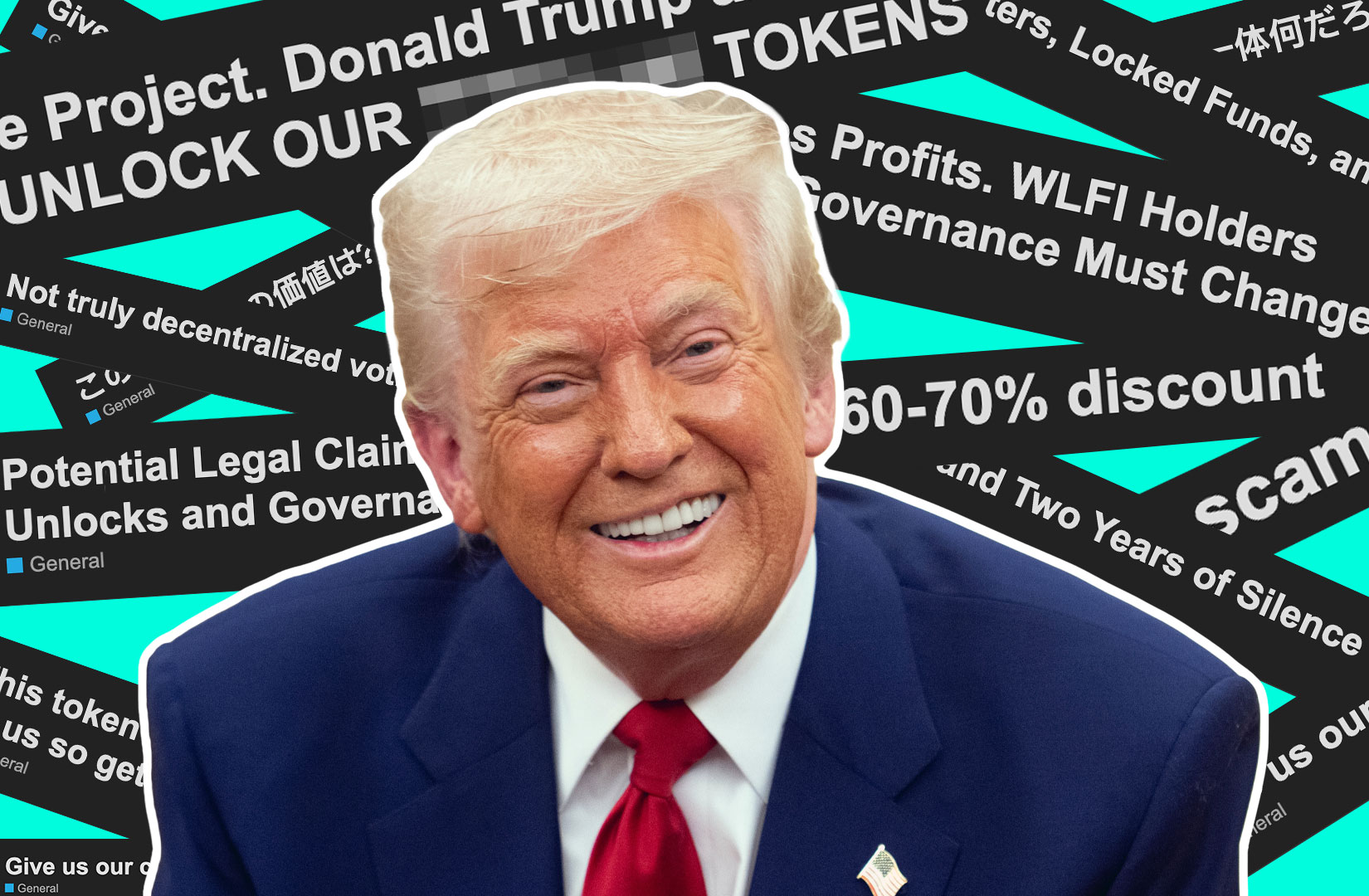
A prominent financial regulation expert is warning that a flagship crypto token tied to Donald Trump’s business orbit could gain sweeping legal cover under a pending U.S. crypto law, despite what he argues are clear signs it operates as an unregistered security today.
In a detailed blog post, Duke University lecturing fellow Lee Reiners examines World Liberty Financial’s WLFI token and the proposed CLARITY Act, a major piece of legislation aimed at reshaping how digital assets are regulated in the United States.
Reiners, a former bank examiner at the Federal Reserve Bank of New York, argues that WLFI functions as an unregistered security under the long-standing Howey test, the Supreme Court’s 1946 framework for determining when an investment contract counts as a security.
Under Howey, something is a security if it involves: (1) an investment of money, (2) in a common enterprise, (3) with a reasonable expectation of profits, (4) primarily from the efforts of others. Reiners applies each element to WLFI, drawing on World Liberty Financial’s own materials and structure:
Capital raising: He notes that WLFI tokens have been sold to raise funds for developing the WLF Protocol, positioning token sales as a financing mechanism for the project.
Trump-linked equity and revenue: According to Reiners’ account, entities affiliated with the Trump family hold equity stakes in World Liberty Financial’s parent company and receive a large share of net revenues.
Expectation of profit: He cites marketing materials that, in his view, gave WLFI buyers a reasonable expectation of profits tied to the project’s future growth.
Centralized control: Reiners points to the use of a Delaware nonstock corporation and technical controls such as manual upgrades via multisignature wallets and the ability to freeze tokens as evidence of ongoing centralized control, rather than a fully decentralized network.
Based on this analysis, he concludes that WLFI fits squarely within the definition of a security, and therefore should be subject to securities regulation and investor protection rules.
Reiners further argues that WLFI should still be considered an unregistered security even under the U.S. Securities and Exchange Commission’s updated digital asset guidance released in March. That guidance introduces several categories for crypto assets including digital commodities, digital collectibles, digital tools, stablecoins, and digital securities in an attempt to bring more structure to how different tokens are treated.
He criticizes the SEC’s framework as legally flawed and inconsistent with decades of precedent, contending that it focuses too heavily on labels and marketing language around blockchain technology instead of the underlying economic reality. In his view, WLFI does not qualify as a “pure digital commodity” like bitcoin, whose value, he notes, is commonly tied to a functional, decentralized network.
CLARITY Act, Regulatory Risk, and Political Entanglements
The policy backdrop for Reiners’ arguments is the CLARITY Act, a wide-ranging crypto bill that has been moving through Congress over the past several years. The legislation is pitched as a way to give the crypto industry regulatory certainty, but Reiners contends that its current language could actually strip away core investor protections for tokens like WLFI.
He highlights Senate drafts that would classify certain tokens as “network tokens” — a form of digital commodity tied to a distributed ledger and treated as non-securities. According to Reiners, this classification could allow World Liberty Financial to sidestep securities rules entirely, removing obligations such as mandatory disclosures and key antifraud provisions that apply to traditional securities offerings.
Reiners’ critique doesn’t stop at legal classifications. He raises deeper concerns about whether the SEC is willing or able to enforce the rules that already exist. He points to a sharp slowdown in enforcement actions against crypto projects over the past year, with many cases paused or dismissed, coinciding with more industry-friendly rhetoric from regulators.
He argues that this shift has overlapped with developments favourable to Trump-connected ventures, which he notes reportedly generated $1.4 billion in profits for the Trump family in the previous year. In the conclusion of his post, he writes that while the SEC clearly has the authority to investigate World Liberty Financial, he doubts whether the agency has the “integrity and independence” to pursue a case involving a crypto project in which the sitting president and his family have a direct financial interest. He concludes that “recent history suggests the answer is no.”
Ethics and influence concerns around U.S. crypto policy are also surfacing in Congress. The Senate Banking Committee has scheduled a markup of the CLARITY Act, where lawmakers are expected to amend and vote on the bill. A prior clash between banking groups and crypto interests over stablecoin yield appears to have eased after new language was released, though some bank trade associations argue the revised provisions still fall short.
Senator Kirsten Gillibrand has said the bill will not advance without ethics safeguards, specifically a ban on senior government officials including the president and members of Congress — holding personal financial interests or industry ties in digital assets. That condition directly links the fate of the legislation to broader concerns about crypto-related profiteering by public officials.
Democratic lawmakers have already focused their criticism on Trump’s crypto connections. House Democrats sent a letter to the SEC flagging what they described as pay-to-play dynamics around the industry’s influence. Their examples included the presidential pardon of Binance co-founder Changpeng Zhao. According to the letter, Binance now holds roughly $2 billion in World Liberty Financial’s USD1 stablecoin and generates tens of millions of dollars in annual revenue for the project.
They also cited a UAE-linked investment firm’s $500 million purchase of a 49% stake in World Liberty Financial, which occurred shortly before the United Arab Emirates received approval for hundreds of thousands of previously restricted Nvidia AI chips. Crypto billionaire Justin Sun, once a prominent supporter of Trump’s crypto agenda, also appears in these criticisms. Sun holds significant positions in WLFI and the TRUMP memecoin and is suing World Liberty Financial over frozen tokens, unilateral changes to smart contracts, and alleged pressure to commit additional capital.
More broadly, the crypto ecosystem around World Liberty Financial intersects with other financial and geopolitical fault lines. The company Strategy is described as effectively a leveraged play on bitcoin, underscoring how deeply some associated entities are tied to crypto market cycles. Meanwhile, one of Trump’s marquee campaign promises on crypto remains unfulfilled, even as his circle has reportedly benefited from the sector’s growth.
Separately, on Friday, the U.S. government said $344 million in Tether had been linked to wallets associated with Iran, underscoring ongoing concerns about crypto’s role in sanctions evasion and illicit finance as lawmakers debate whether to loosen or tighten rules around digital assets.
For now, the CLARITY Act’s final shape and WLFI’s regulatory fate remain unsettled. The coming Senate markup, and whether ethics provisions survive intact, will be a key test of how far Congress is willing to go in redrawing the line between consumer protection and crypto industry growth.
Related Reading
More contextual TechBooky stories selected from tags, categories and article context.
Paul Balo is the founder of TechBooky and a highly skilled wireless communications professional with a strong background in cloud computing, offering extensive experience in designing, implementing, and managing wireless communication systems.
We use cookies to ensure that we give you the best experience on our website. If you continue to use this site we will assume that you are happy with it.