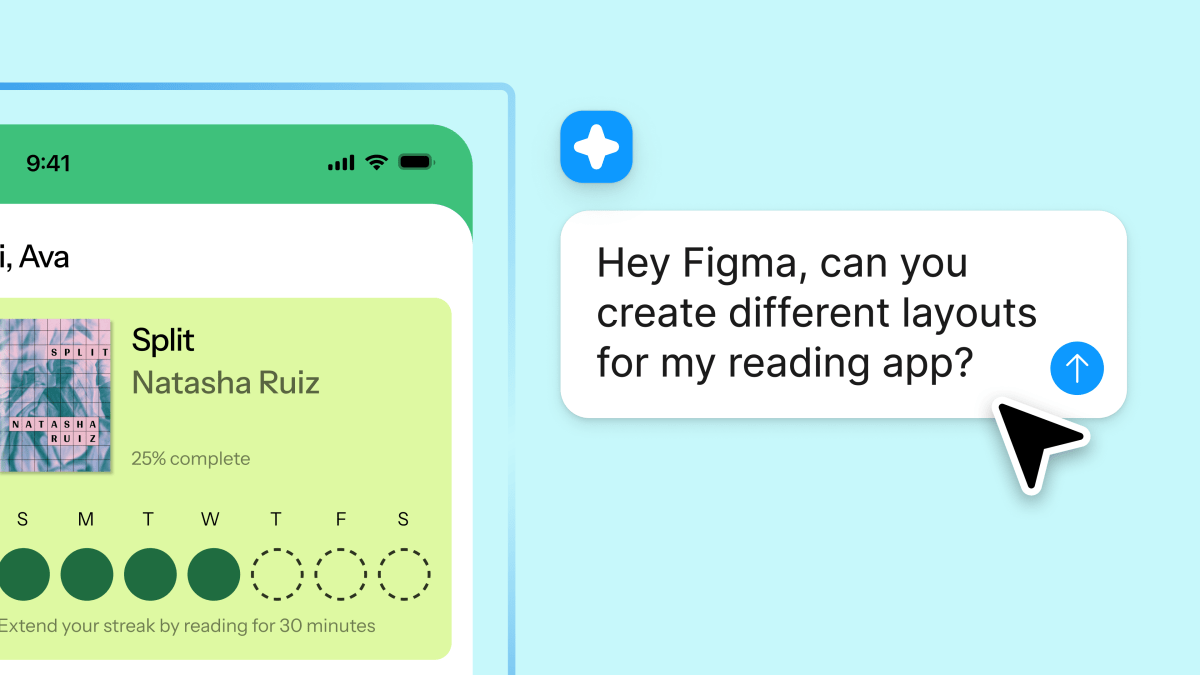
The new AI agent lives directly in Figma’s canvas and responds to natural language prompts. Designers can ask it to create new layouts, tweak existing work, or automate repetitive tasks such as generating multiple design variations.
According to Figma, the assistant is tuned specifically for design workflows and is built on models that have been fine-tuned for design contexts and elements. That specialization is meant to help the agent understand what’s on the canvas and respond with relevant changes rather than generic suggestions.
Users will be able to:
Generate new designs from text prompts
Edit and refine existing designs
Automate tasks like creating iterations of current work
Figma also says teams can spin up multiple agents at once, assigning them to different tasks running in parallel on the same multiplayer canvas. The idea is that human designers and AI agents share the same space, testing ideas and exploring variations together.
“As building software gets easier, what matters most is setting direction; deciding what to work on, how it should function, what the experience should feel like. Teams can now collaborate with agents on the multiplayer canvas to test out ideas, visualize edge cases, and refine concepts together without over-indexing on the more tedious parts,” Figma chief design officer Loredana Crisan said in a statement.
The assistant will debut in Figma Design before expanding to the company’s other products. Over time, Figma says it wants to bring design and code closer together across its apps.
The launch follows earlier partnerships with OpenAI and Anthropic, which brought support for AI command-line tools like Claude Code and Codex into Figma so that users could tap those coding environments alongside design work. The new agent represents Figma’s own integrated approach to AI, rather than relying solely on external tools.
Figma is under pressure from a growing set of rivals, including Canva, Adobe, Flora, Krea and Dessn. In response, the company has been expanding its feature set. Last year it acquired Weavy, a node-based design tool, and has since added new image-editing capabilities across its products.
Despite broader industry debate about AI’s impact on design jobs and demand for design tools, Figma’s business has continued to grow. The company reported revenue of $333.4 million in the first quarter of 2026, a 46% increase compared with the same period a year earlier.
Related Reading
More contextual TechBooky stories selected from tags, categories and article context.
Paul Balo is the founder of TechBooky and a highly skilled wireless communications professional with a strong background in cloud computing, offering extensive experience in designing, implementing, and managing wireless communication systems.
We use cookies to ensure that we give you the best experience on our website. If you continue to use this site we will assume that you are happy with it.