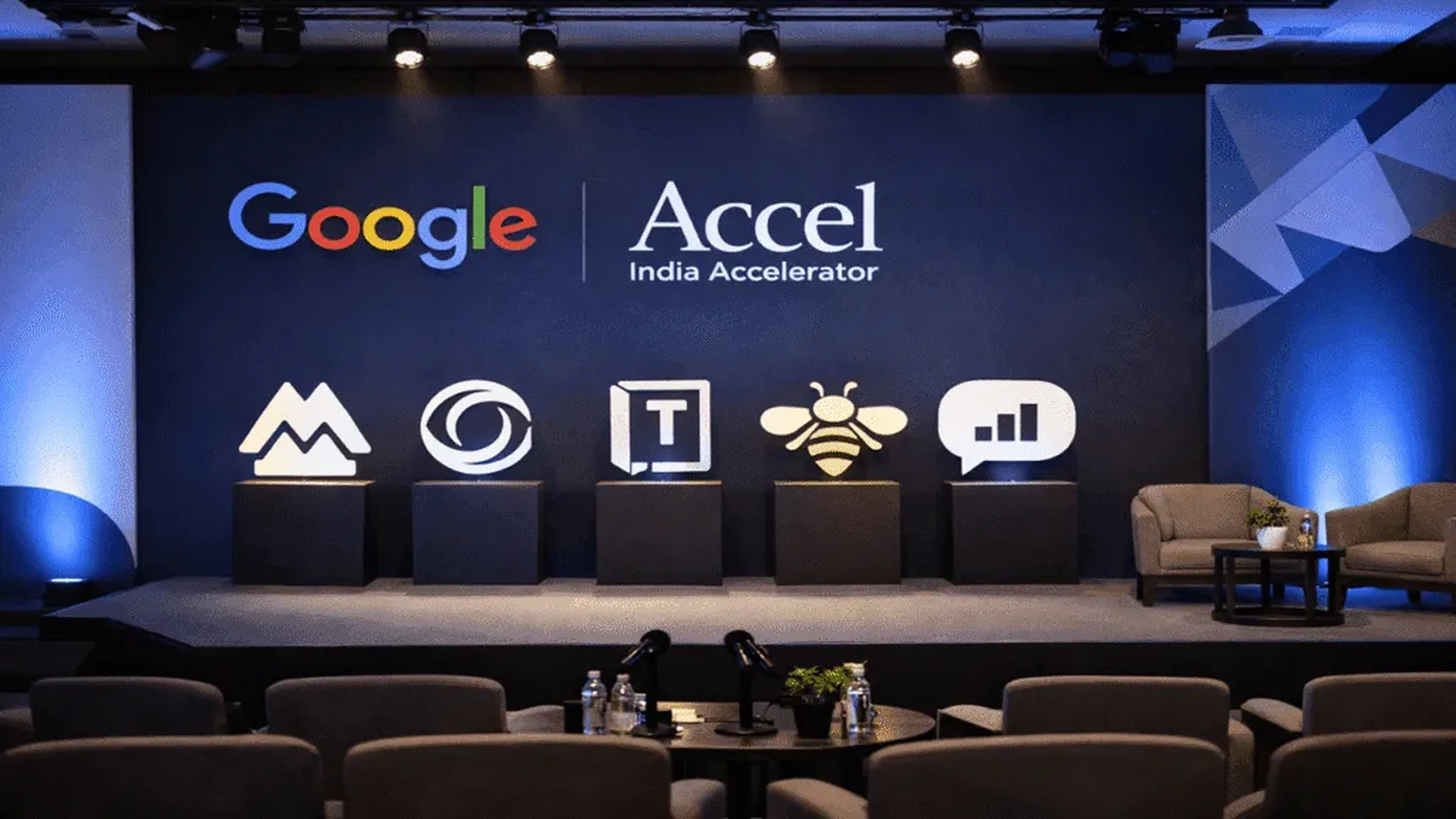
Google and Accel have picked five startups for their AI-focused Atoms accelerator tied to India, and none of them are the “wrapper” ideas that dominated the application pool.
Accel partner Prayank Swaroop told TechCrunch that, as the firms reviewed more than 4,000 applications for the latest cohort, roughly 70% of rejected pitches were so-called wrappers: products that simply layer AI features like chatbots on top of existing software without rethinking how work gets done.
Investors have become increasingly cautious about these shallow integrations as model providers themselves roll out similar functionality, raising the risk that such startups could be marginalized or replaced as underlying AI platforms evolve.
The Atoms program, announced in November by Google and Accel, is aimed at early-stage startups building AI products “linked to India.” For this latest cohort, the selected companies will receive up to $2 million in funding from Accel and Google’s AI Futures Fund, plus as much as $350,000 in Google cloud and AI compute credits, according to the firms.
Despite the surge of interest this year’s AI-focused program drew nearly four times as many applications as previous Atoms cohorts very few pitches convinced the investors that they were doing more than lightly packaging existing AI models.
Swaroop said wrapper pitches “were not reimagining new workflows using AI,” underscoring a growing expectation among investors that AI-native products should fundamentally reshape processes rather than bolt on generative features for incremental gains.
Beyond wrappers, many of the remaining rejected applications clustered in saturated spaces such as marketing automation and AI-driven recruitment tools. Swaroop said these categories showed little novelty, and startups there often struggled to demonstrate clear differentiation.
The flood of applications also offered a snapshot of how India’s AI startup ecosystem is evolving. Swaroop noted that India’s AI scene remains largely enterprise-focused, and the application breakdown reflected that tilt.
About 62% of submissions centred on productivity tools.
Another 13% focused on software development and coding.
That means around three-quarters of all applications were enterprise software ideas rather than consumer-facing products. Swaroop had hoped to see more concepts targeting healthcare and education, two areas that were comparatively underrepresented in the pool.
While Google is co-running the accelerator, the program does not lock startups into its AI stack. The firms said participants are not required to use Google’s models exclusively; many already mix and match multiple models depending on the workflow.
The goal, according to Google’s side of the program, is to use feedback from these startups to understand how Google’s models perform in real products and where they fall short. Those insights are fed back to Google DeepMind teams, creating what was described as a “flywheel” between startup experimentation and AI model development.
In practice, if a company in the cohort is choosing an alternative model for a given task, that is treated as a signal that Google still has work to do to offer the best option in that segment.
The five selected startups themselves were not detailed in the information released, but the design of the Atoms program makes clear what Google and Accel are looking for: India-linked founders building AI products that go beyond surface-level wrappers, target meaningful workflows, and can generate concrete feedback on real-world model performance.
Paul Balo is the founder of TechBooky and a highly skilled wireless communications professional with a strong background in cloud computing, offering extensive experience in designing, implementing, and managing wireless communication systems.
We use cookies to ensure that we give you the best experience on our website. If you continue to use this site we will assume that you are happy with it.