A company working on future energy solutions has just announced a major partnership that could help bring their technology to market faster. TAE Technologies, which has received backing from Google and oil giant Chevron, said this week that it has formed a new business venture with the United Kingdom’s nuclear energy research agency. The goal is to develop and sell special equipment called neutral beam systems that are important for creating fusion energy and other uses.
The partnership brings together TAE Technologies and the UK Atomic Energy Authority to create a new company called TAE Beam UK. Under the arrangement, the British government’s energy agency is putting in about 6.5 million dollars to get the joint venture started. This move represents one of the most concrete steps yet toward turning fusion energy research into actual products that businesses and countries can buy and use. The venture will not only focus on fusion energy but also plans to adapt the technology for other purposes like medical treatments, food safety inspections, and security screening
For people who might not be familiar with fusion energy, it works by copying the same process that makes the sun shine. Inside the sun, tiny particles called atoms get squeezed together under extreme heat and pressure until they combine and release massive amounts of energy. Scientists have been trying to recreate this process here on Earth for many decades because it promises to provide nearly unlimited clean energy without creating pollution, dangerous waste, or contributing to climate change. The challenge has always been making it work reliably and affordably enough to actually power homes and businesses.
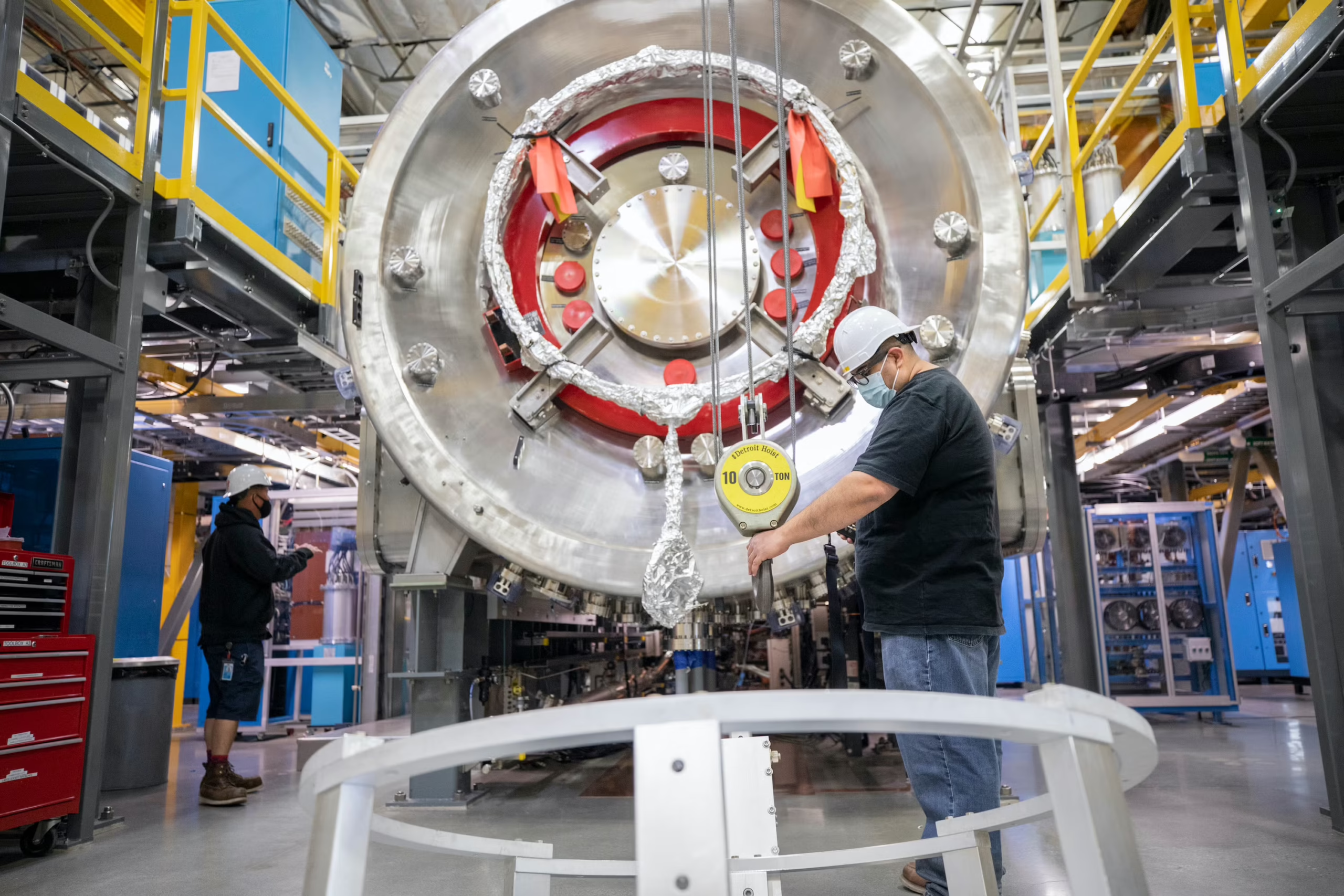
This is where neutral beam systems come into the picture. These devices are essentially powerful machines that shoot streams of particles into super-hot gas to help keep it stable and hot enough for fusion to take place. Think of it like using a powerful fan to keep a fire burning at just the right temperature and shape. TAE Technologies has spent over two decades developing their version of this technology, and they believe they have created a unique systems that work better and cost less than previous designs. The neutral beams help heat up the gas, maintain its shape, and provide the energy needed to keep the fusion reaction going steadily.
The United Kingdom has been a leader in fusion research for many years and their operation is one of the world’s most important fusion laboratories at a place called Culham Campus. By teaming up with TAE Technologies, the British government is betting that combining their research experience with TAE’s commercial approach will help speed up the process of turning fusion from a laboratory experiment into real power plants. The partnership also creates an opportunity for the UK to build a supply chain for fusion technology, which means developing the factories, skilled workers, and business networks needed to manufacture and sell these systems around the world.
TAE Technologies is not a newcomer to this field. The company was founded back in 1998 and has raised about 1.3 billion dollars from various investors over the years, making it one of the best-funded fusion companies in the world. Google has been working with TAE since around 2014, helping them use artificial intelligence and computer learning to figure out the best ways to control the super-hot gas inside their fusion machines. This collaboration between tech expertise and fusion science has helped TAE make progress that might have taken much longer otherwise. Earlier this year, the company achieved an important milestone by creating stable super-hot gas at temperatures over 70 million degrees using a simpler machine design than they had used before.
The new joint venture expects to deliver its first products within the next 18 to 24 months. These initial systems will be what engineers call short-pulse beams, which are designed for specific testing and development purposes. As the partnership matures, TAE Beam UK plans to manufacture a full-scale neutral beam systems that can be sold to other fusion companies, research institutions, and eventually commercial power plants. The same basic technology that TAE developed for fusion can also be adapted to treat certain types of cancer, inspect food products for safety, and perform security checks, which gives the joint venture multiple potential markets to serve.
Several countries including the United States, United Kingdom, China, and Italy are now investing heavily in fusion technology because they see it as a potential solution to their future energy needs. The interest has grown particularly strong in recent years as concerns about climate change have increased and as the development of artificial intelligence has created demand for enormous amounts of reliable electricity to power computer data centres. Google itself has been searching for clean energy solutions to support its growing operations, and the company has made multiple investments in fusion companies as part of this strategy.
What makes TAE Technologies’ approach somewhat different from other fusion companies is the specific method they use to contain and control the super-hot gas. Their system uses eight neutral beam devices positioned at precise angles to heat, shape, and stabilize the gas inside their machine. The gas forms a hollow shape that looks something like a football, and it generates its own magnetic field that works together with external magnets to keep everything contained. The same accelerator technology that produced TAE’s sophisticated neutral beam system for fusion has also been adapted for TAE’s medtech subsidiary, TAE Life Sciences, to provide a non-invasive, targeted treatment for complex and often inoperable cancers. This design has allowed TAE to build machines that are smaller and potentially more affordable than some other fusion approaches being developed by competitors.
The UK government has also expressed enthusiasm about the partnership. Officials from the British energy agency said they are looking forward to working with TAE Technologies on developing neutral beams and bringing this technology to market in ways that will create jobs and economic growth in the United Kingdom. The joint venture will hire engineers, technicians, and other skilled workers to design, build, and test the neutral beam systems. This represents an opportunity for both countries to develop expertise in an emerging technology field that could become increasingly important in the coming decades.
We use cookies to ensure that we give you the best experience on our website. If you continue to use this site we will assume that you are happy with it.