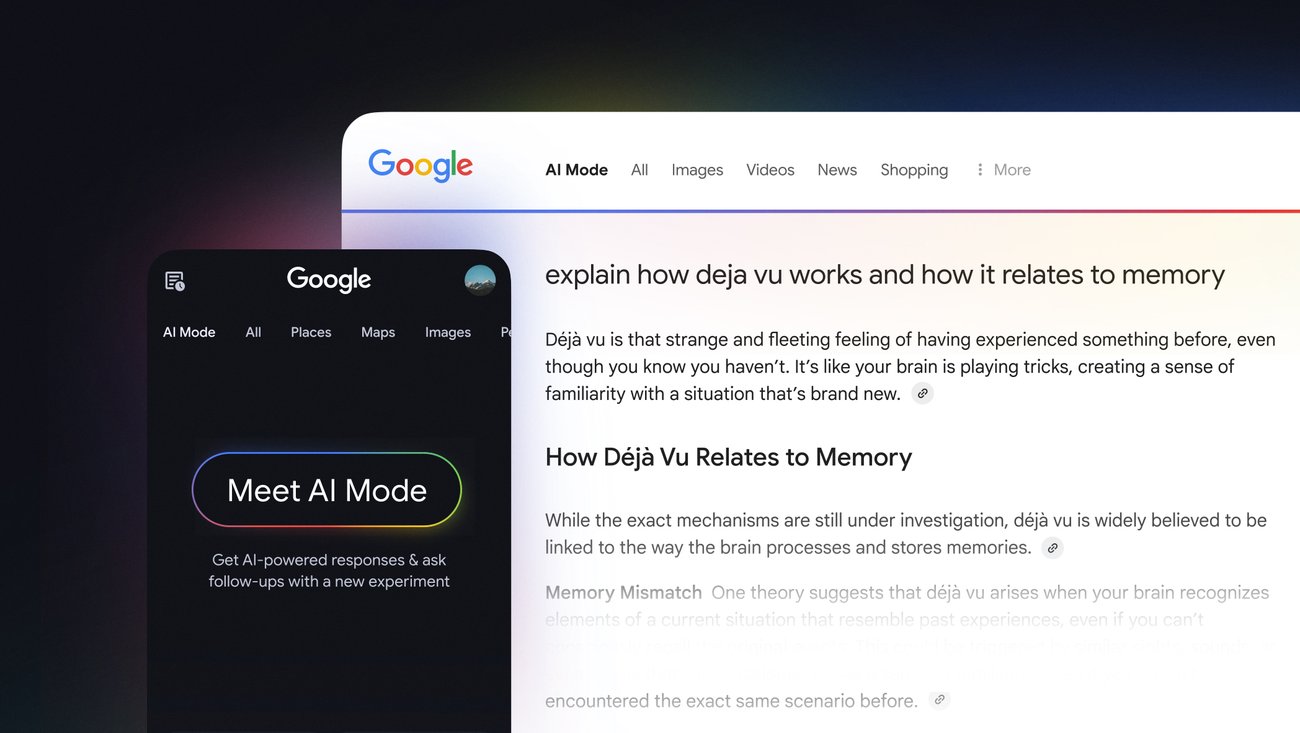
As OpenAI enters “Code Red” due to competition pressures, Google stated that it has begun testing a new tool that combines its AI Overviews and AI Mode in Search. These studies are part of Google’s ongoing efforts to improve the search experience through artificial intelligence. This implies that users who see the now-standard AI-generated snapshot of vital information on a topic or issue above their search results can opt to delve deeper by asking follow-up questions in a conversational interface.
AI Mode is the name Google gives to this conversational function. It went live in the United States in May and globally in August, allowing for back-and-forth discussions with Google’s Gemini AI in an experience similar to ChatGPT.
So far, though, taking advantage of the feature has required planning ahead about the nature of your search query. If it were a more standard search query, or one for which you could expect a speedy response, you’d most likely type it into the search box as usual.
However, if you wanted to ask more questions or delve deeper into a topic, you’d need to navigate to the AI Mode option to begin speaking with the AI.
Google now wants to see if it makes sense to distinguish the two experiences. After all, the process of gathering information can sometimes result in a desire to learn more. You may have believed you were beginning a basic question, only to find yourself going further into the subject.
According to Google, the new test would allow users to “seamlessly go deeper” in AI Mode directly from the Search results page. While the test is being implemented internationally, it is currently only available on mobile devices.
The test, which is being carried out globally on mobile devices, targets a key user behaviour pattern that Google has been examining. People frequently begin with simple questions before feeling compelled to delve further. Previously, this required manually switching to Google’s conversational feature, AI Mode, which debuted in the United States in May and went global in August.
Users who encounter an AI Overview (AI-generated summaries that appear above search results) can now ask follow-up questions without leaving the results page. It’s the kind of seamless experience that might make conversational AI feel more natural than a discrete tool that requires intentional interaction.
The data explains Google’s confidence and the release coincides with a push within Google’s AI rival, OpenAI, which is delaying other products to focus on improving the chatbox experience. As of November, Gemini had over 650 million monthly users, thanks in large part to the release of Gemini’s Nano Banana image model and other Gemini advancements. Combining the conversational mode with AI Overviews, which has 2 billion monthly users, could provide Gemini with a competitive advantage in consumer acceptance. That still falls short of ChatGPT’s stated user base, but Google’s integration strategy has the potential to completely transform the competitive dynamics.
Robby Stein, VP of Product at Google Search, writes on X, “You shouldn’t have to think about where or how to ask your question.” Instead, he added that users will continue to receive an AI Overview as a helpful starting point, but will now be able to ask conversational follow-up questions in AI Mode from the same screen.
Google is changing search by combining these experiences, rather than simply competing with OpenAI. Stein also commented that this brings us closer to our vision for Search; just ask whatever’s on user’s mind, no matter how long or complex, and find exactly what you need.
This is Google’s most obvious attempt yet to own the entire information-seeking process, from fast facts to sophisticated talks. While OpenAI has dominated standalone chat experiences, Google believes that most users do not want to choose between search and discussion; instead, they want search that can smoothly transition into conversation when necessary.
Google’s test is more than just a feature update; it’s a complete overhaul of how users interact with information. Google is positioning itself to attract consumers as they migrate from quick answers to deeper research by removing the artificial barrier between search and conversation. If successful, Google might gain a significant advantage in the AI race by converting its 2 billion AI Overview users into prospective conversational AI adopters without people having to make a conscious decision to “try ChatGPT.” The true test will not be user adoption, but whether OpenAI can respond with equal seamless integration before Google’s lead becomes insurmountable.
We use cookies to ensure that we give you the best experience on our website. If you continue to use this site we will assume that you are happy with it.