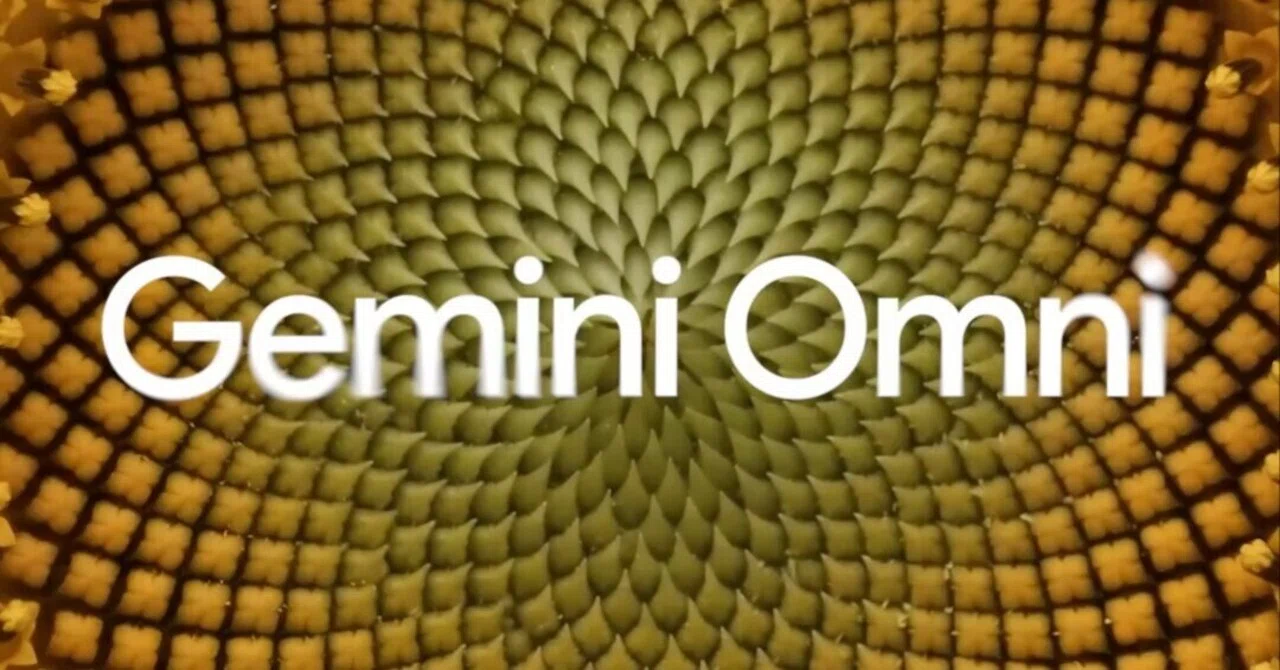
Google has introduced Gemini Omni, a new family of AI models designed to create media from almost any kind of input, and its first release Gemini Omni Flash makes clear where the company believes generative AI is heading next.
This is not just another text-to-video tool. Gemini Omni Flash can take combinations of text, images, audio and video as input, then generate high-quality videos grounded in Gemini’s broader world knowledge. Google says the model is built to “create anything from any input,” starting with video, while future versions will expand further into image and audio output.
That framing is important because most AI video tools still feel like isolated generators. You type a prompt, wait for a clip, and then try again if the result is wrong. Google is trying to turn video generation into something closer to a conversation. With Gemini Omni, users can edit clips using natural language across multiple turns, asking the model to change the environment, camera angle, action, style, lighting or specific objects while preserving the thread of the original scene.
In practice, that means a user could start with a simple phone video, then ask Gemini to transform a sculpture into bubbles, make a mirror ripple like liquid, sync apartment lights to music, or move a violinist into a completely different visual environment. Google says each instruction builds on the last, with characters staying consistent, physics holding up and the scene remembering what came before.
That is the real breakthrough Google is trying to sell: controllability.
AI video has improved rapidly, but control remains one of its biggest weaknesses. Models can produce impressive clips, but getting them to preserve characters, follow a sequence, respect physics and respond to edits consistently has been difficult. Gemini Omni Flash appears designed to solve that problem by combining Gemini’s reasoning abilities with video generation, allowing it to infer what should happen next rather than simply generating visually plausible frames.
Google says Omni has a better intuitive understanding of forces like gravity, kinetic energy and fluid dynamics, making it capable of producing more realistic motion. It can also draw on Gemini’s knowledge of history, science and cultural context to create explainers and structured visual sequences, including educational clips like a claymation-style explanation of protein folding.
That positions Gemini Omni Flash not only as a creative tool, but as a possible production engine for education, marketing, entertainment and social media.
The YouTube angle may be the most important part.
Gemini Omni Flash is rolling out to Google AI Plus, Pro and Ultra subscribers through the Gemini app and Google Flow, but it is also coming at no cost to users on YouTube Shorts and the YouTube Create app. That gives Google something most AI video startups do not have: direct access to one of the largest creator platforms in the world.
This could quickly make AI video generation mainstream. Instead of creators needing separate tools, subscriptions and workflows, Gemini Omni could sit directly inside the apps where short-form video is already being made and distributed. Google’s YouTube announcement says Gemini Omni tools will help users remix Shorts and create more easily, while also introducing conversational search for finding videos through Ask YouTube.
That matters because the AI video race is not just about who builds the best model. It is about who controls distribution.
OpenAI has Sora. Runway has a strong creator base. Adobe is embedding generative AI into professional workflows. But Google has YouTube, Android, Search, Gemini and Google Flow. If Gemini Omni Flash becomes a default creation layer inside YouTube Shorts, Google could push AI video to a scale few rivals can match.
The Verge reports that Gemini Omni Flash is the first model in a new Omni family and can generate video from text, photos, videos and audio, with current clips reportedly limited to around 10 seconds and plans to extend duration over time. Unlike Google’s Veo model, which is primarily text-to-video, Omni Flash can use existing videos as references and create new outputs from them.
That distinction is important. Veo is about generating video from prompts. Omni is about generating and transforming media from mixed inputs. That makes it feel closer to a general-purpose creative model than a single-purpose video generator.
The model also introduces personal avatar creation. Google says users can create videos with their own voice using Avatars, which create a digital version of the user so they can generate clips that look and sound like them. At the same time, Google says it is still testing broader speech and audio editing responsibly before expanding those capabilities further. That caution is necessary.
AI video is one of the most sensitive areas of generative AI because it can be used for creativity, education and storytelling, but also for impersonation, misinformation and deepfakes. Google says all videos created with Gemini Omni include SynthID, its imperceptible digital watermark, and that users will be able to verify Omni-generated videos through the Gemini app, Gemini in Chrome and Google Search.
That transparency layer may become a major competitive issue. As AI-generated video spreads across social platforms, users will increasingly need ways to know whether something was filmed, edited or fully generated. Google’s advantage is that it controls both creation tools and discovery surfaces, giving it a stronger chance of making verification visible across the web.
Still, the risks are obvious.
A tool that can take someone’s voice, likeness, video clips and creative references and generate new content from them will need strict controls. Even if avatars are limited to users creating themselves, the broader direction of the technology raises questions around consent, ownership, impersonation and platform moderation.
For creators, though, the upside is equally clear.
Gemini Omni Flash could lower the barrier to video production dramatically. Small creators, educators, businesses and marketers could produce polished visual content without hiring a full production team. A teacher could turn a science concept into an explainer. A musician could create a synced visual clip. A small business could transform product shots into short videos for ads or social posts.
That is why this launch could matter beyond Google I/O hype.
Generative AI has already changed writing, coding and image creation. Video has been slower because it is harder, more expensive and less controllable. Gemini Omni Flash is Google’s attempt to make video generation feel practical, editable and embedded inside everyday platforms.
And that may be the larger strategy behind the launch.
Google is not just building a model that can generate clips. It is building a media creation layer across Gemini, Flow and YouTube. If that works, the future of short-form video may look very different: less filming, more remixing; less editing timeline, more conversation; less production barrier, more AI-assisted creation.
Gemini Omni Flash is only the first model in the family.
But if Google gets this right, it could become one of the most important tools in the next phase of the creator economy not because it replaces creators, but because it gives millions of people a faster way to turn ideas into video.
Related Reading
More contextual TechBooky stories selected from tags, categories and article context.
Paul Balo is the founder of TechBooky and a highly skilled wireless communications professional with a strong background in cloud computing, offering extensive experience in designing, implementing, and managing wireless communication systems.
We use cookies to ensure that we give you the best experience on our website. If you continue to use this site we will assume that you are happy with it.