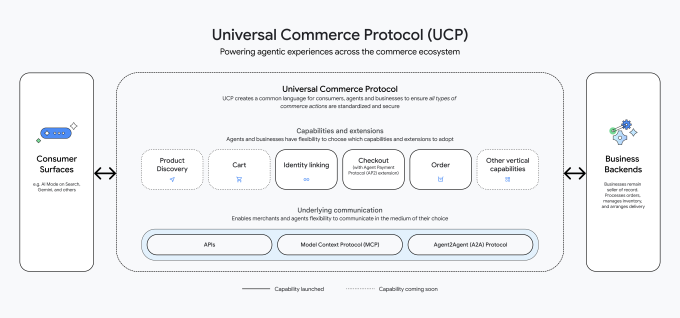
The Universal Commerce Protocol (UCP) is a new open standard for AI agent-based shopping that Google unveiled today at the National Retail Federation (NRF) conference. This is a new open standard designed to facilitate “agentic commerce” by allowing AI agents to handle the entire shopping journey.
The standard, which was created in collaboration with businesses including Shopify, Etsy, Wayfair, Target, and Walmart, enables agents to handle many aspects of consumer purchasing processes, such as post-purchase assistance and discovery. With the protocol which has been approved by more than 20 other businesses, including American Express, Mastercard, Visa, and Stripe. This guarantees standardised and safe transactions. The main notion is that rather than requiring connections with multiple agents, the standard may facilitate these diverse aspects of the process.
The business announced that it will soon employ the Gemini apps to allow customers to check out straight from U.S.-based stores while conducting product research and UCP for qualified Google product listings in AI mode in search. Customers will be able to transfer the shipping details stored in their Google Wallet and make payments using Google Pay. PayPal will soon be accepted as a payment method, according to Google.
Tobi Lutke, CEO and founder of Shopify, stated, “This is one of the really exciting parts about agentic.” It’s excellent at identifying individuals with particular interests and matching them with the ideal product. I never would have looked for this product, but for some reason it came up on the other side. This type of serendipity is where the most successful business transactions occur.
It’s noteworthy that Shopify also revealed a comparable retail interface with Microsoft Copilot today to facilitate consumers’ checkout within the conversational flow.
Google announced that it will now enable brands to provide consumers a special discount while they utilise the AI mode to get a product recommendation. This is another move that will affect consumers. For example, you might use a search term like “I’m looking for a modern, stylish rug for a high-traffic dining room” to find a rug. I want something that is easy to clean because I have a lot of dinner parties. Brands can build up their campaign to give you a discount right then.
In order to help sellers better highlight their products in AI search surfaces, the business is now providing users with additional data attributes within the Merchant Centre. Additionally, companies like PayPal and OpenAI are trying to make vendors easier to find in AI chatbot searches. Additionally, startups like the prompting company are collaborating with retailers to make their products appear in AI responses.
In order to respond to consumer enquiries, Google is now enabling retailers to incorporate a branded AI-powered business agent into Google Search. The tool is already being used by retailers like Lowe’s, Michael’s, Poshmark, and Reebok, according to the business. Rivals like Shopify and Meta have been investigating AI-powered customer service and outreach capabilities.
Gemini Enterprise for Customer Experience (CX), a package to manage shopping and customer service for retailers and restaurants, was also introduced by the search engine behemoth.
And in order to integrate AI into every aspect of purchasing, both for consumers and merchants, companies such as Google, Amazon, Walmart, and OpenAI have been introducing new standards and products. Adobe said earlier in the month that generative AI increased traffic to seller sites by 693.4% over the holiday season; however, the report did not indicate the percentage of this traffic that resulted in sales.
Why they are concerned is that the Agentic buying will alter where and how judgements about purchases are made, frequently even before a customer visits a retailer’s website. Google’s new protocols and AI surfaces extend influence beyond traditional search ads to high-intent times within AI-driven discovery.
As AI becomes the front door to commerce, tools like Direct Offers and branded agents provide advertisers new opportunities to close deals, safeguard profits, and remain visible. It’s unclear if increased conversion and margin management will make up for the decline in direct site visits.
In summary. According to Google, agentic shopping is unavoidable. Google hopes to maintain AI-driven commerce and keep businesses informed as agents take over the purchasing process using UCP and its new retail tools.
We use cookies to ensure that we give you the best experience on our website. If you continue to use this site we will assume that you are happy with it.