Google says its growing use of artificial intelligence is significantly improving Android security, after the company prevented millions of harmful apps from reaching users through the Play Store last year.
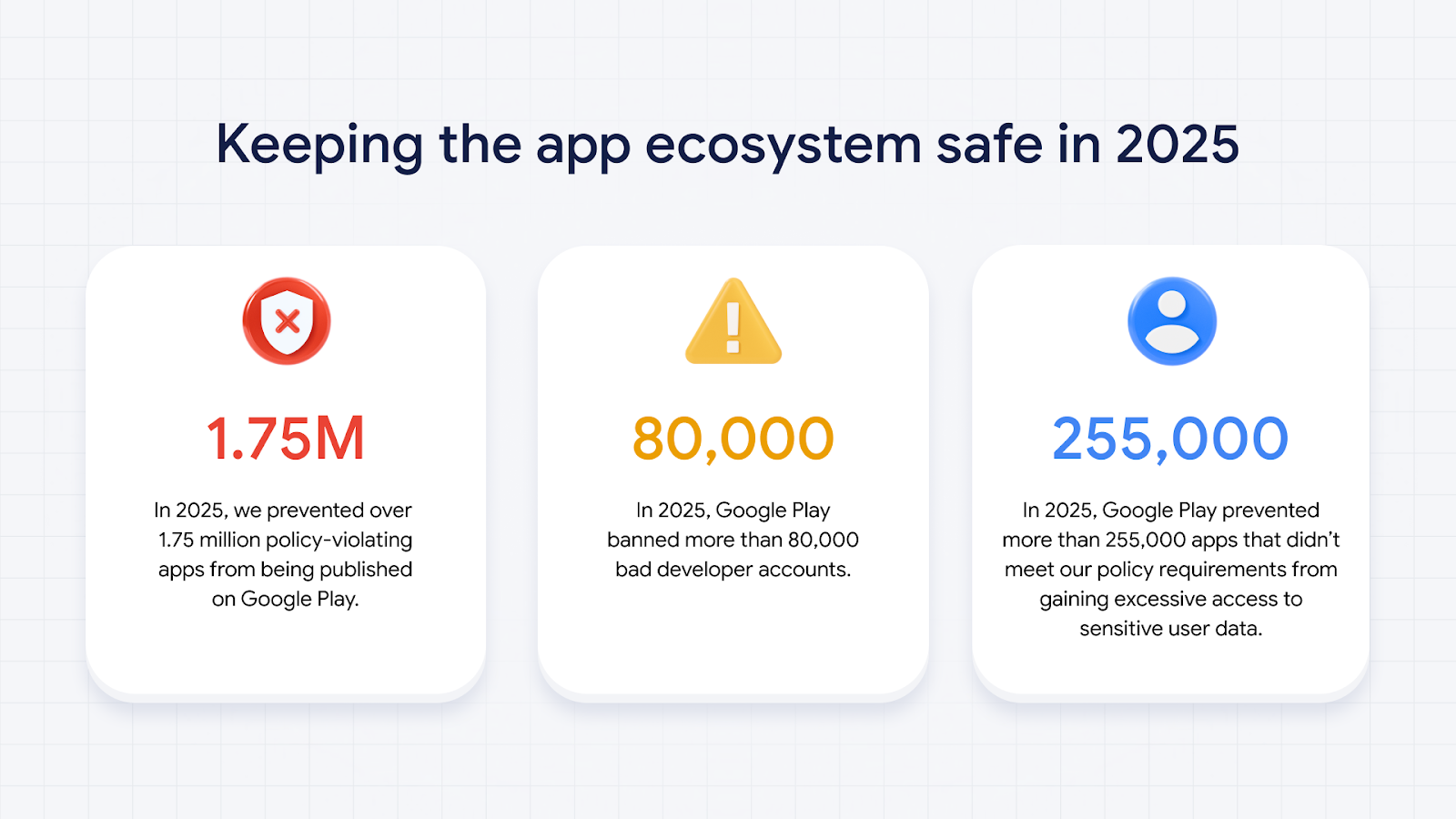
According to Google’s latest Android app ecosystem safety report, the company stopped 1.75 million policy-violating apps from being published in 2025, a drop from 2.36 million the year before suggesting attackers are increasingly discouraged from targeting the official store altogether.
The company also banned more than 80,000 developer accounts linked to malicious activity, another major decline from previous years.
Google credits the improvement largely to AI-driven protections. Its systems now run over 10,000 automated safety checks on every submitted app, and newer generative-AI models assist human reviewers in identifying more complex threats and suspicious behavior patterns.
Beyond blocking harmful apps before publication, Google said its defenses also limited privacy abuse. The company prevented more than 255,000 apps from gaining unnecessary access to sensitive user data and stopped 160 million fake ratings and review spam attempts.
Meanwhile, Android’s on-device security service, Play Protect, detected more than 27 million malicious apps installed outside the Play Store, suggesting attackers are shifting toward sideloaded distribution as the official marketplace becomes harder to exploit.
Google said the combination of AI analysis, developer verification and stricter review requirements has effectively raised the barrier for attackers, turning the Play Store into a less attractive target.
The company plans to expand its AI security systems further in 2026 as threats evolve, highlighting a broader trend in cybersecurity: AI is no longer just powering consumer features, it is increasingly becoming the frontline defense against large-scale digital attacks.
Paul Balo is the founder of TechBooky and a highly skilled wireless communications professional with a strong background in cloud computing, offering extensive experience in designing, implementing, and managing wireless communication systems.
We use cookies to ensure that we give you the best experience on our website. If you continue to use this site we will assume that you are happy with it.