Google has released Gemini 3.5 Flash, a new AI model that the company says can compete with larger flagship systems on coding and agentic tasks while remaining faster and cheaper to run.
That combination is exactly where the AI market is heading. The first wave of the model race was about raw intelligence who could build the most powerful system. The next phase is increasingly about whether those systems can be deployed affordably at scale, especially for developers, enterprises and agentic workflows where speed and cost matter as much as benchmark performance.
Gemini 3.5 Flash is Google’s answer to that shift. The company is pitching it as its most capable Flash model so far, designed for “sustained frontier performance” on coding and agentic tasks, with support for complex multimodal inputs including text, images, video, audio and PDFs. Google’s model page lists a 1 million-token context window, 64,000 output tokens, structured outputs, function calling, code execution, search grounding and tool use, the kind of feature set aimed less at casual chatbot use and more at real workflows.
Google is positioning Gemini 3.5 Flash as a model that can rival larger flagship systems in areas like coding and agentic tasks, which is a bold claim in a market currently dominated by OpenAI and Anthropic at the high end. The key difference is that Google is not only competing on capability; it is competing on efficiency.
That efficiency angle matters because coding and agentic AI are becoming some of the most important battlegrounds in artificial intelligence. These are not simple question-and-answer tasks. They involve writing and debugging software, using tools, managing files, reading long documents, running code, coordinating steps and completing tasks that may take many actions rather than one response.
Google’s examples show Gemini 3.5 Flash building interactive web animations, organizing messy file collections, creating brand assets, coordinating multiple agents and even turning the AlphaGo paper into an autonomous game-building workflow. Those demos point to the model’s broader purpose: Google wants Flash to become a practical workhorse for AI agents, not just a lightweight alternative to its Pro models.
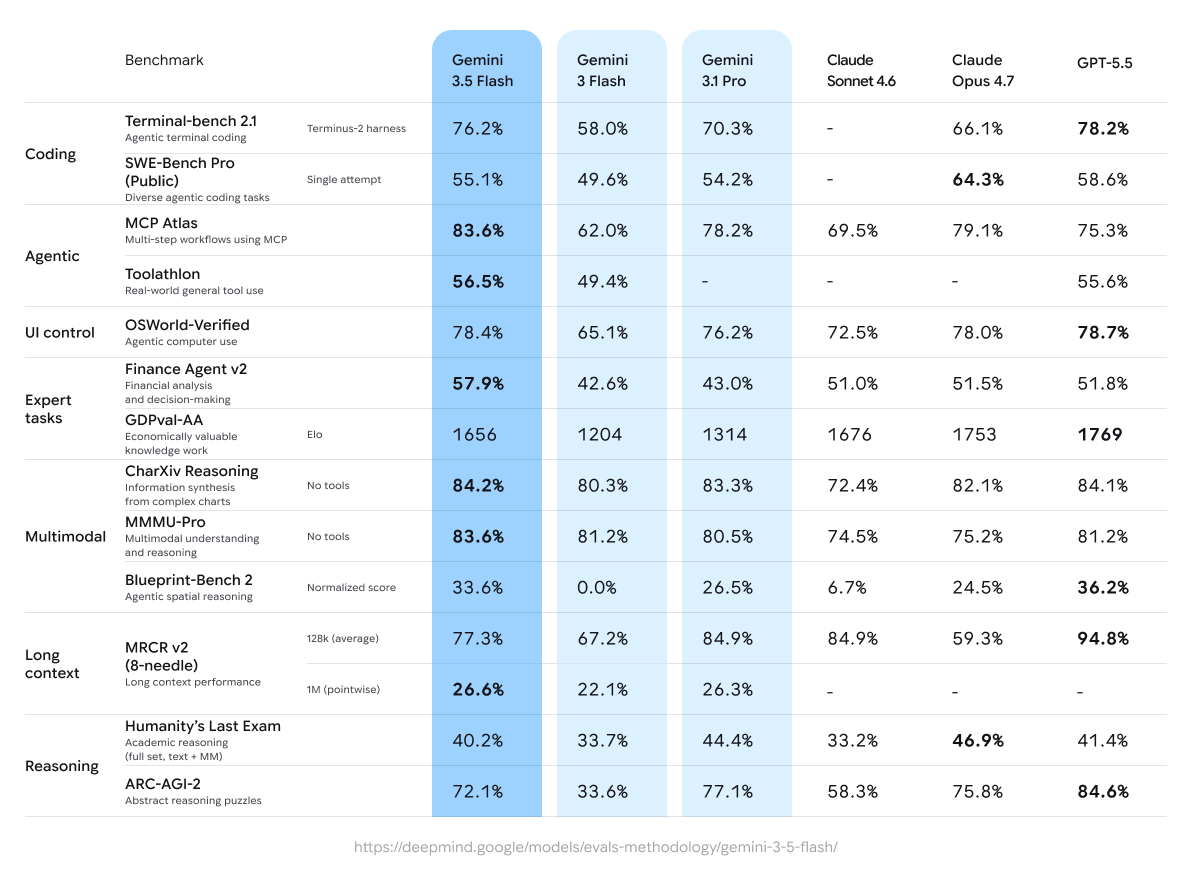
The benchmark numbers support that positioning, though they also show how competitive the field has become. Google says Gemini 3.5 Flash scored 76.2% on Terminal-bench 2.1, up from 58.0% for Gemini 3 Flash, and 83.6% on Agentic MCP Atlas, compared with 62.0% for the earlier Flash model. It also reached 55.1% on SWE-Bench Pro, a benchmark focused on diverse agentic coding tasks.
Those are meaningful gains, especially for a model built around speed and cost. But Google’s own comparison table also shows that GPT-5.5 and Claude Opus 4.7 remain highly competitive in some categories. GPT-5.5 edges Gemini 3.5 Flash on Terminal-bench, while Claude Opus 4.7 leads on SWE-Bench Pro. That makes Google’s pitch more nuanced: Gemini 3.5 Flash may not beat every flagship model everywhere, but it is trying to deliver near-flagship performance at a more practical operating cost.
That may be the smarter battle to fight.
As companies move from experimenting with AI to embedding it inside products, support desks, developer workflows and internal operations, cost becomes unavoidable. A model that is slightly less powerful but much cheaper and faster can be more useful than a top-tier model that is too expensive to run continuously.
This is why Flash could matter more than its name suggests.
For Google, the model is also part of a broader push unveiled around I/O 2026. Reuters reports that Google introduced Gemini 3.5 Flash as a faster and cheaper model optimized for coding and automation, while expanding AI agents across Search, YouTube, Gmail and Drive. CEO Sundar Pichai positioned the announcements as part of Google’s effort to integrate AI deeply into its core services rather than keep it isolated inside a chatbot.
That distribution advantage is Google’s biggest weapon.
OpenAI may have ChatGPT, and Anthropic may be increasingly strong with enterprise developers, but Google has Search, Android, Chrome, Gmail, Docs, Drive, YouTube and Google Cloud. If Gemini 3.5 Flash becomes the fast default model across that ecosystem, Google does not need every user to consciously choose it. It can simply become the AI layer inside the products people already use.
Google is also redesigning the Gemini app with a new “Neural Expressive” interface and making Gemini 3.5 Flash the default model in both the Gemini app and AI Mode. Google is also using the model to power Gemini Spark, its new consumer AI agent, while teasing Gemini 3.5 Pro for June.
That suggests Google is treating Flash not as a secondary model, but as the model it expects most people and many businesses to use day to day.
The strategy is clear: Pro models may still exist for the hardest reasoning tasks, but Flash models are where scale happens.
This also explains why coding is such a central part of the announcement. AI coding tools have become one of the clearest commercial use cases for generative AI, with developers willing to pay for models that can write, debug and manage complex codebases. Google has been under pressure to compete more aggressively with OpenAI, Anthropic and developer-focused AI tools, especially as coding assistants become gateways into broader enterprise adoption.
Financial Times reporting around the launch noted that Google is trying to court coders and enterprise users with a lower-cost model at a time when competitors have gained ground in business automation and software development.
In other words, Gemini 3.5 Flash is not just about performance, it is about Google trying to win back developer mindshare.
The agentic angle may be even more important. Business Insider reports that Google’s new Spark agent is designed to run in the background, helping with tasks like planning events, drafting emails and organizing documents without requiring users to keep a laptop open. That kind of always-on assistant needs a model that can act reliably, cheaply and quickly. A slow premium model would make the experience expensive and impractical.
That is where Gemini 3.5 Flash fits.
It is built for the messy middle of AI adoption: more capable than basic models, cheaper than the very largest ones, and fast enough to sit inside products that millions of people use every day.
There are still reasons to be cautious. Benchmarks are useful but imperfect, and companies often present their strongest results. Real-world performance will depend on how Gemini 3.5 Flash handles long tasks, ambiguous instructions, codebase complexity, hallucinations and tool failures outside controlled demos.
But the direction is important.
Google is no longer just trying to prove that Gemini can match rivals on intelligence. It is trying to prove that it can deliver intelligence at scale across consumer apps, enterprise workflows, developer tools and autonomous agents.
That may be the real significance of Gemini 3.5 Flash.
It is not simply a smaller or cheaper model.
It is Google’s bet that the next AI winner will not be the company with the single most powerful model, but the one that can put capable, fast and affordable intelligence everywhere.
Paul Balo is the founder of TechBooky and a highly skilled wireless communications professional with a strong background in cloud computing, offering extensive experience in designing, implementing, and managing wireless communication systems.
We use cookies to ensure that we give you the best experience on our website. If you continue to use this site we will assume that you are happy with it.