TechBooky AI Assistant
👋 Welcome to TechBooky AI Assistant

I can help with:
🔎 Tech News
🤖 AI Topics
💻 Gadgets
☁️ Cloud
✍️ Guest Posts
📢 Advertising
🔗 Backlinks
📩 Newsletter
  • AI Search
  • Cryptocurrency
  • Earnings
  • Enterprise
  • About TechBooky
  • Submit Article
  • Advertise With TechBooky
  • Contact Us
TechBooky
  • African
  • AI
  • Metaverse
  • Gadgets
Generic selectors
Exact matches only
Search in title
Search in content
Post Type Selectors
Search in posts
Search in pages
  • African
  • AI
  • Metaverse
  • Gadgets
Generic selectors
Exact matches only
Search in title
Search in content
Post Type Selectors
Search in posts
Search in pages
TechBooky
Generic selectors
Exact matches only
Search in title
Search in content
Post Type Selectors
Search in posts
Search in pages
Home Tips

How Do Microwaves Cook Food?

Paul Balo by Paul Balo
June 22, 2014
in Tips
Share on FacebookShare on Twitter
Share this story

Send it to someone who should read it.

f Facebook X X in LinkedIn wa WhatsApp tg Telegram @ Email
In Brief
  • Microwave ovens, renowned for their speed and efficiency, are ubiquitous appliances in most households.
  • They efficiently heat our meals, providing convenience that seems almost like magic.
  • To gain a better understanding, let’s delve into the scientific mechanism behind this revolutionary piece of 20th-century kitchen technology.

Microwave ovens, renowned for their speed and efficiency, are ubiquitous appliances in most households. They efficiently heat our meals, providing convenience that seems almost like magic. So, how exactly does a microwave cook food?

To gain a better understanding, let’s delve into the scientific mechanism behind this revolutionary piece of 20th-century kitchen technology.


Microwaves: Invisible Energy Beams

Microwave ovens operate using microwaves, a type of electromagnetic energy that travels at the speed of light. These can be envisioned as a powerful burst of light inundating your microwave oven’s cooking chamber.

Significantly, microwaves fall in the middle of the electromagnetic spectrum, being shorter than radio waves, but longer than infrared radiation. The precise wavelength used for cooking, about 12 centimeters from peak to peak, is easily absorbed by food. Crucially, microwaves, despite being a form of radiation, lack the energy to damage molecules and cause health issues like cancer, unlike more powerful forms of radiation such as ultraviolet rays or X-rays.


The Microwave Oven: The Mechanism

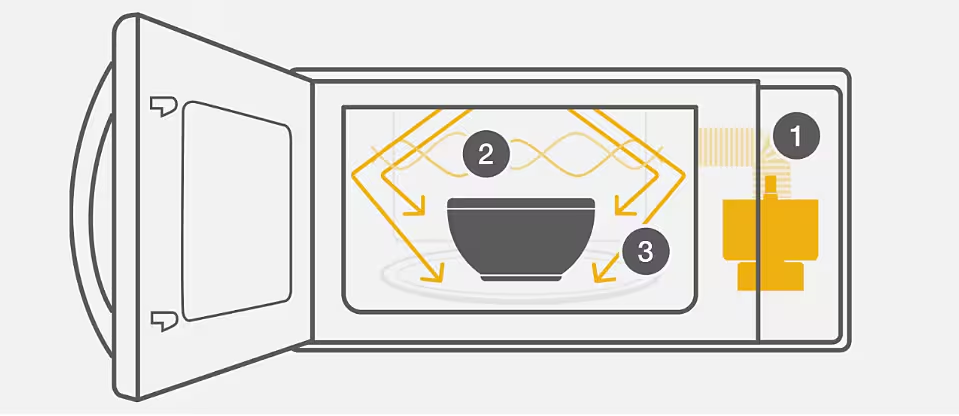
The heart of the microwave oven is the magnetron, a device that converts electricity into microwaves. The whole process starts when a transformer elevates standard household electricity (typically 120 volts) into high-voltage levels (over 4,000 volts). This voltage surge starts a chain reaction that creates heat within the magnetron’s filament, generating electrons. These electrons are then deflected into a continuous circular path within the microwave.

Also worth reading
Too Much Gemini? Here’s How To Dial Back Gemini In Your Google Workspace Apps How One Engineer Built a Local AI News Roundup With Docker & Qwen Best Ways to Open and Read Outlook OST Files without Outlook NCC Shares 9 Tips to Cut Data Depletion Strategies To Save IT Expenses Without Sacrificing Creativity How to Resolve Webcam Not Working in Windows 7

As these electrons move rapidly past cavities in their path, they generate microwaves. Subsequent devices then project these microwaves into the oven’s cooking chamber, which ricochet off the interior surfaces and infiltrate the food, causing it to heat.


Examination of Microwave Cooking

The moment you press the start button on your microwave, the heating process starts almost instantaneously. As the filament of the magnetron begins to heat, the microwaves are then directed into the chamber containing the food. This action causes water molecules inside the food to vibrate rapidly, resulting in friction that effectively creates heat, thereby cooking or heating the food.

An interesting observation is the fact that the 2.45 gigahertz frequency typically used by microwaves is rapidly absorbed by water, fats, and sugars. This characteristic helps explain why items that don’t possess these properties, like dry and microwave-safe containers, remain unaffected by the microwaves and stay cool to the touch.

Therefore, grasping the workings of a microwave oven opens our eyes to more than just their fast-cooking convenience. It offers a fascinating insight into the impactful part electromagnetism plays in our everyday life.


Minor enhancements were applied in 2025 for readability.

Related Reading

More contextual TechBooky stories selected from tags, categories and article context.

  • MTN-new-logo-e1663465256894
    MTN Nigeria Deploys First 25Gbps Microwave Link
  • tae-technologies-norman-employees-option-4-forprint-1660242072
    Google-Backed Fusion Startup Moves to Commercialize…
  • IMG_1819
    Chowdeck Secures $9M to Drive Growth in Nigeria, Ghana
  • d.light-kenya-1140x694
    Solar Company D.Light Secures $842M Africa Funding
  • delivery-risks-blog-header-1024x551
    5 Rising Food Delivery Startups Challenge Chowdeck and Glovo
  • Screenshot-2025-06-11-at-5.17.43 PM
    Apple Launches EnergyKit for Smart Home Efficiency
  • gadgets1
    Best 6 Tech Gadgets To Make Your Home Smart
  • OpenAI-1024x683
    SoftBank & OpenAI Back Energy and Data Centre…
Keep Reading Smarter

Search TechBooky with AI

Use TechBooky's AI Search to explore the context behind this story and related coverage across the site.

Try AI Search
More On This Topic
Tips
Follow TechBooky

Follow TechBooky for more technology stories and newsroom updates.

f Facebook X X in LinkedIn ig Instagram wa WhatsApp

Tags: microwavetips
Paul Balo

Paul Balo

Paul Balo is the founder of TechBooky and a highly skilled wireless communications professional with a strong background in cloud computing, offering extensive experience in designing, implementing, and managing wireless communication systems.

Search TechBooky
Open TechBooky AI Search Try the AI Assistant

BROWSE BY CATEGORIES

Receive top tech news directly in your inbox

subscription from
Loading

Freshly Squeezed

  • M-PESA Brings Tap-To-Pay To Kenyan Shop Counters October 3, 2026
  • MNT-Halan Sets 20% Share Sale As Cairo IPO Takes Shape October 3, 2026
  • Supabase Buys Turso As AI Agents Create Millions Of Databases October 3, 2026
  • Apple Tightens Mac Disk Access As AI Agents Raise Privacy Risks October 3, 2026
  • OpenAI Alerts Over 100 Organisations About AI Agent Activity October 2, 2026
  • Cloudflare Releases Clef AI Models for Faster Decisions October 2, 2026
  • Nigeria Opens New Digital Postcode System To App Developers October 2, 2026
  • Microsoft Launches Three AI Voice Models for Real-Time Agents October 2, 2026
  • Google Wins Chegg and Penske AI Overviews Lawsuits October 2, 2026
  • Reddit Ends RSS Feeds as It Tightens Data Access October 1, 2026
  • OpenAI and Synopsys Plan AI Model to Help Design Chips October 1, 2026
  • Angola Cables Upgrades Atlantic Links for AI Traffic October 1, 2026

Browse Archives

October 2026
M T W T F S S
 1234
567891011
12131415161718
19202122232425
262728293031  
« Sep    

Quick Links

  • About TechBooky
  • Advertise With TechBooky
  • Contact us
  • Submit Article
  • Privacy Policy
Generic selectors
Exact matches only
Search in title
Search in content
Post Type Selectors
Search in posts
Search in pages
  • African
  • Artificial Intelligence
  • Gadgets
  • Metaverse
  • Tips
  • AI Search
  • About TechBooky
  • Advertise With TechBooky
  • Submit Article
  • Contact us

© 2025 Designed By TechBooky Elite

Discover more from TechBooky

Subscribe now to keep reading and get access to the full archive.

Continue reading

We use cookies to ensure that we give you the best experience on our website. If you continue to use this site we will assume that you are happy with it.