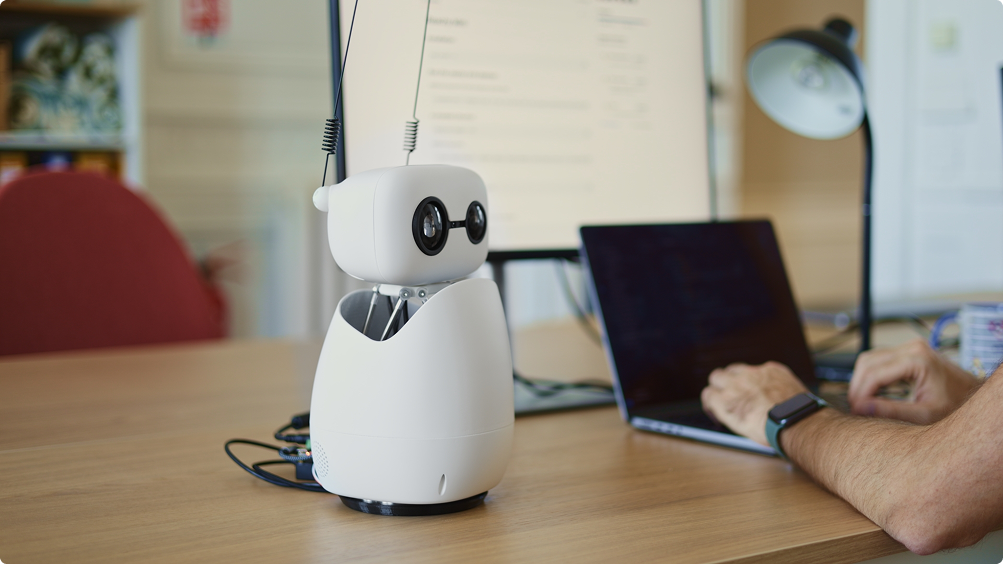
Hugging Face is pushing apps beyond the smartphone. The AI-focused startup has launched an open-source App Store for Reachy Mini, its $299 desktop robot, bringing an app ecosystem to physical robotics.
Reachy Mini is a small, stationary robot equipped with camera “eyes,” a speaker and a microphone. It was introduced in July 2025 following Hugging Face’s acquisition of robotics startup Pollen Robotics, and around 10,000 units have been sold so far, according to the company.
The new Reachy Mini App Store already lists more than 200 community-built applications. Owners of the robot can download any of these apps free of charge. Unlike traditional smartphone app marketplaces, there is currently no monetisation option for creators on this store.
The store is open-source and hosted through Hugging Face’s infrastructure, aligning with the company’s broader positioning as a hub for open AI models, agents and applications. Apps are designed to run on Reachy Mini hardware, tapping into its sensors and audio capabilities.
Hugging Face frames the launch as a shift away from software ecosystems that revolve entirely around phones. Instead, the company is positioning Reachy Mini as a low-cost physical platform where people can run and share robotics apps.
Beyond simply downloading existing apps, the Reachy Mini App Store is meant to make it easier for people to build their own. Hugging Face is tying the store to its AI-powered agent called “ML Intern,” which helps users create custom applications for the robot.
Using ML Intern, Reachy Mini owners can generate functional robotics software without needing a background in engineering or coding. The company says individuals are now able to ship working robot apps in under an hour, a change it describes as removing the traditional “roboticist” barrier.
“Anyone can build the apps,” said Clément Delan, underscoring Hugging Face’s focus on accessibility and community-driven development.
For now, the combination of a low-cost robot, a free library of more than 200 apps and an AI assistant for building new ones marks a notable step toward making robotics software feel more like everyday app development.
Paul Balo is the founder of TechBooky and a highly skilled wireless communications professional with a strong background in cloud computing, offering extensive experience in designing, implementing, and managing wireless communication systems.
We use cookies to ensure that we give you the best experience on our website. If you continue to use this site we will assume that you are happy with it.