TechBooky AI Assistant
👋 Welcome to TechBooky AI Assistant

I can help with:
🔎 Tech News
🤖 AI Topics
💻 Gadgets
☁️ Cloud
✍️ Guest Posts
📢 Advertising
🔗 Backlinks
📩 Newsletter
  • AI Search
  • Cryptocurrency
  • Earnings
  • Enterprise
  • About TechBooky
  • Submit Article
  • Advertise With TechBooky
  • Contact Us
TechBooky
  • African
  • AI
  • Metaverse
  • Gadgets
Generic selectors
Exact matches only
Search in title
Search in content
Post Type Selectors
Search in posts
Search in pages
  • African
  • AI
  • Metaverse
  • Gadgets
Generic selectors
Exact matches only
Search in title
Search in content
Post Type Selectors
Search in posts
Search in pages
TechBooky
Generic selectors
Exact matches only
Search in title
Search in content
Post Type Selectors
Search in posts
Search in pages
Home Medical

Researchers Develop Infrared Imager That Can Help Map Out A Person’s Blood Vessels Without Touching The Skin

Ayoola by Ayoola
September 13, 2021
in Medical, Research/How to do it, Science
Share on FacebookShare on Twitter
Share this story

Send it to someone who should read it.

f Facebook X X in LinkedIn wa WhatsApp tg Telegram @ Email
In Brief
  • A team of researchers at the University of California, San Diego has developed a new infrared imager that can see through smog and fog, map out...
  • The research supported by the National Science Foundation (ECCS-1839361) and Samsung Advanced Institute of Technology, was performed in part at the San Diego Nanotechnology Infrastructure (SDNI)...
  • It should be noted that the shortwave infrared imaging is not the same with thermal imaging that detects much longer infrared wavelengths given off by the...

A team of researchers at the University of California, San Diego has developed a new infrared imager that can see through smog and fog, map out a person’s blood vessel, and at the same time monitor the heart rate, without actually touching the person’s skin.

The research supported by the National Science Foundation (ECCS-1839361) and Samsung Advanced Institute of Technology, was performed in part at the San Diego Nanotechnology Infrastructure (SDNI) at UC San Diego, a member of the National Nanotechnology Coordinated Infrastructure, which is supported by the National Science Foundation (grant ECCS-1542148). 

The infrared imager can also see through silicon wafers to inspect the composition and quality of electronic boards, while detecting a part of the infrared spectrum with wavelengths from 1000 to 1400 nanometers dubbed ‘short wave infrared light’ right outside the 400 to 700 nanometers visible spectrum.

It should be noted that the shortwave infrared imaging is not the same with thermal imaging that detects much longer infrared wavelengths given off by the body.

The imager functions when it shines shortwave infrared light on an area of interest, converts the low energy infrared light reflecting back to the device into shorter, higher-energy wavelengths visible to the human eye.

Tina Ng, a Professor of Electrical and Computer Engineering at the University of California, San Diego Jacobs School of Engineering affirmed that the process ‘makes the invisible light visible’.

Even thought the infrared imaging technology has been in function for decades, most of the systems are expensive, bulky and complex, most times requiring a separate camera and display. Aside this, they are produced with the use of inorganic semiconductors, that are hitherto costly, rigid, while also having toxic elements like arsenic and lead.

The developed infrared imager seeks to solve and overcome these challenges as it combines the sensors and the display into a thin device, thereby making it compact and simple. It is created with organic semiconductors, saving cost, while at the same time flexible and safe to use in biomedical applications. The imager provides better image resolution than many of its organic counterparts.

Aside the enumerated, the new infrared imager has other advantages. One of them is that is sees more of the shortwave infrared spectrum, from 1000 to 1400 nanometers, where existing similar systems had most times seen below 1200 nanometers.

The Imager also has the largest display sizes of  infrared images , with 2 square centimeters in area. It is easy and not expensive to scale up to have larger displays as the imager is tuned and fabricated using thin film processes.


Invigorating Infrared photons to visible photons

Also worth reading
Google’s Gemini for Science Aims to Streamline Research With New AI Tools AI Beats Doctors in Harvard ER Study, Showing Major Shift in Healthcare OpenAI Unveils GPT-Rosalind, Aiming at Drug Discovery and Genomics Artemis II astronaut snaps stunning far‑side Moon shot on an iPhone 17 Pro Nvidia Expands Open AI Models for Robotics and Healthcare Gates Foundation & OpenAI Partner to Advance AI-Driven Healthcare in Africa

Made up of multiple semiconducting layers, with hundreds of thin, stacked nanometers on top of each other, the imager has three of these layers that are made of different organic polymer standing as the image key players: a photo detector layer, an organic light-emitting diode (OLED) display layer, and an in between electron-blocking layer.

Shortwave infrared light with low energy protons are absorbed by the photodetector layer, and then generates electric current, which then flows to the OLED display layer, with an onward conversion to a visible image with low energy protons. There is an in between layer called the ‘electron-blocking layer’ that prevents the OLED display layer from losing current, in the process enabling the  device to produce a clearer, more readable image.

The conversion of low energy photons to high energy photons highlighted above known as ‘upconversion’ is an electronic process, with the first author of the research, Ning Li, a postdoctoral researcher in Ng’s lab adding that:

“The advantage of this is it allows direct infrared-to-visible conversion in one thin and compact system. In a typical IR imaging system where upconversion is not electronic, you need a detector array to collect data, a computer to process that data, and a separate screen to display that data. This is why most existing systems are bulky and expensive.”

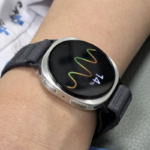
According to Li, the imager is effective in providing optical and electronic readouts, a feature that makes it multifunctional. For instance, when infrared light is shined at the back of a subject’s hand, a clearer picture of the subject’s blood vessels is provided by the imager while recording the subject’s heart rate.

The team furthermore used the infrared imager to see through smog and silicon wafer in a demonstration where a photomask was placed and patterned in a small chamber filled with smog with the ‘EXIT’ tag. They also placed a photo mask patterned with “UCSD” behind a silicon wafer. The imager sees the letters in these demonstrations after the infrared light had penetrated through smog and silicon. This process would be useful in everyday applications for self-driven cars to see clearly in bad weather. It would also be useful for the inspection of silicon chips, while looking out for defects.

It is believed that the team of researchers will focus on improving the imager’s efficiency to achieve clearer results.


Reference: “Organic Upconversion Imager with Dual Electronic and Optical Readouts for Shortwave Infrared Light Detection” by Ning Li, Naresh Eedugurala, Dong-Seok Leem, Jason D. Azoulay and Tse Nga Ng, 19 February 2021, Advanced Functional Materials.
DOI: 10.1002/adfm.202100565

Research Co-authors : Naresh Eedugurala and Jason D. Azoulay, University of Southern Mississippi; and Dong-Seok Leem, Samsung Electronics Co., Ltd.

Related Reading

More contextual TechBooky stories selected from tags, categories and article context.

  • Meta-acquires-robotics-AI-startup-to-boost-its-humanoid-tech-vision-1
    Meta Acquires Robotics Startup To Boost & Improve…
  • 495118a3-b074-416b-87d1-59647cdc9db9
    Google Commits N3bn To Strengthen Nigeria’s AI Strategy
  • science__keyword__blog-header.width-2200.format-webp
    Google’s Gemini for Science Aims to Streamline…
  • 240819-waymo-al-1158-9659ab
    Waymo Gets California Approval For Sacramento And…
  • lesotho-2
    Lesotho Launches National CSIRT As Cybersecurity…
  • Gwo8cbrXQAAa6no
    Africa’s AI Future Gets a $37 Million Boost from Google
  • samsung faint detection
    Samsung Bets on Fainting Prediction as Next Big…
  • ouras-stress-tracking-just-got-a-useful-upgrade
    Oura Unveils "Cumulative Stress" Feature and New Interface
Keep Reading Smarter

Search TechBooky with AI

Use TechBooky's AI Search to explore the context behind this story and related coverage across the site.

Try AI Search
More On This Topic
Medical Research/How to do it Science
Follow TechBooky

Follow TechBooky for more technology stories and newsroom updates.

f Facebook X X in LinkedIn ig Instagram wa WhatsApp

Tags: healthcareinfrared imagerresearchersscience
Ayoola

Ayoola

Ayoola Faseyi, an Abuja based Journalist with interest in Technology and Politics. He is a versatile writer with articles in many renowned News Journals. He is the Co-Founder of media brand, The Vent Republic.

Search TechBooky
Open TechBooky AI Search Try the AI Assistant

BROWSE BY CATEGORIES

Receive top tech news directly in your inbox

subscription from
Loading

Freshly Squeezed

  • Nvidia’s $96.2B Quarter Shows The AI Boom Has Not Slowed Yet August 26, 2026
  • Meta’s $18B Teen Safety Deal Turns Social Media Into A Regulated Product August 26, 2026
  • Ventures Platform’s $84M Fund Shows African VC Is Becoming More Selective August 26, 2026
  • Bill Gates Says AI Needs A Robot Tax And Human Reserved Jobs August 26, 2026
  • Amazon Shuts Down Mechanical Turk As Human Data Work Enters The AI Age August 26, 2026
  • India’s AM Intelligence Orders 9,000 Nvidia Rubin GPUs For An $8B AI Factory Push August 26, 2026
  • Perplexity And Nvidia Take AI Agents Local With Portable Computer August 26, 2026
  • Fitbit Founders Return With Luffu Link, A Wearable Built For Family Care August 25, 2026
  • Meta’s Hatch AI Agent Plan Would Put Zuckerberg In The Paid AI Race August 25, 2026
  • OpenAI Wants ChatGPT Work To Bring Coding Agents Into The Office August 25, 2026
  • Amazon Device Price Hikes Show The AI Memory Squeeze Is Reaching Homes August 25, 2026
  • India’s Airbound Raises $37M As Drone Delivery Looks For Its Trucking Moment August 25, 2026

Browse Archives

August 2026
M T W T F S S
 12
3456789
10111213141516
17181920212223
24252627282930
31  
« Jul    

Quick Links

  • About TechBooky
  • Advertise With TechBooky
  • Contact us
  • Submit Article
  • Privacy Policy
Generic selectors
Exact matches only
Search in title
Search in content
Post Type Selectors
Search in posts
Search in pages
  • African
  • Artificial Intelligence
  • Gadgets
  • Metaverse
  • Tips
  • AI Search
  • About TechBooky
  • Advertise With TechBooky
  • Submit Article
  • Contact us

© 2025 Designed By TechBooky Elite

Discover more from TechBooky

Subscribe now to keep reading and get access to the full archive.

Continue reading

We use cookies to ensure that we give you the best experience on our website. If you continue to use this site we will assume that you are happy with it.