Fixr Technologies is quietly building a very different kind of tech-enabled services company in Nigeria one that has crossed ₦3 billion in revenue and processed nearly ₦5 billion in solar financing without taking a naira of venture capital.
Co-founded by Ikechi Adolphus and Olamide Akangbe, the Lagos-based startup doesn’t want to be called a marketplace. Instead of simply listing technicians and taking a cut, Fixr operates like a contractor: it owns the entire customer relationship, employs most of its technicians on salary, runs its own logistics, and layers technology on top of a tightly controlled operations engine.
Nigeria has seen multiple attempts at service marketplaces where platforms onboard technicians, connect them with customers, and collect a commission. Adolphus argues that model is structurally flawed. If a technician does a great job, the customer is incentivised to bypass the platform next time by calling them directly. If the technician performs poorly, the customer doesn’t return at all. In both cases, the platform loses.
Fixr experimented with that model and found it could not scale. The company’s answer was to stop behaving like an agency and instead act as the principal contractor for engineering services. Customers request service from Fixr; the company then manages everything else technician assignment, parts procurement, job reporting, customer communication, and payment.
“The customer comes to our platform or requests a service through us, and they don’t have any business with the technician. Fixr has full control,” Adolphus explains. That control is reinforced by the decision to put technicians on payroll.
Fixr now works with roughly 400 technicians, a majority of whom are full-time salaried staff. That is a heavy fixed cost for a business with no equity funding, but it gives the company leverage over quality and deployment: it can decide which technician goes where, how work is done, and how to respond when jobs need follow-up. The company says technician circumvention where technicians try to work with clients directly stands at about 0.1%.
Since pivoting to a more technology-focused structure in early 2023, Fixr has expanded across multiple geopolitical zones in Nigeria, with a presence in Ghana and Nairobi. According to Adolphus, the business grew seven times year-on-year in its last full year and is targeting a tenfold jump on that figure in 2026, again without outside equity investment.
Fixr operates across seven defined engineering service categories, chosen not just for ease of entry but for long-term market potential and scalability:
HVAC (heating, ventilation, and air conditioning)
Renewable energy and solar
Electrical and fitting
Electronics
CCTV and surveillance
Fibre optics and communications
Home automation
These categories sit on top of a physical and operational backbone. Fixr manages five to six dark stores that serve as component warehouses and runs its own in-house logistics to move technicians and parts.
Renewable energy and solar have become a standout segment. Beyond installing solar systems, Fixr has built a financing product for customers who can’t afford the full upfront cost. Through partnerships with financial institutions such as Checkoff Finance and Sterling Bank, the company facilitates asset-backed credit to get solar systems into homes and businesses.
The solar credit product works on flat interest of 4% per month. Repayment timelines range from three to six months for smaller, short-cycle installations and up to twelve months for larger systems. If customers repay early, they pay interest only for the months the credit was active. During the entire repayment period, Fixr is responsible for post-installation support to keep systems running.
In just two years, this renewable energy financing arm has generated close to ₦5 billion in gross merchandise value (GMV). That figure highlights how much unmet demand exists for reliable power in Nigeria and how Fixr has positioned itself at the intersection of engineering services and consumer credit.
Technology layered on top of a shop floor
Fixr did not begin as a software startup. Its roots are in a physical repair business: co-founder Akangbe ran an electrical repair outlet before meeting Adolphus initially as a technician called in to fix a washing machine. The initial ask was a website; the opportunity, as Adolphus saw it, was a better business that could later be scaled through technology.
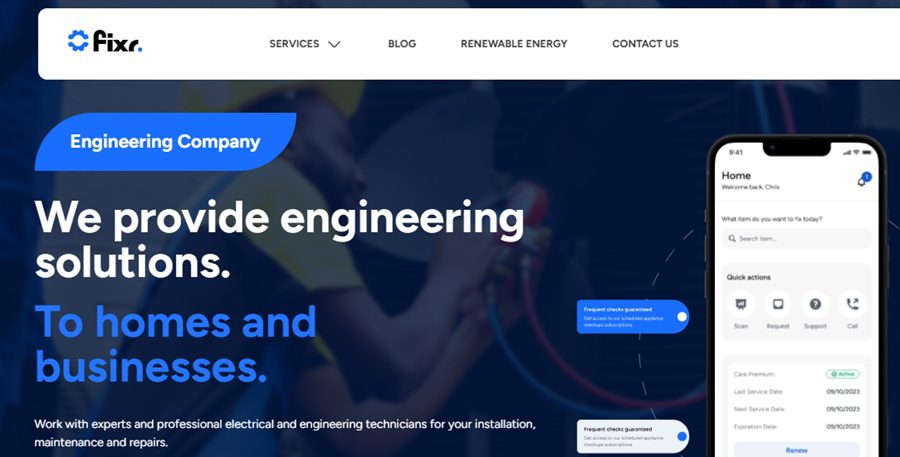
Today, Fixr’s operations sit on three layers of software built to support that thesis that “technology is about democratising value” rather than existing for its own sake.
1. Internal operations tools The first layer is internal software used by Fixr’s team to coordinate day-to-day work. These tools help track jobs, assign technicians, manage service subscriptions, monitor component procurement, follow up with customers, and flag when maintenance visits are due. The aim is to keep service delivery predictable as volumes grow.
2. Technician app The second layer is a technician-facing application, not available publicly but central to field execution. Through it, technicians see assigned tasks, access logistics support (including disbursement of transport funds), and participate in a performance points system tied to completion rates and job quality. For a workforce of hundreds spread across multiple regions, this is how Fixr maintains visibility and consistency.
3. Customer app On the customer side, an application lets users request services, manage annual maintenance contracts, view inspection reports, check component prices, and monitor their solar loan status. Fixr says this has been particularly useful for subscription customers who sign annual maintenance contracts on appliances or systems, as well as for users of the solar financing product who need to track repayments and support.
Unlike many African startups chasing aggressive growth with venture capital, Fixr has opted to build on operating profits and structured debt. The company has not raised VC funding. Instead, it leans on reinvested earnings and debt facilities from partners including Sterling Bank and Checkoff Finance.
That strategy forces discipline. Fixr has reworked how it allocates internal costs to stay liquid through growth cycles, relying on credit lines for working capital while channelling margins back into the business rather than distributing them. This can slow expansion, but it also shields the company from equity dilution and some of the external growth pressures that have weighed on other African tech firms.
The numbers suggest the approach is paying off. Fixr launched in its current, tech-enabled form in early 2023. By 2025, annual revenue had grown to more than ₦3 billion. Adolphus expects 2026 to deliver a tenfold increase on that revenue base, and the company maintains its multi-country footprint and 400-strong technician workforce without VC backing.
As Fixr extends its contractor-led model across Nigeria, Ghana, and Nairobi, its experiment offers a counterpoint to the dominant “asset-light marketplace” narrative in African tech: own the relationship, own the workforce, build disciplined financing around real demand and layer technology only where it amplifies value.
Paul Balo is the founder of TechBooky and a highly skilled wireless communications professional with a strong background in cloud computing, offering extensive experience in designing, implementing, and managing wireless communication systems.
We use cookies to ensure that we give you the best experience on our website. If you continue to use this site we will assume that you are happy with it.