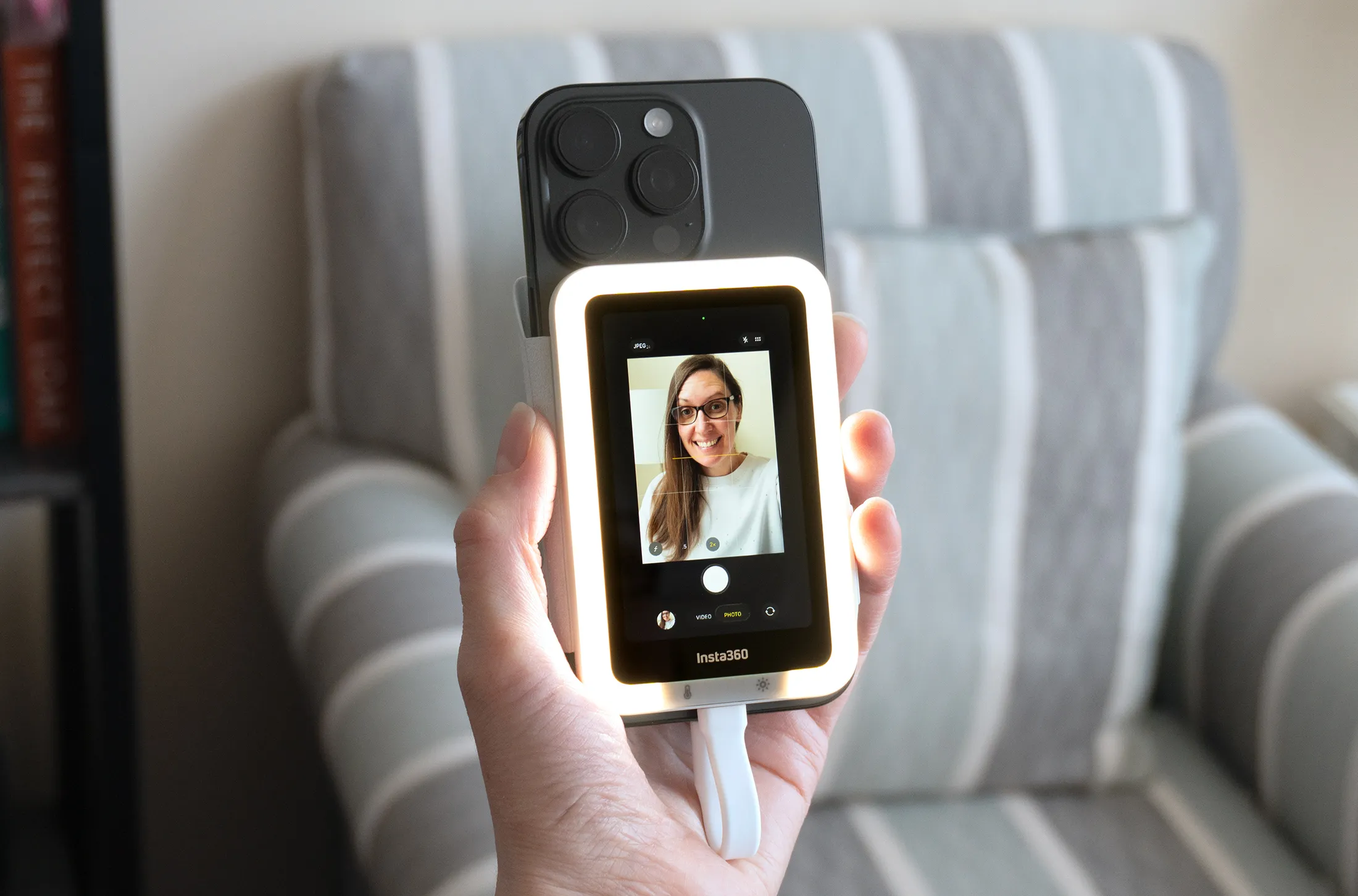
Insta360, best known for its action cameras, has launched a new accessory called Snap, a compact USB-C display that sits on the back of your phone and doubles as a dedicated selfie and vlogging screen.
The idea is simple: instead of relying on your phone’s lower-resolution front camera, Snap lets you use the higher-resolution rear camera while still being able to see yourself, frame the shot and tweak settings in real time.
Snap is built around a 3.5-inch touchscreen that plugs into your phone via USB-C. Once connected, it mirrors your phone’s camera view and gives you on-screen controls for settings like zoom and focus, so you can line up selfies and vlogs before you hit record or take a photo.
Insta360 is also offering a second version of the device co-developed with beauty tech brand AMIRO. That variant adds a built-in light with multiple colour temperature and brightness options, aimed at creators and users who want more control over how they look on camera. The standard Snap is priced at $79.99, while the illuminated AMIRO co-branded version costs $89.99.
While standalone selfie and preview screens already exist a quick Amazon search for “selfie screen” turns up several options Insta360 is leaning on the benefits of a wired connection. The company says its USB-C approach delivers a more stable, lower-latency video feed than typical wireless alternatives, which can matter when you’re trying to monitor framing and timing while recording.
Physically, Snap measures 6.8mm thick, which Insta360 notes is slightly thinner than an iPhone 17. It attaches magnetically to the back of MagSafe-compatible iPhones, effectively turning the rear of the phone into a flip-style camera rig without adding a bulky case. For other phones, the company includes a magnetic ring that can be attached to supported devices.
On Android, Snap works with phones that support DisplayPort Alt Mode, a screen-mirroring feature available on some USB-C devices. With that in place, the accessory can function as a live viewfinder. Insta360 also says Snap works with all major third-party camera and social media apps, so users can record and post directly to the platforms they already use.
The hardware is being positioned as a way to unlock the full potential of modern smartphone cameras. According to Insta360’s cited examples, recent flagships like the iPhone 17 and Samsung Galaxy S25 offer rear cameras with around three to five times the resolution of their front-facing shooters. On the Galaxy S25 Ultra, that gap jumps to roughly 16 times the resolution. With that kind of difference, being able to comfortably use the rear camera for self-shot content could significantly improve image detail for creators and everyday users alike.
Snap’s pitch, then, is less about introducing a new category and more about refining it: a slim magnetic accessory, wired for low latency, designed to ride on the back of your phone and make the best camera you already own easier to use for selfies and vlogs.
Paul Balo is the founder of TechBooky and a highly skilled wireless communications professional with a strong background in cloud computing, offering extensive experience in designing, implementing, and managing wireless communication systems.
We use cookies to ensure that we give you the best experience on our website. If you continue to use this site we will assume that you are happy with it.