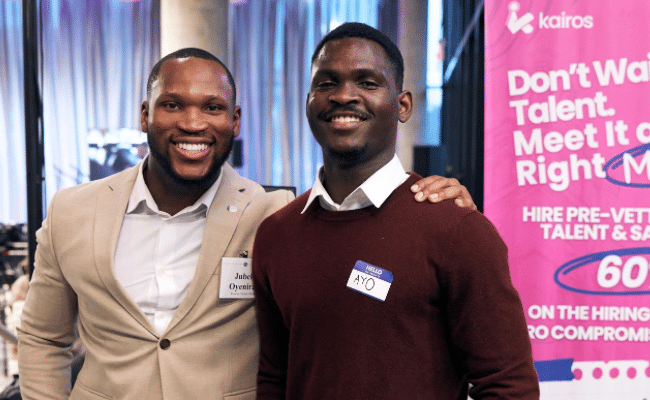
Kairos Nexus Global, a cross-border outsourcing startup led by two young Nigerian founders, has secured ₦75 million (about $50,000) in non-dilutive funding to connect U.S. businesses with vetted global talent, starting from Nigeria.
The company positions itself as a trust-focused alternative to open freelance marketplaces, arguing that the next phase of outsourcing will be less about broad access to talent and more about rigorous verification and risk control.
Kairos Nexus Global is led by 22-year-old Jubelo Oyeniran, who was born in Ijebu-Ode. He drives the company’s strategy, growth, fundraising, and financial structuring. Oyeniran has an accounting background and is completing a Master’s degree in Forensic Accounting, expected in May 2026. His approach to the business combines technology with a focus on unit economics, cost arbitrage sustainability, risk mitigation, and scalable revenue models.
On the technical side, 24-year-old Ayorinde Alase, a former AXA employee and graduate of Olabisi Onabanjo University, leads the AI systems and verification architecture behind the platform. Alase is a PhD candidate in Computer Engineering, and is responsible for building the infrastructure that underpins how Kairos evaluates and manages talent.
Rather than separating vision and execution, the founders say Kairos operates at the intersection of business strategy and technical delivery, with both sides treated as core to how the platform functions.
Global platforms like Upwork and Fiverr have already made it easier for companies to hire across borders. But their open marketplace structure often leaves businesses to navigate challenges on their own, including trust, quality control, and risk management. Kairos Nexus Global is betting that a more controlled model with baked-in verification will appeal to smaller companies that cannot afford costly missteps.
The startup’s thesis is that outsourcing’s “next evolution” will not be defined by who can surface the most talent, but by who can best verify that talent and structure engagements to reduce risk. Instead of relying on open bidding, the platform integrates multiple layers of checks and controls into its core model, including:
Identity verification for talent
Skill validation processes
Onboarding controls
Escrow-backed engagements
By baking these elements into the platform, Kairos aims to make cross-border hiring more predictable for U.S. small businesses. The company operates from Maryland while building a cross-continental pipeline of talent, with Nigeria as the initial focus and broader expansion across emerging markets in view.
Payroll is typically the largest cost line for early-stage companies. A domestic mid-level developer in the U.S. can cost over $100,000 annually. According to Kairos’ framing, structured cross-border hiring can enable comparable roles to be filled at up to 60% lower cost. The startup presents this not as a way to replace domestic workers, but as a mechanism to help resource-constrained founders stretch limited capital, keep operations running, and reach scale.
Small businesses account for nearly half of private-sector employment in the United States, yet around 20% fail in their first year and nearly half fail within five years, often because of capital constraints. Against that backdrop, Kairos positions itself as an “economic amplifier” for entrepreneurs, suggesting that access to more affordable, verified talent can give early-stage companies more room to grow before capital runs out.
For startups in Maryland and other U.S. ecosystems dealing with funding gaps, the company argues that reliable offshore capacity can be the difference between shutting down and scaling up.
Non-dilutive funding and trust-first model
Kairos Nexus Global has secured ₦75 million in non-dilutive funding via the Pava Innovation Award. Because the capital is non-dilutive, the founders retain ownership while accelerating product development and platform refinement. The company has also won the Spark Impact Award, which it views as a signal of ecosystem confidence in its trust-oriented approach.
The funding is being deployed to build out the platform’s core systems, including its AI-driven verification architecture and the operational infrastructure needed to manage cross-border engagements. The company projects annual revenue of $500,000 within three years, with that target hinging on disciplined execution and the continued demand from small businesses looking for cost-effective ways to hire.
As remote work infrastructure continues to lower the practical barriers of geography, Kairos argues that the real differentiator will not be who can offer the lowest labor costs, but who can engineer trust into every stage of the outsourcing relationship and pair that with sound business fundamentals.
For Nigerian professionals, the model opens up channels to earn in dollars by working remotely for U.S. companies. For U.S. small businesses, it offers a curated, verification-heavy alternative to open marketplaces, with an emphasis on capital efficiency rather than just headcount reduction.
Paul Balo is the founder of TechBooky and a highly skilled wireless communications professional with a strong background in cloud computing, offering extensive experience in designing, implementing, and managing wireless communication systems.
We use cookies to ensure that we give you the best experience on our website. If you continue to use this site we will assume that you are happy with it.