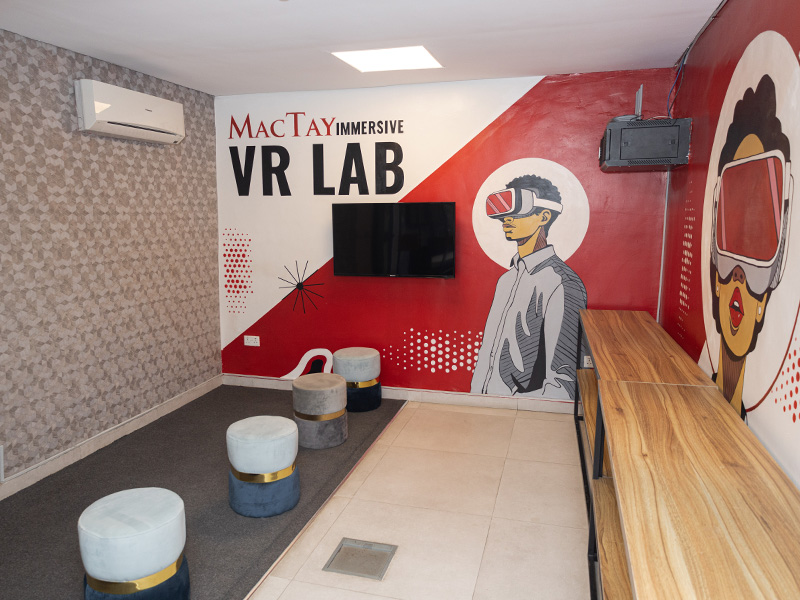
MacTay, a four-decade-old HR consulting firm, is betting on virtual reality to reshape how Lagos prepares for emergencies and, in the process, redefine itself as a technology-focused company.
More than 300 emergency service professionals in Lagos have now trained using VR goggles developed under MacTay’s Better Lagos Initiative, which focuses on low-cost, high-impact, technology-driven solutions. Instead of sitting in a classroom, trainees are dropped into a simulated accident on the Lekki-Ikoyi link bridge and forced to make decisions in real time.
MacTay’s pivot began with an internal rethink of what kind of company it wants to be. Founded over forty years ago as a traditional HR consulting firm, it now describes itself as transitioning into a technology company that deploys HR solutions, rather than an HR company merely adopting technology to keep up.
Tunde Rotimi, who leads Strategy and Innovation at MacTay, frames virtual reality as a practical answer to a longstanding problem in training: how to safely recreate dangerous, high-stakes environments. Rebuilding real emergencies such as major fires or complex traffic accidents is not only risky but also commercially unrealistic. MacTay’s answer is to model those scenarios virtually.
The Lekki-Ikoyi link bridge is a case in point. MacTay recreated the landmark in VR and used it to train hundreds of first responders. In the real world, the bridge cannot host more than a handful of trainees at once; closing it repeatedly for large-scale drills would be impractical. Inside VR, the same space can host unlimited training sessions without disrupting traffic or endangering anyone’s life.
Rotimi highlights “repetition without risk” as the core value proposition. Trainees can run through the same crisis scenario multiple times, build confidence, and refine their responses, all without the cost or danger of real-world drills.
This shift into immersive technology sits alongside MacTay’s growing focus on what it calls “precision AI solutions” — tools designed to augment workers or automate specific workflows rather than fully replace human labor. The company is also working with the Lagos State government on technology deployments across public sector systems, including healthcare.
Ironically, MacTay’s VR platform was not originally built for ambulance crews. The company first developed immersive learning tools for STEM education in Lagos schools, aiming to help students grasp complex ideas by visualising them in 3D. In those early use cases, a student could explore the human body from the inside or interact with a microchip in ways that go beyond static textbook diagrams.
That direction shifted after MacTay began engaging with the Lagos State Ministry of Health. The company paused its education-focused rollout and retooled the same underlying immersive capabilities for high-risk medical emergencies.
The first major outcome of that collaboration is the training of first responders at the Lagos State Ambulance Service (LASAMBUS). In the current simulation, trainees find themselves at the scene of a bike accident on the Lekki-Ikoyi link bridge. Using handheld controllers, they:
Assess victims at the scene
Check pulse and breathing through haptic feedback
Administer first aid
Coordinate evacuation as an ambulance approaches
The system guides them with prompts and forces decisions under time pressure, replicating the intensity of a real emergency as closely as possible without exposing victims or trainees to harm. According to Rotimi, this shift from purely theoretical instruction to simulation-based practice is key to building the muscle memory that first responders rely on in life-or-death situations.
MacTay’s Better Lagos Initiative provides the umbrella for this work, with an emphasis on solutions that are scalable and affordable for public agencies. The VR approach eliminates many of the logistical headaches and safety concerns that come with traditional drills, making it easier for institutions like LASAMBUS to train larger cohorts more frequently.
MacTay’s strategy also aligns with broader global trends. In healthcare, large institutions such as Johns Hopkins Medicine and Mayo Clinic use VR to train surgeons and simulate emergencies, reducing risk while building confidence. Construction companies run safety drills in virtual environments before workers ever step onto a real site. Military organisations, including the US Army, rely on immersive simulations to prepare soldiers for high-pressure missions.
Across these sectors, VR is emerging as a practical tool to improve readiness and build muscle memory, rather than a novelty. MacTay’s Lagos deployment fits squarely into that pattern, demonstrating how experience can be simulated, repeated, and improved without putting lives on the line.
Africa has seen earlier efforts to apply VR beyond entertainment. In Nigeria, startups like Imisi 3D have experimented with VR and augmented reality for educational and immersive experiences, while StanLab has focused on virtual science labs for schools lacking physical infrastructure. Despite a wave of activity between 2016 and 2019, however, VR remains far from mainstream in the country.
MacTay is now in talks with the Lagos State Ministry of Education to bring VR into basic education and is also exploring deployments in higher institutions. The goal is to make STEM learning more immersive and engaging, reviving some of the original ambitions of its classroom-focused tools while building on lessons learned from emergency response training.
For MacTay, VR is ultimately a capacity-building strategy. By moving training into virtual environments, it aims to help more people learn faster, more safely, and at lower cost than traditional methods allow. If that approach delivers in Lagos — across ambulances, schools, and potentially other public systems — the company sees an opportunity to extend immersive training solutions across Nigeria and, eventually, other African markets.
Paul Femi Balo is the founder and publisher of TechBooky. He covers artificial intelligence, African technology, digital infrastructure, enterprise technology and the global digital economy.
We use cookies to ensure that we give you the best experience on our website. If you continue to use this site we will assume that you are happy with it.