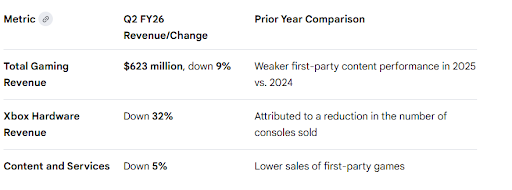
Microsoft’s overall revenue rose 17% in its Q2 FY26, fuelled by cloud growth. However, its gaming division saw a broad decline, with total gaming revenue down 9% and Xbox content and services revenue falling 5% for the quarter ended December 31.
During the earnings call, Microsoft CFO Amy Hood revealed that Xbox content and services revenue declined 5% year over year and was below estimates. According to Microsoft, the decrease was caused by a dearth of Xbox first-party content that affected the entire platform.
Xbox hardware revenue dropped 32%, while Microsoft gaming revenue dropped 9%. Citing “strong content performance” from the previous year as a benchmark, the company projects Xbox content and services revenue to drop in the mid-single digits in the third quarter.
Microsoft stated that Xbox Game Pass growth is anticipated to partially offset the decline. In Q3, the Xbox parent company anticipates a greater year-over-year fall in hardware revenue. Xbox Game Pass growth for the quarter was not disclosed by the firm.
Microsoft is “committed to delivering great games across Xbox, PC, cloud, and every other device,” according to CEO Satya Nadella. Additionally, he stated that Xbox paid streaming hours and PC gamers reached all-time highs in the third quarter.
The Xbox drop contrasted with Microsoft’s overall revenue of $81.3 billion, a 17% year-over-year gain. $38.3 billion was the company’s operational income for the third quarter. Revenue from Microsoft Cloud increased by 26% to $51.5 billion during the quarter.
Microsoft’s personal computer division, which includes gaming, search and news advertising, and Windows OEM and devices, saw a 3% decline. Revenue from Windows OEMs and devices rose by 1%. According to the business, Windows 11 achieved 1 billion users during the quarter, an increase of more than 45% from the previous year.
The important insight from the earnings call outlined the following:
The Overall Business Performance: Despite the downturn in gaming, Microsoft’s overall revenue increased by 17% to $81.3 billion, primarily due to its cloud (Azure) and artificial intelligence (AI) divisions.
The Reasons for Decline: The weaker first-party content sales in late 2025 compared to a better lineup the year before, along with the ongoing decline in console sales, were the main causes of the decline in gaming revenue.
Future Strategy: Microsoft is concentrating on building its ecosystem by adding more games to PCs and other consoles like PlayStation, as well as increasing its Game Pass subscription service, even though it anticipates that hardware income will continue to decline.
Stock Reaction: Despite an overall earnings beat, Microsoft shares dropped in after-hours trading. Investors were concerned about the gaming division’s performance and the company’s high AI infrastructure spending.
We use cookies to ensure that we give you the best experience on our website. If you continue to use this site we will assume that you are happy with it.