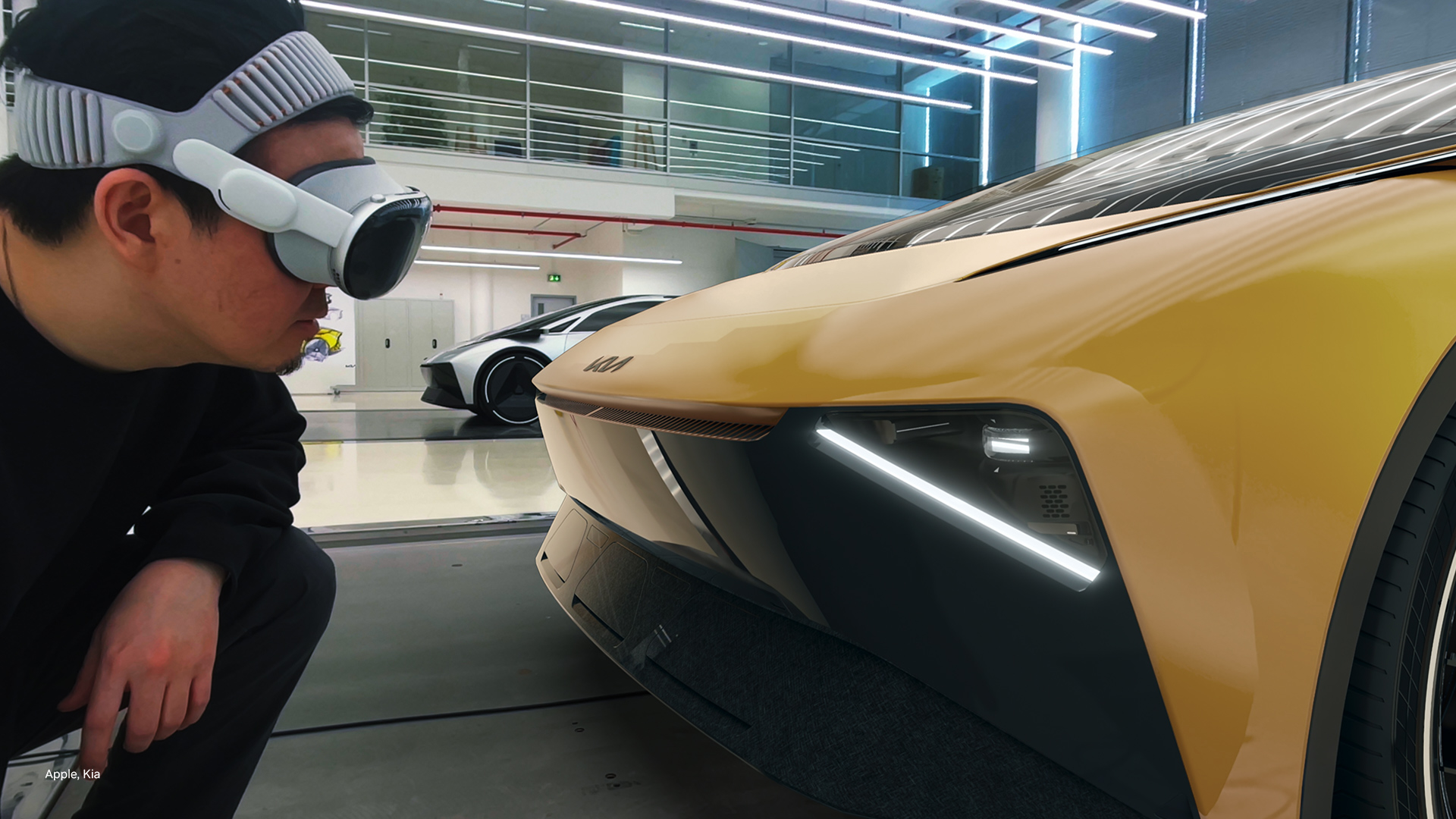
Announced during NVIDIA’s GTC conference in San Jose, the collaboration means Apple Vision Pro owners can stream demanding simulators and professional 3D applications from NVIDIA RTX hardware including RTX workstations and GeForce RTX GPUs while maintaining 4K visuals, low latency and full immersion.
CloudXR 6.0 for visionOS enables Vision Pro to serve as a front end for RTX-powered workloads running locally or in the cloud. NVIDIA describes use cases ranging from digital twins of AI factories and healthcare labs, to extended reality automotive design, to high-resolution racing simulations.
The integration supports foveated streaming on Apple Vision Pro, a technique that adjusts rendering quality based on where the user is looking. According to NVIDIA, dynamic foveated streaming, enabled by CloudXR 6.0 and visionOS 26.4, concentrates maximum visual fidelity at the user’s focus point while improving performance and bandwidth efficiency.
NVIDIA emphasizes that approximate gaze data is never exposed to the application layer, aiming to protect user privacy while still delivering the ultra-low latency needed for comfortable, photorealistic experiences.
Apple’s senior director of the vision products group, Jeff Norris, said Apple Vision Pro is enabling professionals to “visualize, collaborate and work with extraordinary fidelity,” and framed the partnership as a way to accelerate work in sectors including automotive design, healthcare and aviation.
A growing ecosystem of software providers and enterprises is already building around CloudXR for visionOS. NVIDIA highlights support from:
Autodesk – with Immersive for Autodesk VRED, enabled by Innoactive’s XR streaming solutions, to bring automotive design reviews into spatial computing.
Innoactive – offering enterprise XR streaming that delivers workstation-class visualization directly to spatial devices such as Apple Vision Pro for product showrooms, design reviews and digital twins.
Synopsys, Trifork, X-Plane and iRacing – using the integration to bring simulation and visualization workloads to Vision Pro.
Enterprises already working with the new tooling include healthcare, manufacturing, automotive and data center players. NVIDIA says the integration gives these organizations a way to view massive 3D assets and complex simulations on Vision Pro without aggressively simplifying models a common compromise on untethered devices until now.
Automotive brands are a major focus area. Immersive for Autodesk VRED, expected later this spring, is designed to support automotive giants such as BMW Group, Kia, Rivian and Volvo Group. Designers can visualize large-scale models with RTX-powered ray tracing at true-to-life 1:1 scale on Apple Vision Pro.
Thomas Heermann, vice president of automotive design at Autodesk, said combining VRED, NVIDIA CloudXR, Apple Vision Pro and Innoactive’s app expertise enables immersive, real-time collaboration without traditional high-end fixed setups. He framed automotive design reviews as high-stakes sessions that benefit from faster iteration and less infrastructure overhead.
Karim Habib, executive vice president and head of Kia Global Design, said CloudXR for visionOS lets Kia teams evaluate full-size designs with more clarity and speed on Apple Vision Pro, experiencing proportions, surfaces, colours and materials together in a shared physical space while collaborating across global teams.
At Volvo Group Design, Mikael Gordh, head of Volvo Group Design, said the team works “digitally first,” building physical prototypes only when essential. He described spatial computing with Apple Vision Pro and CloudXR as a way to experience everything users see and touch years earlier in the process, aiming for “premium experiences through seamless collaboration.”
Beyond automotive, other early adopters include:
Roche – using Autodesk Revit, NVIDIA Omniverse libraries and CloudXR for visionOS, in collaboration with Innoactive, to simulate layouts for biofluid analysis labs in spatial computing before construction.
Foxconn – using CloudXR for visionOS to visualize factory-floor walkthroughs, letting designers explore and optimize facilities virtually before visiting the physical site.
MHP – a management and IT consultancy for mobility and manufacturing, combining Synopsys Ansys Discovery 3D product simulation software, NVIDIA Omniverse and Innoactive Spatial with CloudXR for real-time aerodynamic airflow simulations.
Switch – collaborating with Trifork on an Omniverse digital twin of its EVO AI Factories. Via CloudXR for visionOS, operators can step into an immersive spatial environment to monitor and manage complex data centre layouts from anywhere.
For simulation enthusiasts outside of enterprise, CloudXR for visionOS also connects RTX-powered titles like iRacing and X-Plane to Apple Vision Pro. NVIDIA positions this as a route to “ultimate” simulation rigs with uncompromised 4K resolution in a fully immersive environment.
One of the key technical benefits NVIDIA highlights is the ability to keep full-fidelity 3D assets intact. Previously, to run rich content on untethered devices, developers often had to degrade or heavily simplify datasets. By offloading rendering to RTX systems and streaming to Vision Pro, CloudXR for visionOS is designed to preserve visual quality while cutting the extra work required to maintain separate, reduced-detail models.
Swift Developers Get Native CloudXR Framework
CloudXR 6.0 now ships as a native streaming framework for Swift, Apple’s primary programming language across its platforms. That means visionOS, iOS and iPadOS developers can integrate high-fidelity streaming into their apps directly from Xcode, Apple’s IDE for building, testing and distributing apps.
According to NVIDIA, Swift developers can “stream and build high-fidelity, consumer and enterprise apps right out of the box” using this framework. Support for CloudXR streaming arrives alongside visionOS 26.4, with NVIDIA stating that the updated OS and compatible apps will become available to users this spring.
NVIDIA positions the CloudXR–Vision Pro integration as a foundation for “collaborative, multi-location deployments” in XR, where performance, control and scalability are critical. As enterprises move beyond single-headset pilots, the combination of RTX rendering, visionOS spatial computing and Swift-native streaming aims to make Apple’s headset a front end for everything from car design studios to AI factory digital twins.
Paul Balo is the founder of TechBooky and a highly skilled wireless communications professional with a strong background in cloud computing, offering extensive experience in designing, implementing, and managing wireless communication systems.
We use cookies to ensure that we give you the best experience on our website. If you continue to use this site we will assume that you are happy with it.