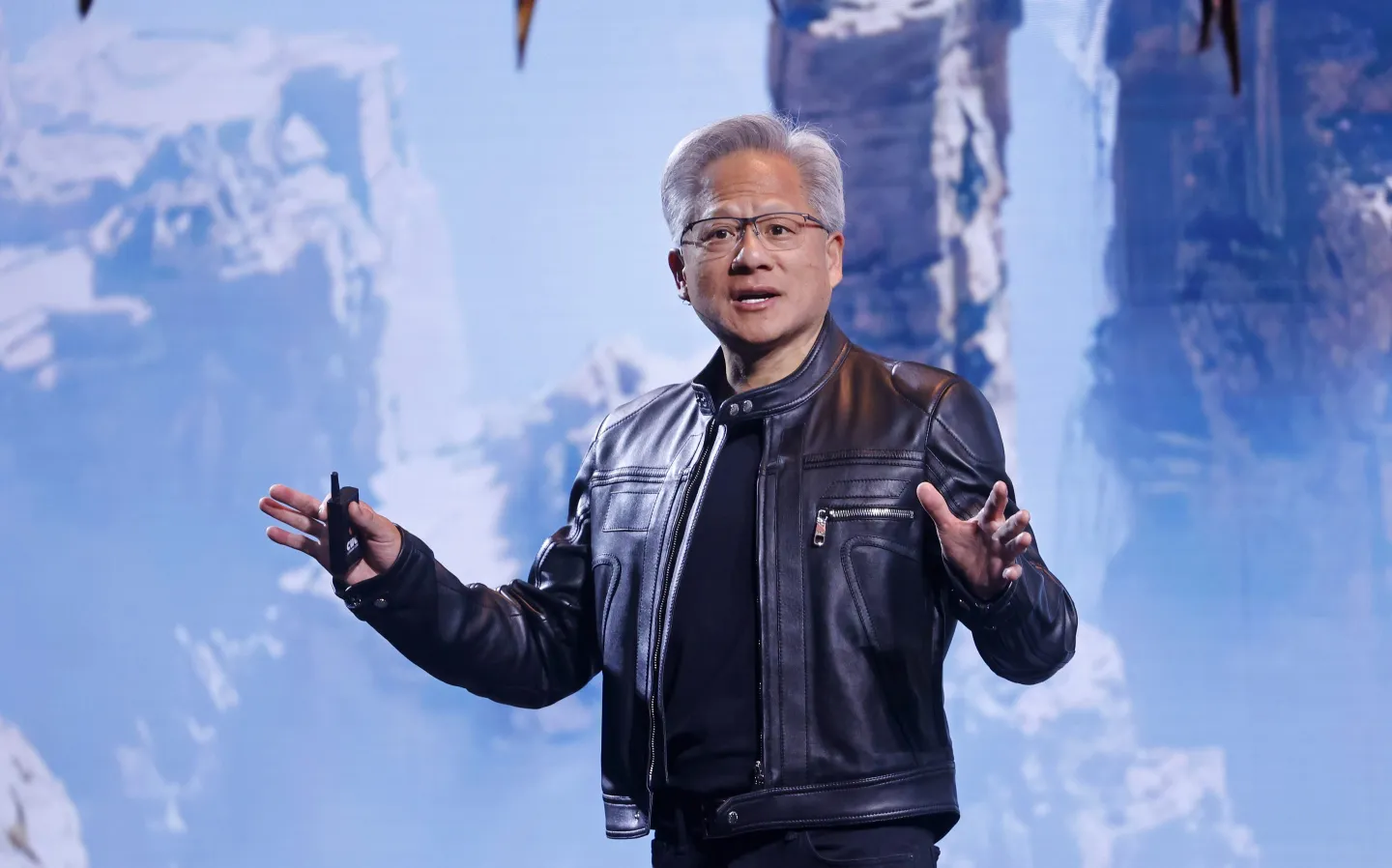
Nvidia CEO Jensen Huang is pushing back against growing fears that artificial intelligence will hollow out the workforce, arguing instead that AI is already acting as a powerful job creator.
Speaking in a conversation with MSNBC’s Becky Quick at an event hosted by the Milken Institute, Huang said he believes concerns about AI-driven mass unemployment are overstated. Rather than being a “harbinger of mass unemployment,” he described AI as an industrial-scale generator of new work.
Economic anxiety around AI’s rapid rollout framed much of the discussion. Quick raised a question that has become central to the public debate: with AI advancing so quickly, could it cause a deeper kind of economic dislocation than past technological shifts, and lead to greater inequality?
Huang repeatedly returned to an optimistic view. “AI creates jobs,” he said during the session, adding that he sees AI as the United States’ “best opportunity to re-industrialize” itself.
He pointed to the physical backbone of the AI boom: industrial facilities that produce the specialized hardware underpinning modern AI systems. Those factories, he argued, are a new class of industrial operation and require significant human labour. Beyond manufacturing, he suggested that the broader AI ecosystem is “blossoming” and will demand workers across its value chain. Nvidia, which dominates the market for AI accelerators, is a major supplier of that hardware.
A key part of Huang’s case rests on distinguishing between automating tasks and eliminating entire roles. He argued that people who assume AI will simply replace workers misunderstand the difference between the “purpose” of a job and the discrete tasks that make it up.
In his view, automating a particular task does not automatically erase the broader function a worker serves inside an organization. Even if AI systems take over specific activities, he suggested that the role itself — and the need for human judgment and coordination can remain.
Huang also criticized more extreme warnings that AI could dominate humanity or wipe out huge swaths of the economy. He said he is worried that “science fiction” narratives about AI could backfire by turning the public away from the technology altogether.
“My greatest concern is that we scare… people, all the people that we’re telling these science fiction stories to, to the point where AI is so unpopular in the United States, or people are so afraid of it, that they don’t actually engage it,” he said.
The irony, he noted, is that much of the so-called “doomer” rhetoric has come from within the AI industry itself. Critics of this trend argue that alarmist claims about near-future superintelligence double as a marketing tactic, designed to build hype around products that do not yet match those dramatic capabilities.
Despite Huang’s optimism, the longer-term impact of AI on employment and inequality is still uncertain. Financial and academic institutions have published analyses suggesting that AI could eliminate as much as 15% of jobs in the United States over the next several years. Those projections underline the scale of potential disruption, even if new roles emerge elsewhere in the economy.
Huang’s comments land in the middle of that tension: between models that predict large-scale job losses and a tech industry narrative that emphasizes productivity, new industries and, in Nvidia’s case, a new wave of industrial investment.
Related Reading
More contextual TechBooky stories selected from tags, categories and article context.
Paul Balo is the founder of TechBooky and a highly skilled wireless communications professional with a strong background in cloud computing, offering extensive experience in designing, implementing, and managing wireless communication systems.
We use cookies to ensure that we give you the best experience on our website. If you continue to use this site we will assume that you are happy with it.