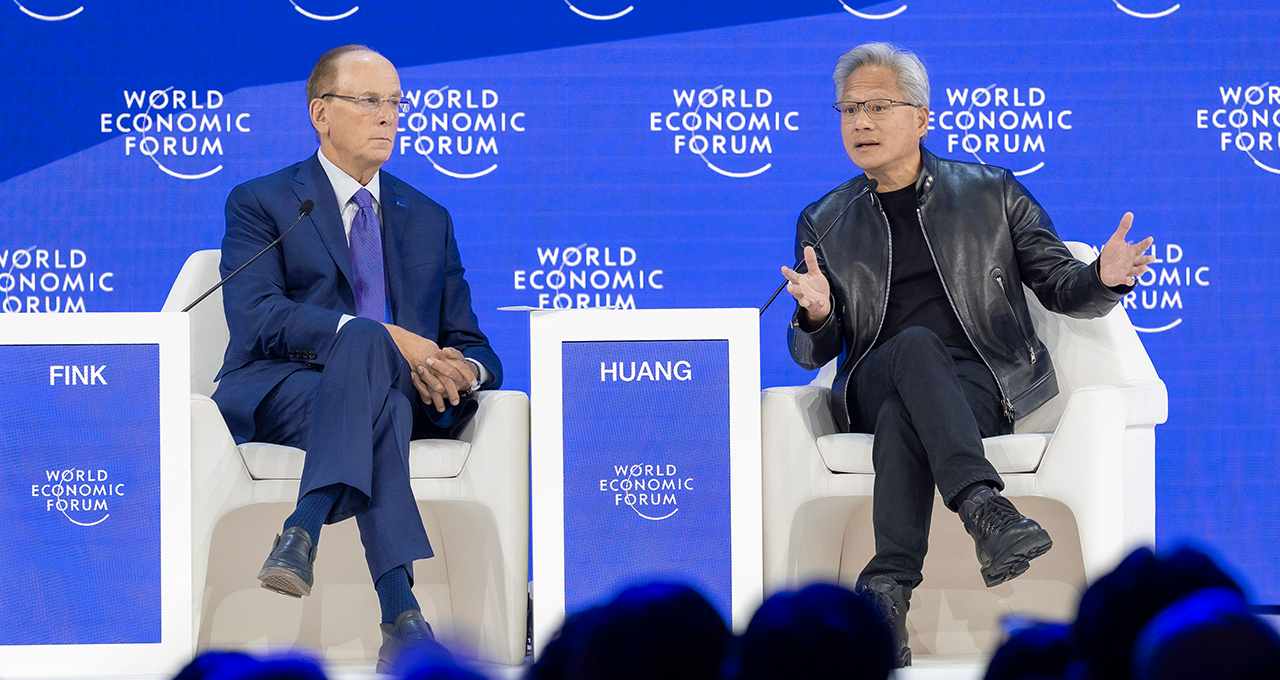
At this year’s World Economic Forum in Davos, NVIDIA founder and CEO Jensen Huang characterized artificial intelligence as underpinning what he termed “the largest infrastructure buildout in human history.” In a discussion with BlackRock CEO Larry Fink, Huang outlined a framework describing AI as a “five-layer cake” spanning from energy and computing infrastructure to AI models and applications.
Huang emphasized that AI is not just a singular technology but a multi-layered platform shift requiring extensive development across various sectors. The layers include energy production, semiconductor manufacturing, data centres, AI model creation, and finally, the application layer, where AI solutions are integrated into industries such as financial services, healthcare, and manufacturing.
This expansive buildout is already driving substantial job growth in areas such as energy, construction, manufacturing, cloud operations, and software development. Huang highlighted that the AI-driven transformation is increasing demand for skilled labour, including plumbers, electricians, steelworkers, and network technicians responsible for deploying and maintaining AI infrastructure.
Counter to concerns about job displacement, Huang argued that AI is creating new roles and enhancing productivity across professions. For example, in radiology, AI accelerates image analysis allowing radiologists to spend more time with patients, thus expanding the need for their expertise. Similarly, nursing faces a shortage of around 5 million in the U.S., a challenge partially addressed by AI assisting with administrative tasks such as charting and transcription, which improves efficiency and enables healthcare providers to hire more staff.
Huang framed AI as a tool that helps workers focus on the core purpose of their jobs rather than routine tasks. He illustrated this by comparing himself and Fink to typists whose work would not be eliminated by automation because typing is not the essence of their roles. Instead, AI amplifies human productivity and value.
He also positioned AI as essential national infrastructure on par with electricity and roads, urging countries to develop localized AI tailored to their languages and cultures and to consider AI a strategic asset integral to national intelligence and economic ecosystems.
Addressing accessibility, Huang stressed that AI is among the easiest software tools ever created, already reaching nearly a billion users within a few years. He noted that AI literacy including direct usage, management, evaluation, and ethical considerations is becoming a fundamental skill akin to leadership and people management.
For developing economies, Huang expressed optimism that AI could help bridge existing technology gaps given its accessibility and scalability. Highlighting Europe’s manufacturing strengths, he cited an opportunity to combine industrial capabilities with AI and robotics, describing robotics as a “once-in-a-generation opportunity.”
On investment trends, Huang pointed out that 2025 saw record venture capital funding worldwide, surpassing $100 billion largely directed towards AI-native startups across healthcare, robotics, manufacturing, and financial services. These startups are focused on building the AI application layer and will require substantial infrastructure and continued investment to realize future growth.
Fink summarized the discussion by proposing that the question is not whether AI is a bubble but whether investment in it is sufficient to meet the opportunity. He advocated for broad participation in AI-driven growth, highlighting the importance of pension funds and ordinary savers having access to AI-related investments to avoid exclusion from the economic benefits of AI.
Huang concluded with an open call for inclusivity in the AI future, reinforcing that the scale of the infrastructure buildout demands cross-sector collaboration and investment from governments, industries, and capital markets alike.
Paul Balo is the founder of TechBooky and a highly skilled wireless communications professional with a strong background in cloud computing, offering extensive experience in designing, implementing, and managing wireless communication systems.
We use cookies to ensure that we give you the best experience on our website. If you continue to use this site we will assume that you are happy with it.