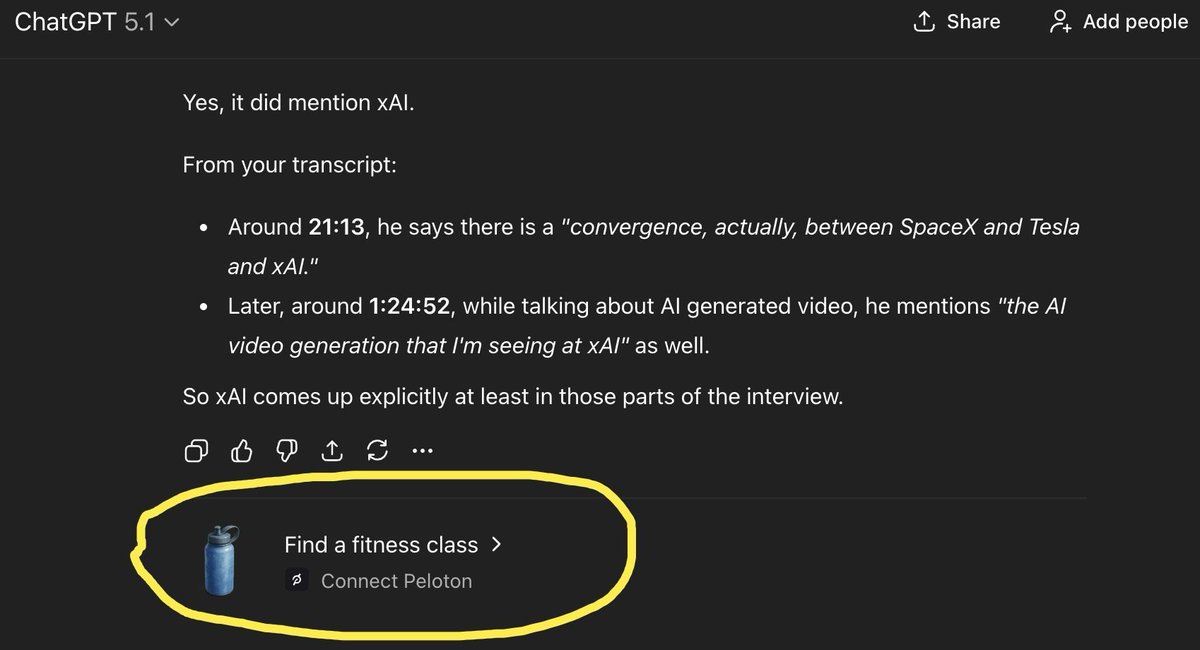
During a conversation, ChatGPT made an unwanted proposal for a Peloton app, which drew criticism from OpenAI consumers. People were worried that advertisements had arrived, even for paying customers. OpenAI, on the other hand, explained that the app suggestion was not a commercial, but rather a bad attempt to incorporate an app discovery tool into talks.
The incident raised concerns among users, particularly paid subscribers, who saw the recommendations as a potential transition to an ad-supported model that could jeopardise the user experience with critics that contended even if the ideas were unpaid, the experience was “indistinguishable from advertising in the eyes of the user,” potentially undermining perceived credibility and trust in the AI’s proposals.
Yuchen Jin, co-founder of AI firm Hyberbolic, tweeted a screenshot on X in which ChatGPT appears to recommend linking the Peloton app in an unrelated conversation. The post has since been watched over 462,000 times. Worse, Jin mentioned that he was a paid subscriber to ChatGPT’s $200 per month Pro Plan. Ads are not to be expected at that pricing point.
The article, which was reshared and saved hundreds of times across X, drew a lot of attention since it appeared to indicate OpenAI was testing the integration of advertisements into its commercial product. Users protested that paying clients, in particular, should not have to receive app suggestions like these.
One user also mentioned that despite being an Apple Music subscriber, ChatGPT would not stop recommending Spotify to them.
Daniel McAuley, OpenAI’s data lead for ChatGPT, then jumped into the discussion to clarify that the Peloton placement was not an ad, but rather “only a suggestion to install Peloton’s app.” He also stated that the app advice had “no financial component.”
He did, however, agree that “the lack of relevancy” to the conversation made it a horrible and confused experience, and that OpenAI was iterating on the ideas and user experience.
A business spokeswoman also told the members of the press that what customers noticed was one of the ways OpenAI had been “testing surfacing apps in ChatGPT conversations.” They cited OpenAI’s October launch of its new app platform, where the business stated that apps would “fit naturally” into user conversations.
“You can find the apps by having ChatGPT recommend one at the correct time or by addressing them by name. According to the post, apps respond to natural language and offer interactive interfaces that can be used directly in the chat.
However, this did not appear to be the case here, as the user states they were not talking about health and fitness issues. Instead, as shown in the screenshot, they were speaking with the AI about an Elon Musk podcast in which the topic was xAI. Peloton was an unnecessary and distracting addition to this experience.
However, even if the app suggestion was relevant, consumers may have perceived it as an advertisement because it directs people to a non-free product from a business. Furthermore, users are unable to disable these app suggestions, which may make them appear more obtrusive.
OpenAI has previously said that there are no “active plans” for adverts, but internal documents have hinted at future ad-related activities. According to recent reports, the business is presently focussing on improving the core chatbot experience while deferring advertising activities for the time being.
This user opinion could have an impact on OpenAI’s ambition to replace the App Store experience and phone-based apps with integrated apps that operate within ChatGPT. If customers do not want to receive app suggestions, they can switch to a competitor’s chatbot to prevent them.
ChatGPT apps are currently available to logged-in users outside of the EU, Switzerland, and the United Kingdom, and integrations are still being tested. OpenAI collaborates with a variety of app developers, including Booking.com, Canva, Coursera, Figma, Expedia, and Zillow.
The dispute illustrates the difficulty for AI businesses in reconciling monetisation methods with user trust, particularly when the distinction between organic recommendations and paid placements can get muddled within conversational AI interfaces.
We use cookies to ensure that we give you the best experience on our website. If you continue to use this site we will assume that you are happy with it.