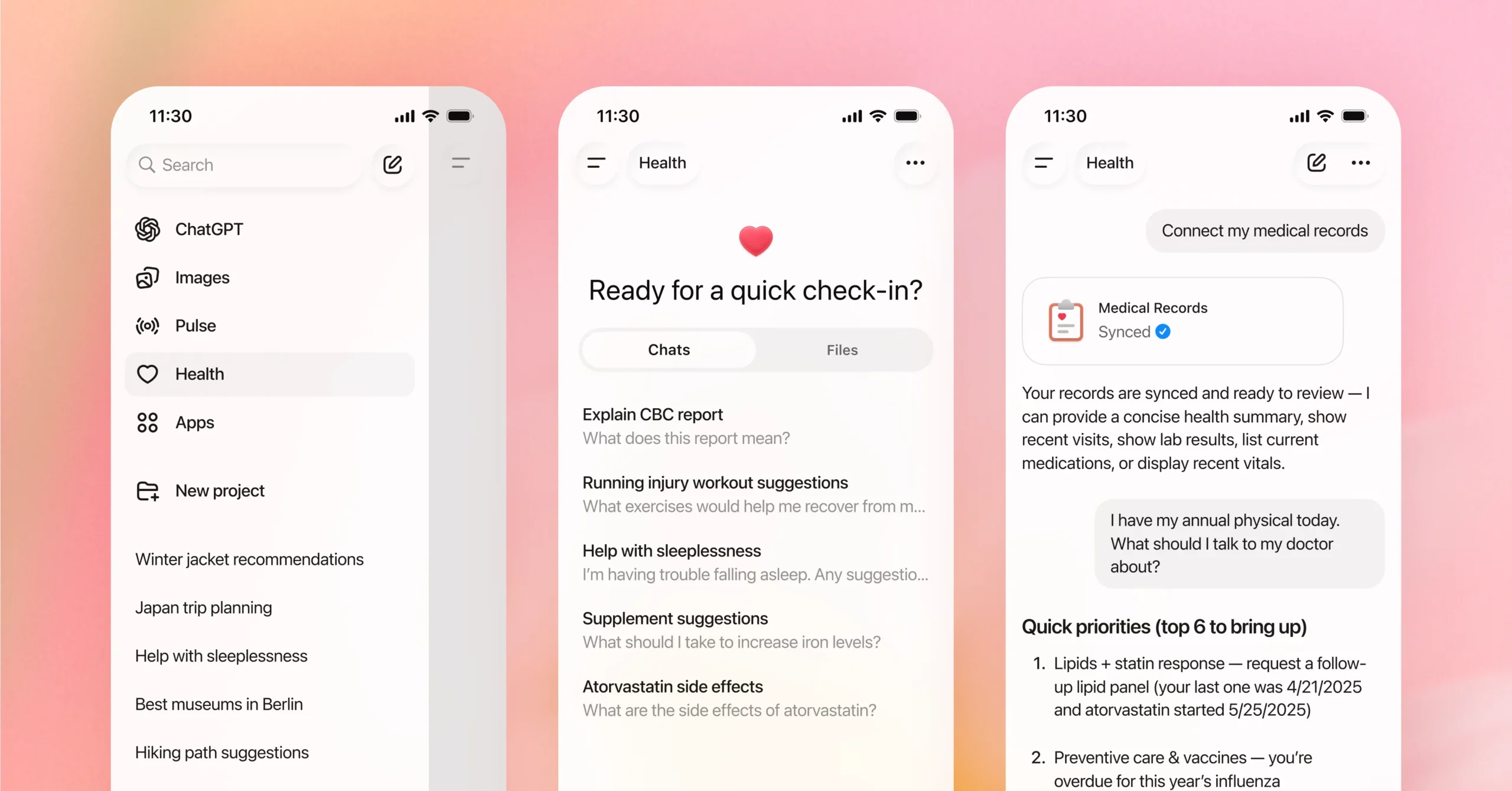
On Wednesday, OpenAI unveiled ChatGPT Health, a brand-new platform for discussions on healthcare. The San Francisco-based artificial intelligence (AI) giant has expanded its capabilities, adding multilayer protection for the area, and connected third-party wellness apps. It is intended for consumers who want a more consistent and integrated experience when asking the chatbots questions regarding their test results, medical appointments, diet and exercise recommendations, and health insurance. A bigger deployment is anticipated in the upcoming months, and the corporation is presently conducting a pilot test.
ChatGPT Health is a specialised, high-security environment within the ChatGPT ecosystem which is intended to customise health and wellness management, was formally introduced by OpenAI. Targeting the 230 million users who already ask health-related enquiries on the platform on a weekly basis, this specialised tool is OpenAI’s biggest direct entry into the consumer healthcare sector.
The AI giant revealed and explained the new feature in ChatGPT in a blog post. A limited number of people will get early access to the feature thanks to OpenAI. Those who are interested can join the waitlist by clicking this link, here. Users can still ask questions about healthcare in regular chats, but the business has not yet disclosed a global rollout date.
The new experience coincides with a high volume of health-related enquiries on ChatGPT; according to OpenAI, hundreds of millions of enquiries concerning health and wellbeing are already made every week. In order to lower the danger of sensitive data exposure, ChatGPT Health provides a distinct workspace within the platform where health chats, linked apps, and files are separated from standard chat history, according to the business. This incorporates multi-layered safeguards that surpass OpenAI’s current security measures, like data isolation and specially designed encryption.
In order to anchor ChatGPT’s comments in their personal health context, users will be able to integrate electronic medical records and wellness apps like Apple Health, Function, MyFitnessPal, and others. According to the AI giant, by utilising this data, the system can assist users in comprehending test results, getting ready for clinical visits, monitoring health trends like sleep or activity patterns, talking about diet and exercise regimens, and even comparing health insurance options based on personal care patterns.
ChatGPT Health is intended to support users in interpreting health data and engaging with their care, not to replace licensed medical advice or diagnoses, the company said.
The essence of this comes down to conversations on health which are ring-fenced in a different area with their own memory and built-in encryption. Importantly, OpenAI declared that model training does not incorporate health data in this domain.
The service provides users with personalised diet or exercise recommendations based on their unique health context, helps them comprehend medical test results, and helps them get ready for doctor’s consultations with pertinent questions.
With the user of the HealthBench, which is a tool created in partnership with hundreds of doctors in dozens of specialities, is used to evaluate a specialised OpenAI health model that powers the responses.
According to Fidji Simo, CEO, Applications at OpenAI, “ChatGPT Health is another step towards turning ChatGPT into a personal super-assistant that can support you with information and tools to achieve your goals across any part of your life.”
Beyond basic ChatGPT security, OpenAI also detailed the measures it is taking to safeguard private health information. Conversations about health and related files are encrypted during transmission and storage, and they are kept apart from the user’s other chat memories. According to the company, Health expands upon its current privacy architecture, which currently offers default safeguards against training models on personal data and the ability to remove conversations after 30 days. To improve account access, it also incorporates safeguards like multi-factor authentication. According to the post, OpenAI’s foundation models are not trained using conversations or data from ChatGPT Health.
Also OpenAI has clearly made it known that, the ChatGPT Health should not be used in place of expert medical judgement and is not meant for diagnosis or treatment. It is intended to be a helpful tool for “everyday health” in order to enhance patient readiness and health literacy.
Currently it is accessible to a small number of early adopters, wider web and iOS availability is anticipated in the upcoming weeks. Users in the UK, Switzerland, and the European Economic Area (EEA) are not included in the initial launch due to data protection rules.
We use cookies to ensure that we give you the best experience on our website. If you continue to use this site we will assume that you are happy with it.