OpenAI has introduced GPT-5.4 mini and GPT-5.4 nano, two new smaller versions of its latest GPT-5.4 artificial intelligence model aimed at delivering faster performance and lower operating costs for developers and businesses.
The new models are designed to make advanced AI capabilities more accessible while still retaining many of the core strengths of OpenAI’s flagship GPT-5.4 system.
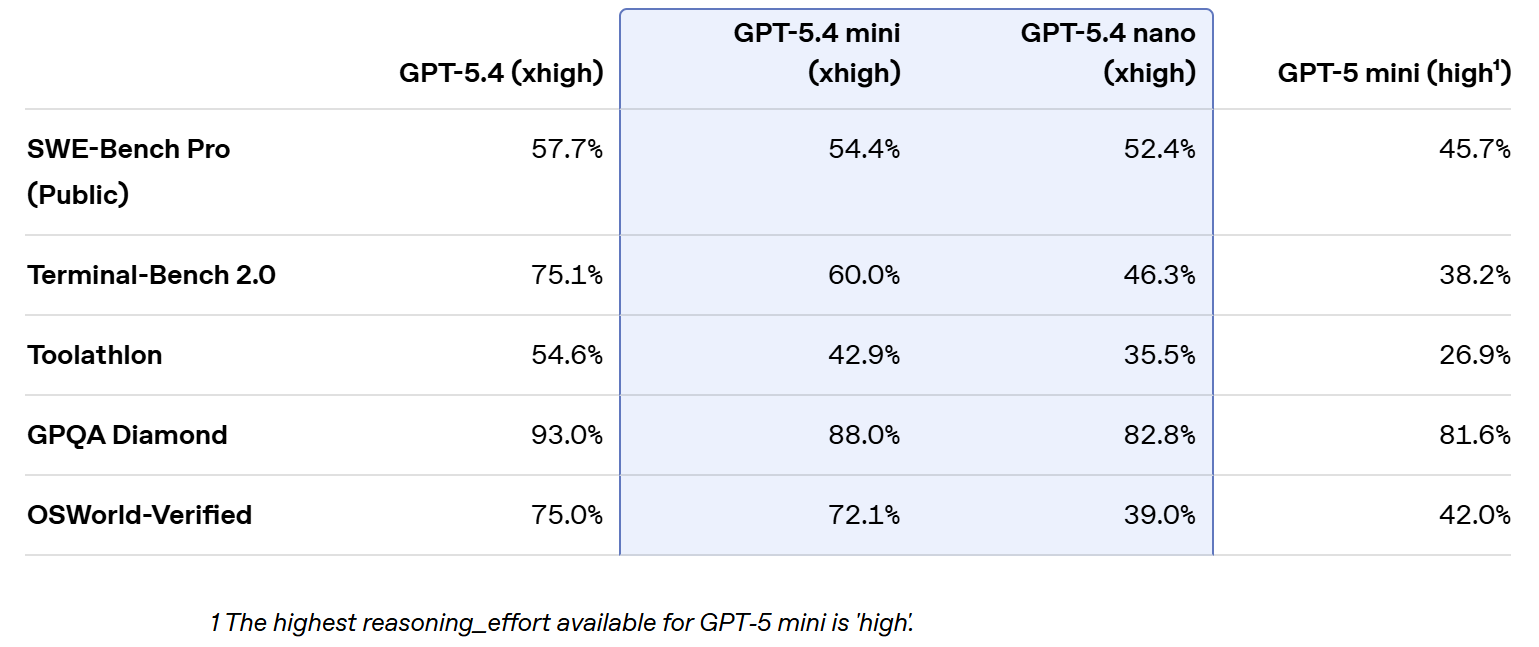
GPT-5.4 mini, the more capable of the two, focuses on tasks such as coding, reasoning, multimodal understanding, and tool use, while maintaining significantly faster response times than earlier models.
According to OpenAI, the model delivers major improvements over the previous GPT-5 mini version and in some benchmarks approaches the performance of the larger GPT-5.4 model used for more complex workloads.
The release reflects a growing trend in AI development: building smaller, more efficient models that can handle everyday tasks without requiring the massive computing power used by flagship systems.
OpenAI says GPT-5.4 mini can run more than twice as fast as earlier versions, making it suitable for applications where response speed is critical.
Meanwhile, GPT-5.4 nano is the smallest and cheapest variant in the GPT-5.4 family. It is optimized for lightweight workloads such as:
data classification
information extraction
ranking and filtering
simple coding tasks
Because of its small footprint and low cost, GPT-5.4 nano is designed primarily for developers building high-volume automated systems or AI sub-agents.
Lower prices for developers
Pricing is another major focus of the release.
OpenAI says GPT-5.4 mini costs roughly $0.75 per million input tokens and $4.50 per million output tokens, while GPT-5.4 nano is significantly cheaper at about $0.20 per million input tokens and $1.25 per million output tokens.
Lower pricing is expected to encourage developers to build more AI-driven applications while reducing the cost of running large-scale AI systems.
OpenAI says GPT-5.4 mini is now available in ChatGPT, Codex, and the OpenAI API, while GPT-5.4 nano is currently available through the API for developers building custom applications.
Within ChatGPT, the mini model is being introduced as part of the “Thinking” feature, allowing users to access improved reasoning capabilities even without using the most powerful models.
The new models are part of the broader GPT-5.4 family, which OpenAI launched earlier in 2026 with a focus on improved factual accuracy and real-world productivity tasks.
The flagship GPT-5.4 model includes features such as native computer-use capabilities, allowing AI systems to interact with software interfaces, perform actions on websites, and automate workflows.
In internal testing, OpenAI said GPT-5.4 reduces factual errors by 33% compared with GPT-5.2, highlighting the company’s efforts to improve reliability in AI systems.
By introducing smaller, cheaper models alongside its flagship systems, OpenAI is aiming to support a broader ecosystem of AI applications from lightweight automation tools to complex enterprise-grade AI systems.
The strategy mirrors a wider shift across the AI industry, where companies are releasing multiple model tiers designed for different workloads, performance levels, and cost constraints.
For developers and businesses adopting AI at scale, models like GPT-5.4 mini and nano could make it easier to integrate AI into everyday products without the high computing costs typically associated with large language models.
Paul Balo is the founder of TechBooky and a highly skilled wireless communications professional with a strong background in cloud computing, offering extensive experience in designing, implementing, and managing wireless communication systems.
We use cookies to ensure that we give you the best experience on our website. If you continue to use this site we will assume that you are happy with it.