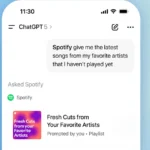
On Wednesday, OpenAI began letting developers to submit applications directly through ChatGPT for evaluation and publication purposed. As a result, developers of third-party apps can now start the process of integrating their apps into the chatbot and allowing its artificial intelligence (AI) agent to use the interface to do specific tasks. These apps, together with desktop and mobile apps, will be displayed in a new ChatGPT app directory on the website if they are approved. It’s interesting to note that the news was made a few days after an executive of the firm stated that the AI giant intended to transform the chatbot into an operating system.
The San Francisco-based AI company announced in a post that the developers can now submit their apps to ChatGPT for assessment and publication. After these apps are published, users of ChatGPT will be able to write text instructions about tasks, and an AI agent will take care of them. The startup highlights a number of use scenarios, such as placing grocery orders, creating a slide deck from an outline, and looking for a flat.
The company initially unveiled this feature at its DevDay event in October. Adobe, Booking.com, Canva, Expedia, Figma, Instacart, Lovable, Spotify, Target, and many more apps are currently compatible with ChatGPT. To access these, users can navigate to the Apps area by tapping on the side bar.
The Apps SDK, which is presently in beta and intended for creating chat-native experiences that integrate into the ChatGPT interface, is where developers start. To aid developers, the company has released tools such as an open-source UI library, sample applications, and best practices. A developer can submit an app for approval after finishing the build and testing it on the Developer Platform Dashboard. Apps can be approved and published if they adhere to the quality, safety, and privacy criteria outlined in the rules.
It is notable to note that developers must publish explicit privacy policies in every app and only request the data essential for the app to operate. ChatGPT presents the app’s privacy policy and displays the data that may be shared when a user connects to a new app. Apps can be disconnected at any time, which instantly removes the app’s access.
To make sure that security, safety, and privacy regulations are strictly followed, OpenAI will perform both automated scanning and manual checks. Applications that don’t adhere to these guidelines might be turned down or deleted from the directory. The Developer Platform Dashboard allows developers to monitor the status of submissions as well.
According to the AI giant, developers can conduct transactions for tangible commodities on their native apps or through a website outside of ChatGPT. The company intends to provide developers with more advanced revenue streams in the future, such as digital goods revenue.
The most recent app to be added to the ChatGPT app directory is Apple Music. As a result, users can now ask the chatbot to make playlists and locate songs, albums, and artists using straightforward language commands. Fidji Simo, CEO of Applications at OpenAI, also disclosed that Salesforce will be accessible on the chatbot in a Substack post.
To finish transactions for tangible items, developers might link to their own websites or native apps during this first stage known as the monetisation stage. OpenAI is also currently investigating potential future revenue streams for digital goods.
The first time a user connects an app, ChatGPT will ask for their consent. Presently we have been able to see more detailed data restrictions that let users specify precisely what the data, each app can access are anticipated to be implemented.
We use cookies to ensure that we give you the best experience on our website. If you continue to use this site we will assume that you are happy with it.