OpenAI is pushing into one of the most complex and high-stakes industries in the world drug discovery with a new AI model that could significantly change how medicine is developed.
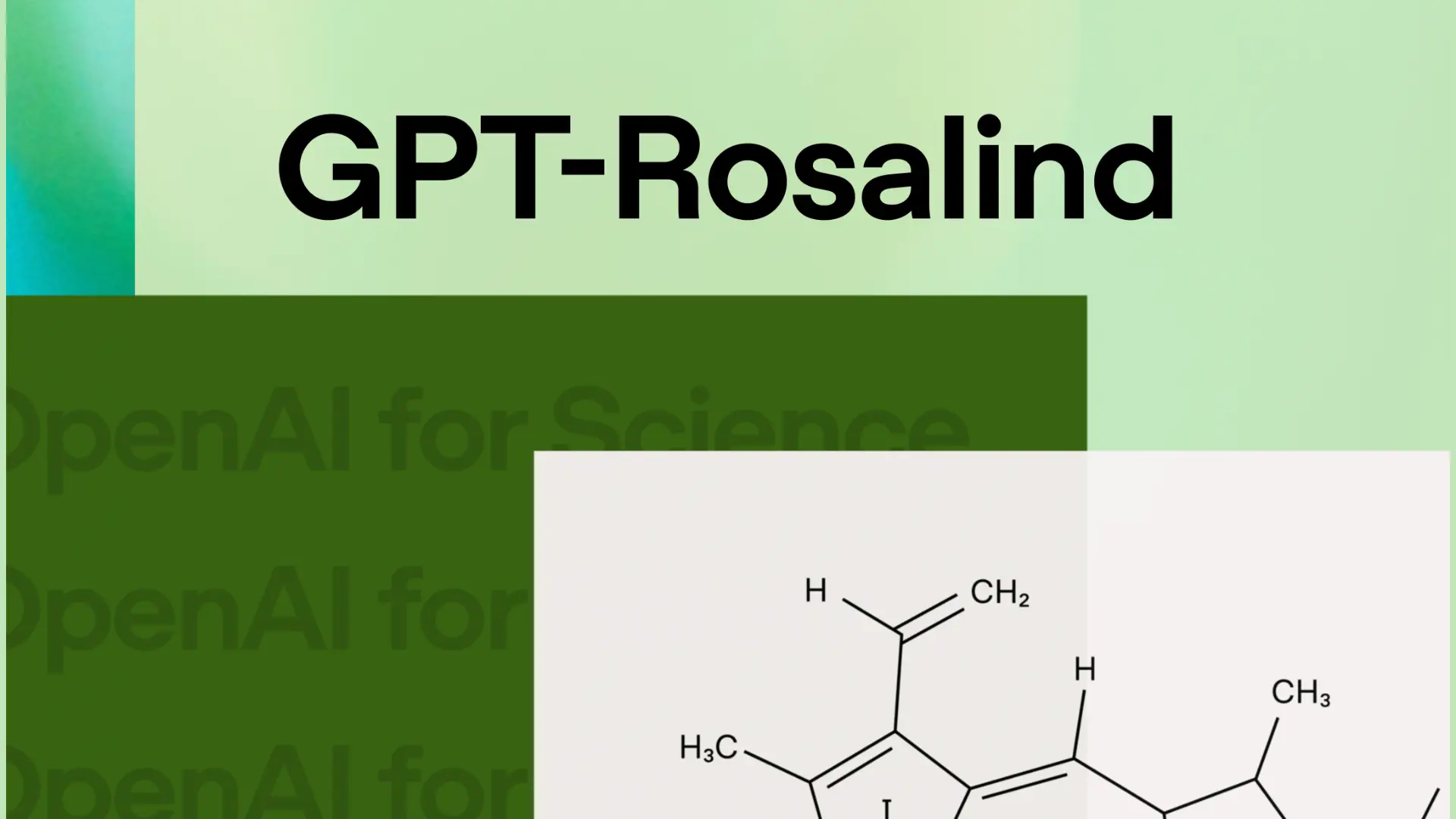
They have introduced GPT-Rosalind, a specialized reasoning model built specifically for life sciences, designed to help researchers navigate everything from molecular biology to experimental design.
Unlike general-purpose AI systems, GPT-Rosalind is tailored for scientific workflows, with deeper capabilities in genomics, protein engineering, chemistry, and disease biology, allowing it to operate across the full early-stage research pipeline.
That focus matters because the biggest bottleneck in drug development isn’t just discovery, it’s complexity.
Today, bringing a new drug to market can take 10 to 15 years, with massive costs and high failure rates, largely due to the difficulty of identifying viable biological targets and designing effective experiments early on.
GPT-Rosalind is designed to attack that exact problem.
It can synthesize large volumes of scientific literature, generate hypotheses, suggest experimental approaches, and even connect insights across datasets that would typically take teams of researchers months or years to fully analyse.
In practical terms, that means scientists can move faster through the earliest and most uncertain stages of research — the point where small improvements can have outsized downstream impact on whether a drug ever reaches patients.
The model is already being tested with major pharmaceutical and biotech players, including Amgen, Moderna, and Thermo Fisher Scientific, as OpenAI works to embed it directly into real-world research workflows.
That level of integration signals something bigger than a typical AI release.
OpenAI isn’t just building tools for developers or enterprises anymore, it’s moving into domain-specific intelligence, where models are trained to operate inside highly specialized fields with their own data, constraints, and risks.
And life sciences may be one of the most important of them all.
The model also introduces a broader ecosystem approach. OpenAI is launching a Life Sciences plugin for Codex, connecting GPT-Rosalind to more than 50 scientific tools and databases, allowing it to move beyond static responses into active, tool-driven research workflows.
That’s a key shift.
Instead of just answering questions, the model can now interact with the same systems researchers use — from literature databases to experimental design tools effectively becoming part of the scientific process itself.
But OpenAI is being careful about how it rolls this out.
GPT-Rosalind is currently available only as a research preview through a trusted access program, meaning only vetted organizations and users can experiment with it for now.
That controlled release reflects a growing awareness across the AI industry: highly capable models in sensitive domains need to be deployed gradually, with safeguards and real-world testing before broader access is granted.
And in life sciences, the stakes are particularly high.
While the potential upside is enormous, faster drug discovery, better treatments, more efficient research there are also risks around accuracy, misuse, and overreliance on automated systems in areas where mistakes can have serious consequences.
Even OpenAI acknowledges that the model is not replacing scientists.
Instead, it is positioned as a force multiplier, helping researchers handle the most complex and time-consuming parts of their work so they can focus on interpretation, validation, and decision-making.
That distinction is important.
Because despite the hype, AI still operates best as a collaborator — not an autonomous scientific authority.
Still, the competitive implications are already emerging.
The launch of GPT-Rosalind places OpenAI directly into a rapidly growing race in AI-driven drug discovery, competing with efforts from companies like Google DeepMind and its spinout Isomorphic Labs, as well as a wave of biotech startups building AI-first research platforms.
And the market is paying attention.
Early reactions suggest that tools like GPT-Rosalind could disrupt parts of the contract research industry particularly in preclinical research by reducing the need for certain types of outsourced analysis and accelerating internal capabilities for pharmaceutical companies.
But the broader story goes beyond competition.
This is part of a larger shift in how AI is evolving.
The industry is moving away from one-size-fits-all models toward highly specialized systems designed for specific domains cybersecurity, finance, healthcare, and now life sciences each with its own rules, risks, and opportunities.
And in that shift, GPT-Rosalind represents something new.
Not just an AI that understands language but one that is beginning to understand biology at a level where it can actively participate in scientific discovery.
That doesn’t mean AI will suddenly start curing diseases on its own.
But it does mean the process of discovering those cures may never look the same again.
Related Reading
More contextual TechBooky stories selected from tags, categories and article context.
Paul Femi Balo is the founder and publisher of TechBooky. He covers artificial intelligence, African technology, digital infrastructure, enterprise technology and the global digital economy.
We use cookies to ensure that we give you the best experience on our website. If you continue to use this site we will assume that you are happy with it.