Six months in, that vision is starting to look… shaky.
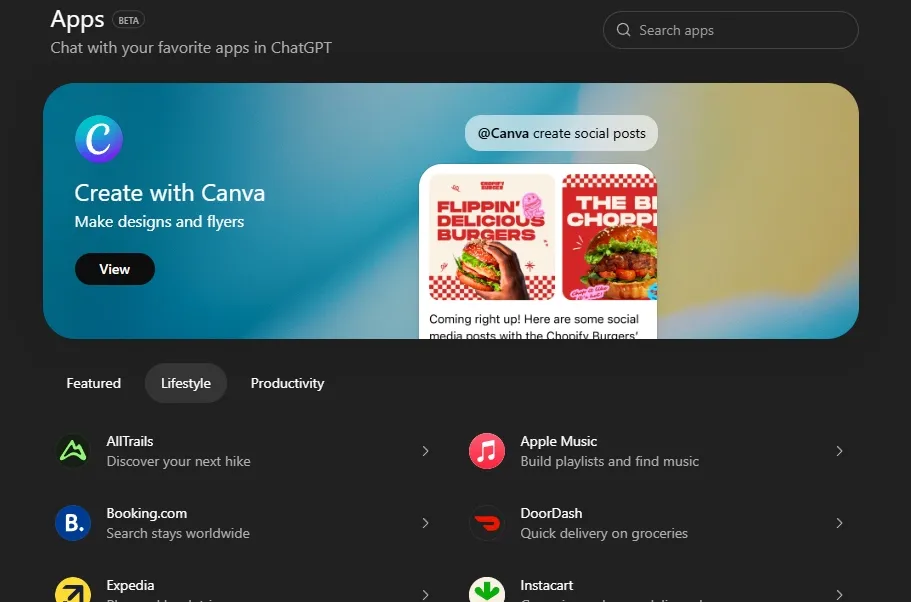
According to recent reporting, the ChatGPT “app store” a marketplace for custom GPT-powered tools has struggled to gain meaningful traction. Developers are frustrated, users aren’t deeply engaged, and many of the apps themselves feel limited in what they can actually do.
That’s a far cry from what an app store is supposed to be.
Because if you think about it, the modern app store isn’t just a distribution channel, it’s an economy. Apple’s App Store generates billions, powers entire companies, and acts as the primary gateway between users and software on mobile devices.
ChatGPT’s version, by comparison, still feels more like a feature than a platform.
And that raises a bigger question: where is the app store in an AI-first world?
The problem starts with functionality.
Traditional apps are persistent, deeply integrated, and often indispensable; think banking apps, ride-hailing, or social media. But many GPT-based “apps” today are lightweight wrappers around prompts. They’re useful in bursts, but rarely something users return to daily.
That makes retention difficult and without retention, there’s no real ecosystem.
Developers are feeling that gap too. Unlike Apple’s App Store, where monetization models are well-defined and scalable, the ChatGPT ecosystem is still figuring out how creators actually make money. Without strong incentives, the quality and depth of apps remain limited.
It’s a classic chicken-and-egg problem.
But there’s something deeper going on.
AI doesn’t behave like traditional software.
In a normal app store, you download different apps for different tasks. In an AI-native world, one intelligent system can potentially handle all of those tasks inside a single interface.
You don’t need 20 apps, you need one assistant.
And that may be the real reason the ChatGPT app store is struggling: it’s trying to replicate a model that AI might ultimately replace.
Even Apple seems to be moving in that direction, reportedly exploring ways to integrate multiple AI systems directly into its ecosystem rather than relying on standalone apps.
At the same time, competition is intensifying. ChatGPT’s dominance in the AI app space is already slipping, with rivals like Google’s Gemini and Elon Musk’s Grok gaining ground.
That puts pressure on OpenAI to rethink its strategy.
Because right now, the ChatGPT app store sits in an awkward middle ground: not powerful enough to replace traditional apps, but not fundamentally different enough to justify a new ecosystem.
And users can feel that.
The irony is that OpenAI may already have the answer.
Instead of building an app store, it may need to build something closer to an “AI operating system”—a single interface that replaces the need for apps altogether. Early signs of that shift are already visible in tools like Codex and agent-based workflows, which aim to execute tasks end-to-end rather than just assist.
If that vision materialises, the concept of an app store could start to fade not because it failed but because it became unnecessary.
For now, though, the ChatGPT app store is a reminder that even the most powerful AI company in the world can’t easily replicate what Apple built over more than a decade.
And in the process, it’s forcing the entire industry to confront a bigger question – in an AI-first world, do we still need app stores at all?
Paul Balo is the founder of TechBooky and a highly skilled wireless communications professional with a strong background in cloud computing, offering extensive experience in designing, implementing, and managing wireless communication systems.
We use cookies to ensure that we give you the best experience on our website. If you continue to use this site we will assume that you are happy with it.