Workspace Agents are available to customers on ChatGPT Business (priced at $20 per user per month) as well as OpenAI’s Enterprise, Edu and Teachers subscription plans, which use variable pricing. The idea is to let organisations design their own agents or pick from pre-built templates, then connect those agents directly into the software where work already happens.
According to OpenAI’s description, Workspace Agents can plug into a wide range of third-party apps and data sources, including Slack, Google Drive, Microsoft apps, Salesforce, Notion, Atlassian Rovo and other popular enterprise tools. Once set up, they can be created and accessed inside ChatGPT, but also added into platforms like Slack so employees can work with them without leaving their usual channels.
In practice, that means staff can message an agent in Slack (or another connected app), ask it to use information from the current channel and other authorised tools, and have it complete tasks such as:
Drafting emails to an entire team or selected members
Pulling data from connected sources
Producing presentations based on that data
OpenAI frames this as a move away from “babysitting” AI agents. Instead of users needing to continuously guide and correct them, Workspace Agents are meant to manage the complexity of hopping between systems, handling context and finishing the job even if the person who made the request steps away.
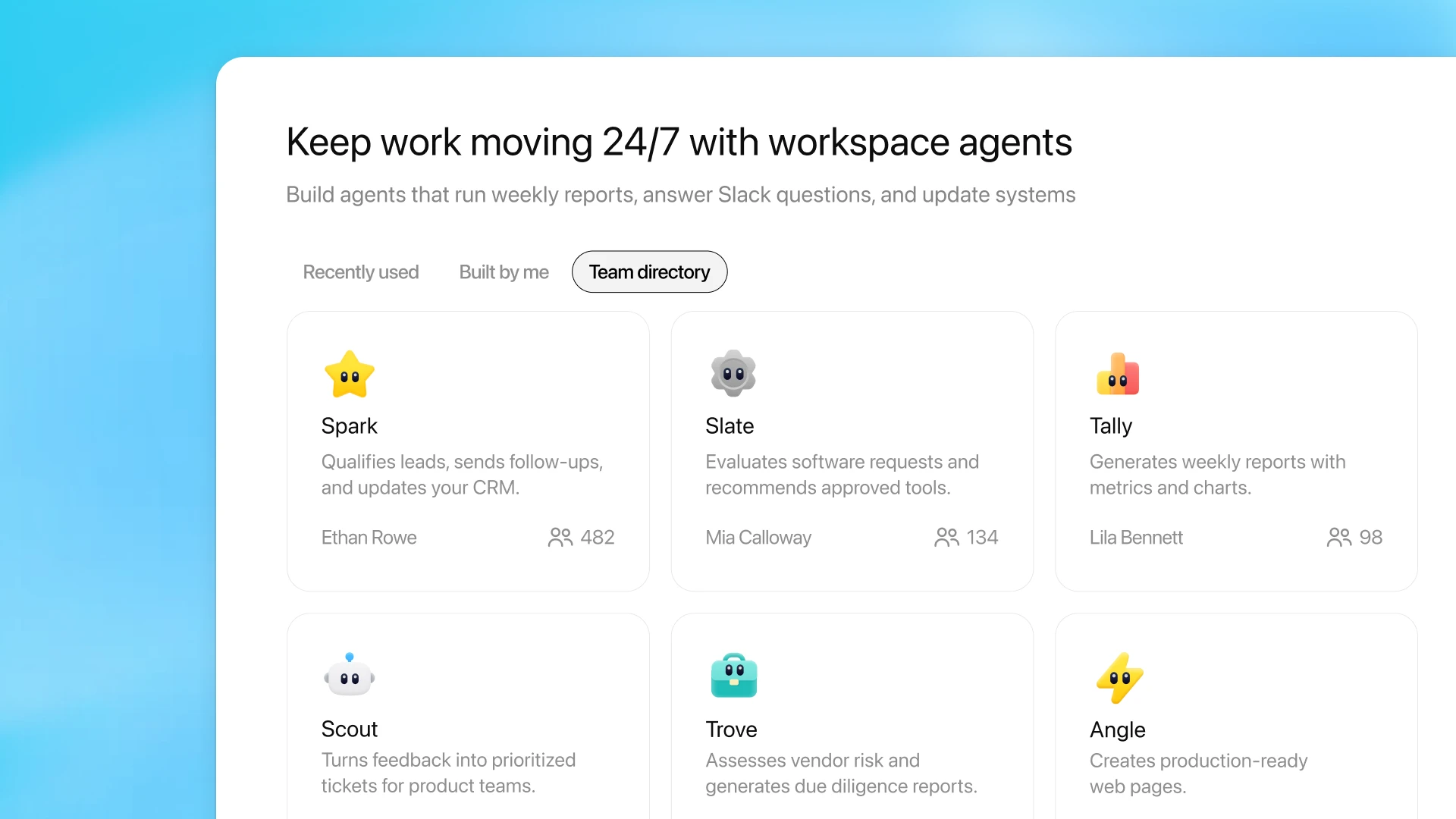
The product experience centres on a new Agents tab in the ChatGPT sidebar. This acts as a kind of team directory for AI: a space where shared agents built by colleagues can be discovered, reused and managed across a workspace.
In this model, an agent that understands a company’s sales process, or a specific documentation structure, can be created once and then reused by others instead of each employee building their own version. OpenAI’s broader pitch is that AI should shift from being an individual productivity hack to becoming a shared organisational resource, aligned with defined business processes and permissions.
By allowing agents to operate across multiple apps and teams, OpenAI is also aiming at a long-standing pain point in office work: the handoff between people and systems. Workspace Agents are designed to sit in the middle of those handoffs, coordinating information and execution so tasks move forward without constant human supervision.
Related Reading
More contextual TechBooky stories selected from tags, categories and article context.
Paul Femi Balo is the founder and publisher of TechBooky. He covers artificial intelligence, African technology, digital infrastructure, enterprise technology and the global digital economy.
We use cookies to ensure that we give you the best experience on our website. If you continue to use this site we will assume that you are happy with it.