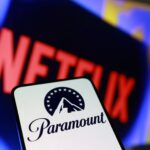
Many Americans, including Nick LaFleur, believe that a Netflix-Warner Bros. partnership could alleviate “subscription fatigue”.
Despite constant price increases, the resident of New York City has managed to hold onto a full poker hand of streaming services, including Netflix, Disney+, Apple TV, HBO Max, and Paramount+.
In an effort to keep Paramount at bay as the two contend for the company’s highly sought-after studio and content library, Netflix changed its roughly $83 billion offer for the majority of Warner Bros. to all-cash on Tuesday. If successful, a new tab tie-up between Netflix and Warner Bros. might unite the streaming service HBO Max with Netflix.
LaFleur and others hope that might translate to smaller bills.
“The trajectory of streaming prices, whether there is a merger or not, seems to be going up and up,” said LaFleur, who works in tech communications. “I would imagine they would not just add the price of HBO Max to Netflix… my expectation is that I could get a discount.”
According to a November Forbes Home study of 1,000 respondents, Americans now pay for an average of 2.9 streaming subscriptions despite the escalating expenses, which now total $552 annually.
Most HBO Max subscribers also had Netflix as of June, with overlap reaching 94%, while 38% of Netflix users subscribed to HBO Max, according to Bernstein.
Before studios pulled their content to launch competing services, streaming’s early promise of “everything under one roof” might be revived through a partnership.
Experts caution that the deal may suppress competition and weaken HBO’s standing as a leader in prestige content, a position it currently holds over Netflix.
The rapid growth of streaming services has flooded consumers with content, echoing the era when cable TV offered hundreds of channels that many viewers never watched. A Mintel survey of nearly 2,000 U.S. consumers conducted last August found that 72% believe streaming bundles provide better value, while 63% say they feel overwhelmed by the sheer number of choices.
“It’s a hassle to manage subscriptions,” said Orlando resident Frank Weaver, who said he bought an app to track his services and has cancelled several due to rising costs.
An industry tracker Antenna report last year found that the discounted Disney+, Hulu, and HBO Max bundle retained 80% of subscribers after three months, outperforming any of the services offered on their own.
For many viewers, Netflix, which is the world’s largest streaming service with 325 million subscribers, serves as the foundation of any entertainment bundle. A Forrester Research survey of more than 400 adults in the U.S., the UK, and Canada published last year found that 78% of respondents selected Netflix when creating a hypothetical custom bundle, ranking it ahead of Disney+, Paramount+, and HBO Max.
According to Reuters, Netflix has argued in its bid for Warner Bros. that a combined offering could reduce costs for consumers while also addressing regulatory concerns.
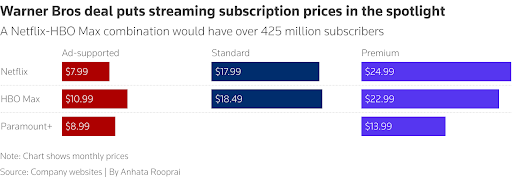
Pricing reflects Netflix’s premium position: its standard plan costs $17.99 per month, compared with $18.49 for HBO Max’s comparable tier and $13.99 for Paramount+’s ad-free Premium plan, based on company websites.
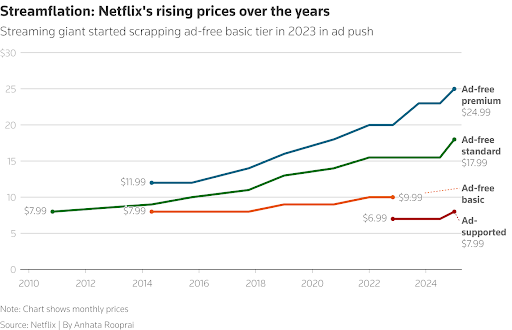
The streaming giant scrapped its Basic ad-free plan in 2023, leaving subscribers with Premium, Standard, or Standard with ads.
The cost of the ordinary ad-free plan increased by more than $2 to $17.99 during that time, while the premium plan now costs $24.99 per month, up from $19.99 in 2022.
The merger of Netflix and Warner Bros. may give the merged company excessive bargaining leverage, lawmakers have warned. According to experts, this could result in fewer options, giving Netflix greater leeway to increase its prices, cut back on the quality of HBO’s programming, or do both.
Bill Baer, a visiting scholar at the Brookings Institution and former U.S. assistant attorney general for antitrust under President Barack Obama, stated, “The worry is whether they will be positioned to pay less for content, whether the winning bidder is Netflix or Paramount.”
In terms of the risks and trade-offs of market concentration, lawmakers and critics caution that the deal could give Netflix disproportionate bargaining power, which may drive up subscription costs over time.
Industry experts warn that HBO’s reputation for high-quality, prestige programming could be diluted if it is absorbed into Netflix’s broader content strategy. They also caution that reduced competition, with fewer rival platforms, may lessen a merged company’s incentive to invest in top-tier creative projects.
We use cookies to ensure that we give you the best experience on our website. If you continue to use this site we will assume that you are happy with it.