OpenAI’s video-generation tool Sora is currently going through a decline, having trouble after quickly rising to the top of the software store in October. As the initial excitement surrounding the AI video social network fades, new data indicates that the app is experiencing drops in both app installs and user spending.
The “novelty” of AI-generated video is wearing off for many casual users, according to new data, even though it scored No. 1 on the U.S. App Store and reached 1 million downloads faster than ChatGPT.
Despite being an invite-only experience, the iOS version, powered by OpenAI’s video creation model Sora 2, surpassed 100,000 installs on its first day. It surpassed ChatGPT in reaching the milestone of one million downloads and quickly rose to the top of the U.S. App Store. Because Sora’s app was only available on iOS at the time and still required an invitation, its popularity was all the more remarkable.
The present difficulties are caused by a number of variables which are outlined below.
Increasing competition from the likes of Google (Gemini) and Meta, two rivals that have released their own AI video solutions.
Whereas the early iterations made it possible for users to make videos using characters that were protected by copyright, which resulted in more stringent safety regulations that many users felt were constrictive.
Low Retention: Unlike other platforms, the feed’s repeated information doesn’t promote social engagement.
Technical and Legal Issues: The program faces a trademark dispute over the “Sora” moniker, and technical limitations exist.
But Sora’s popularity has started to decline in the weeks following its mobile release.
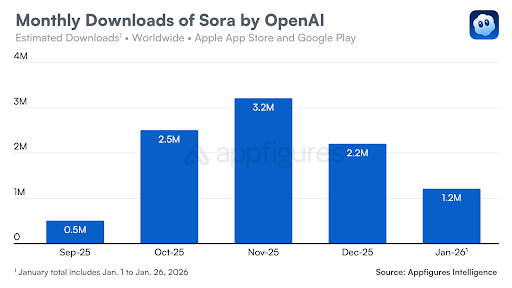
Sora’s downloads fell 32% month over month in December, according to data from market research firm Appfigures. That’s problematic because the holidays are traditionally a bonanza for mobile apps, as people are awarded new cellphones and often have time off from work, allowing them to install new apps and games.
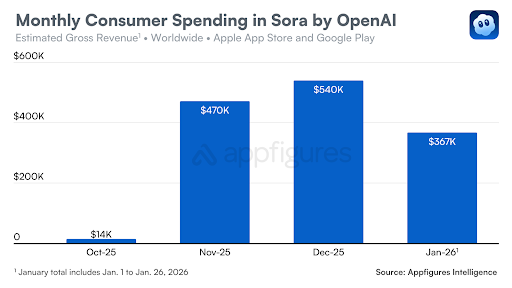
Installations fell 45% month over month to 1.2 million in January 2026, continuing the downward trend. According to Appfigures, consumer spending has also decreased, falling 32% month over month as of January.
A request for comment was not immediately answered by OpenAI.
Sora lets users make AI videos with prompts, much like an AI-flavoured TikTok. Users can opt to put themselves and their friends as the primary actors in the videos thanks to a special feature, and others can remix uploaded videos to further personalise them. To finish the scenes that users build, the videos can also incorporate dialogue, sound effects, and music.
To date, Sora’s app has received $1.4 million in customer spending and 9.6 million downloads on iOS and Android. The majority of the amount ($1.1 million) comes from the United States, with Japan, Canada, South Korea, and Thailand following.
Customers spent $367,000 on Sora’s app this month, compared to a peak of $540,000 in December.
Sora has dropped out of the Top 100 free apps on the U.S. App Store. Right now, it is located at No. 101. In the Photo & Video category, it has the highest ranking of No. 7. The app performs badly on Google Play in the United States, ranking No. 181 overall among the best free apps.
These stats are still too high to call off the app as “dead”, but they are alarming.
The drop is probably the result of several interrelated reasons.
To begin with, Google’s Gemini, especially its Nano Banana model, has shown itself to be a tough competitor, contributing to the popularity of its Gemini AI software. In October, just as Sora was gaining popularity, Meta AI’s app released an AI-powered Vibes video, increasing its downloads.
At the same time, OpenAI has had trouble keeping Sora’s copyright violations under control. Hollywood studios and agencies naturally objected when the company first informed them that they would have to choose not to have their intellectual property used in Sora. However, adoption was fuelled by users’ ability to make AI videos utilising well-known characters like SpongeBob and Pikachu in the absence of strong copyright limitations. Sora switched from an opt-out to an opt-in model and tightened the app’s restrictions in order to placate Hollywood and fend off legal threats.
A partnership between OpenAI and Disney last month made it possible for users to create videos in Sora using the company’s characters. However, neither Sora installations nor consumer spending have grown as a result of this announcement thus far. (Given some of the obscene films Sora users have made with its characters, it’s also not necessarily a good look for Disney.)
There was a lot of excitement surrounding the introduction of Sora 2, with some referring to it as the TikTok of AI and a disruption to social media. However, a lot of people were not interested in having their likeness used to create AI films by others, including their friends. People’s interest in Sora appears to have decreased in the absence of familiar faces and with restrictions on using commercial intellectual property. For now, it remains unclear whether the app can rebound through additional copyright agreements or the rollout of new features.
With additional studio agreements, such as a collaboration with Disney, and capabilities like video remixing, OpenAI is trying to stabilise the platform.
Paul Balo is the founder of TechBooky and a highly skilled wireless communications professional with a strong background in cloud computing, offering extensive experience in designing, implementing, and managing wireless communication systems.
We use cookies to ensure that we give you the best experience on our website. If you continue to use this site we will assume that you are happy with it.