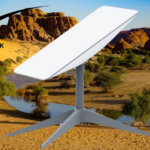
Eutelsat OneWeb, a significant rival of SpaceX’s Starlink, uses satellite components produced by NewSpace Systems, a South African maker of satellite components for international businesses, and it is one of Starlink’s most significant international competitors at the moment that receives essential components from the South African satellite component maker NewSpace Systems.
The company responded that although it has stringent NDAs in place, it could verify the identity of a Starlink competitor it manufactures for when we asked if it makes satellite systems, especially for Starlink.
According to NewSpace Systems, it supports more than 40 satellite constellations or individual mass-produced satellite “buses,” also known as repeating platforms, that are used by businesses all over the world.
The corporation stated, “For instance, we have been a proud supplier to the first generation of Airbus OneWeb satellites.”
In December 2024, Eutelsat hired Airbus, a European aircraft manufacturer, to construct a low-Earth orbit expansion for OneWeb. One hundred more satellites were included in the contract.
“Airbus will build the first batches of the extension, totalling 100 satellites, under the contract signed between the two companies, with delivery targeted from the end of 2026,” the company stated.
At its newly constructed 5,200 m² manufacturing plant in Somerset West, Western Cape, NewSpace Systems produces parts for Airbus.
“Airbus will build the first batches of the extension, totalling 100 satellites, under the contract signed between the two companies, with delivery targeted from the end of 2026,” the company stated.
At its newly constructed 5,200 m² manufacturing plant in Somerset West, Western Cape, NewSpace Systems produces parts for Airbus that are used.
It stated, “With more than 648 OneWeb satellites launched, their primary mission is to provide widespread, high-speed internet access worldwide, ensuring reliable coverage even in remote regions.”
The company informed the members of the press in March that it produces high-precision satellite hardware, such as reaction wheels, solar sensors, and GPS receivers, with an emphasis on space navigation and orientation.
It described itself as a significant supplier to providers of “broadband-from-space.” At its Somerset West factory, it constructs parts for low-earth-orbit satellite constellations.
The National Aeronautics and Space Administration (NASA) and other organizations across the world have used its components on more than 2,500 spacecraft missions to date.
One of the biggest low-Earth orbit satellite Internet providers in the world, Eutelsat OneWeb is a part of the Eutelsat Group and one of the few organizations, aside from Starlink, that is to oversee a constellation of more than 500 satellites.
At present, the OneWeb satellite constellation consists of more than, and not less than, 648 interconnected tiny satellites that offer low-latency Internet services to businesses all over the world.
The company started shifting away from the direct-to-consumer business model in April, and it is now concentrating on business-to-business internet services for telecom companies.
The Tata Group, European airline Volotea, and the massive shipping and logistics company CMA CGM are just a few businesses that Eutelsat OneWeb currently has as partners. Additionally, it has made a widespread reach to South Africa and beyond.
Paratus South Africa, a telecommunications network provider, partnered with Eutelsat OneWeb to offer its services in the nation at the start of 2024.
The statement stated that “Paratus South Africa now offers high bandwidth with a latency of less than 70 milliseconds through Eutelsat OneWeb’s LEO service.”
Eva Berneke, who is the CEO of Eutelsat, had affirmed that Airbus will assist the company in integrating its constellation utilizing technology that is in line with the European IRIS2 constellation in 2030.
The European Union’s response to SpaceX’s Starshield, which is a secured satellite government network, is called Infrastructure for Resilience, Interconnectivity, and Security via Satellite (IRIS2).
IRIS2 will be utilized by states in the European Union and certain African nations, while Starshield will only be utilized by the US government.
Berneke further stated that they are eager to start the next phase of our journey to meet the growing demand for low-earth orbit capacity.
Airbus has been in collaboration with NewSpace Systems for a while, and in 2020 the European giant named it the “Best Small Company Performer.”
In addition, the company has provided parts to commercial customers and over 17 national space agencies, including the Japanese Aerospace Exploration Agency (JAXA).
“We have collaborated with clients like Astroscale, whose primary goals are to remove space debris, prolong the life of satellites, and carry out in-orbit inspection and docking.”
Eighty percent of its clients were commercial, according to the statement. “Additional commercial clients worth mentioning include Aerospacelab, OHB Sweden, Firefly Aerospace, Synspective, and Berlin Space Technologies.”
While South African manufacturers support the global space economy, Starlink remains blocked locally due to ownership laws, creating opportunities for rivals like Amazon’s Project Kuiper (which is open to compliance), China’s SpaceSail (already trademarking in the country), and Vodacom (partnering with Starlink elsewhere in Africa to bypass restrictions).
Related Reading
More contextual TechBooky stories selected from tags, categories and article context.
We use cookies to ensure that we give you the best experience on our website. If you continue to use this site we will assume that you are happy with it.