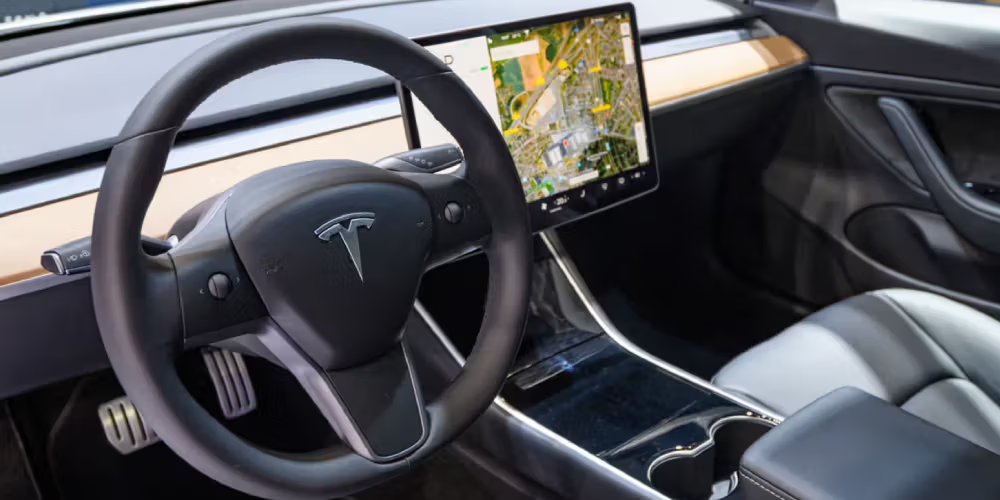
Tesla has taken autopilot California’s Department of Motor Vehicles to court, seeking to overturn a state ruling that stopped the company from using the terms “Autopilot” and “Full Self-Driving” to market its vehicles in the state.
The lawsuit, filed on February 13 and reported by CNBC, escalates a years-long dispute over how aggressively Tesla can promote its driver-assistance technology and how clearly it must communicate the system’s limits to customers.
The legal battle stems from a December decision by a California administrative law judge, who found that Tesla’s marketing language around its driver-assistance features needed to be tightened up. The judge’s ruling effectively told Tesla to clean up how it described “Autopilot” and “Full Self-Driving” or risk having its California vehicle sales license suspended.
In response, Tesla adjusted its wording. Among the changes, it rebranded the package as “Full Self-Driving (Supervised)” language the DMV later accepted as sufficient. Last week, California’s DMV said Tesla had made the required updates and confirmed that no suspension of the company’s sales license would go ahead.
Tesla, however, is now challenging the underlying finding. In its complaint, the company argues that the DMV “wrongfully and baselessly” labelled Tesla a false advertiser. It calls the order “factually wrong” and “unconstitutional,” and asks the court to set it aside.
The DMV’s original position was that terms like “Autopilot” and “Full Self-Driving” could reasonably lead buyers to believe the vehicles were capable of safe operation without a human driver ready to take control. Regulators have long warned that branding can shape driver behaviour as much as the underlying technology.
Tesla counters that the DMV has not shown that customers were actually misled. According to the complaint, the company says it is “impossible” to purchase a Tesla without encountering “clear and repeated statements” that the systems are not fully autonomous and that driver supervision remains required.
The confrontation comes as Tesla leans heavily on automated driving as a core part of its future strategy. The company has repeatedly framed autonomy as central to the value of its vehicles and its long-term business model.
CEO Elon Musk has for years told buyers and investors that Tesla vehicles would ultimately become fully autonomous, with the potential to operate as robo-taxis when drivers are not using them. In 2019, he predicted that within about a year to 15 months there would be more than a million robo-taxis on the road; that forecast did not materialise.
Despite setbacks, Tesla is continuing to push automated driving initiatives. After a notable sales decline last year, especially in Europe, the company is pinning some of its hopes on a two-seat “Cybercab” concept, which it sees as a way to revive demand. Tesla has also begun limited testing of automated vehicles under a Robotaxi pilot program in Austin, Texas, indicating that it is still investing in the robo-taxi vision.
At the same time, the company’s driver-assistance branding and its real-world performance are facing mounting legal scrutiny. Just last week, Tesla lost an appeal in a $243 million lawsuit verdict tied to a 2019 crash involving a Model S. The case centred significantly on the company’s use of “Autopilot” and “Full Self-Driving” terminology and how those terms shaped expectations about what the car could safely do.
Tesla has also started to restructure its driver-assistance product tiers. Last month, it scrapped the “Autopilot” tier described as the basic advanced driver-assistance package on new Model 3 and Model Y vehicles. In parallel, Tesla shifted its “FSD (Supervised)” offering to a subscription-only model, moving away from one-time purchase pricing for that package.
Those changes, together with the DMV dispute, show how closely regulators, courts and the company itself are now focused on not just what Tesla’s systems can do, but what its marketing tells people they can do.
Paul Balo is the founder of TechBooky and a highly skilled wireless communications professional with a strong background in cloud computing, offering extensive experience in designing, implementing, and managing wireless communication systems.
We use cookies to ensure that we give you the best experience on our website. If you continue to use this site we will assume that you are happy with it.