As part of what it described as an ongoing safety assessment, TikTok has temporarily limited Nigerian users’ access to its LIVE feature during late-night hours, sending creators an in-app alert.
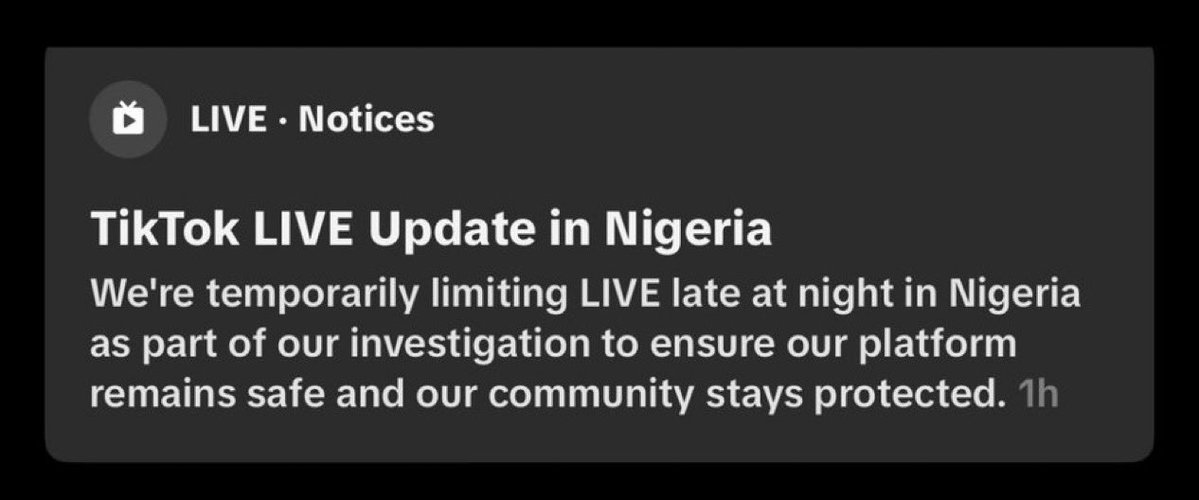
On Sunday at midnight Nigerian time, viewers received a system message from the platform saying, “LIVE⚫Notices TikTok LIVE Update in Nigeria.”
In order to maintain the security of our platform and the safety of our community, we are temporarily restricting LIVE late at night in Nigeria.
More key details to the restrictions on this late-night access are due to an increase in broadcasts of pornographic and sexually explicit content, TikTok has temporarily limited late-night LIVE access for Nigerian users.
And as part of a larger safety review, the platform put the step into place to make sure the community is kept safe.
The time restriction is between 11 p.m. and 5 a.m. (Nigerian time), which were found to be the busiest times for content that violated policy, Nigerian users were momentarily prohibited from hosting or viewing LIVE sessions.
During this time, LIVE sessions that were operational earlier in the evening were rendered inaccessible between 11 p.m. and 5 a.m., according to PUNCH Online’s checks, and the impacted accounts displayed a “No Access” mark.
According to TikTok, late-night streams in Nigeria are now frequently linked to producers engaging in pornographic actions in return for virtual presents, which is a clear violation of both community and monetisation policies. Over 49,000 Nigerian LIVE sessions were banned for these infractions in just the second quarter of 2025.
Additionally, creators were unable to watch live broadcasts from other nations due to the limitation.
The message was only sent to creators who had at least 1,000 followers, which is a prerequisite for holding a live session.
A number of people attested to the fact that all LIVE activity had been suspended overnight.
Concerns about financial loss are allayed because creators who make money through LIVE giving still maintain their accounts and prior profits.
LIVE access has been restored as of Monday morning, spurring conversations on social media as users conjectured about the reason behind the abrupt, countrywide block.
For Nigerian streamers who broadcast games, entertainment segments, trends, and other interactive sessions that draw viewers and virtual gifts, night-time hours are usually their busiest.
TikTok issued updated safety statistics for West Africa a few weeks prior to this development.
The business revealed during its West Africa Safety Summit in Dakar, Senegal, that it has taken action against 1,040,356 LIVE producers and 2,321,813 LIVE sessions worldwide in the second quarter of 2025 for breaking its LIVE Monetisation policies.
During that time, 49,512 LIVE sessions were prohibited in Nigeria alone.
Additionally, TikTok claimed that between April and June 2025, 3,780,426 videos in Nigeria were removed for violating Community Guidelines; 98.7% of these videos were removed before they were viewed, and 91.9% were removed within a day.
Unlike pre-recorded videos, TikTok Live is an in-app feature that allows users to broadcast in real-time, encouraging direct contact with viewers through comments and virtual gifts. This allows users to create interactive sessions for Q&As, talent showcases, or simply talking.
Creators must typically have 1,000+ followers (though occasionally less), be at least 16 (18 to earn money), have a clean account, choose “LIVE” using the “+” button, and add a title and effects before beginning.
The platform has not provided a schedule for the completion of its safety inquiry, although access to the late-night LIVE feature was restored by Monday morning after the interim ban.
The House of Representatives recently passed a motion for the Nigerian Communications Commission (NCC) to prohibit all pornographic websites in order to defend social values, which is part of a larger movement in Nigeria for more stringent control of online content.
Users debated the restriction, with some applauding it as a vital step to stop exploitation and others voicing concerns about the financial impact on legitimate authors who depend on peak overnight hours for revenue.
We use cookies to ensure that we give you the best experience on our website. If you continue to use this site we will assume that you are happy with it.