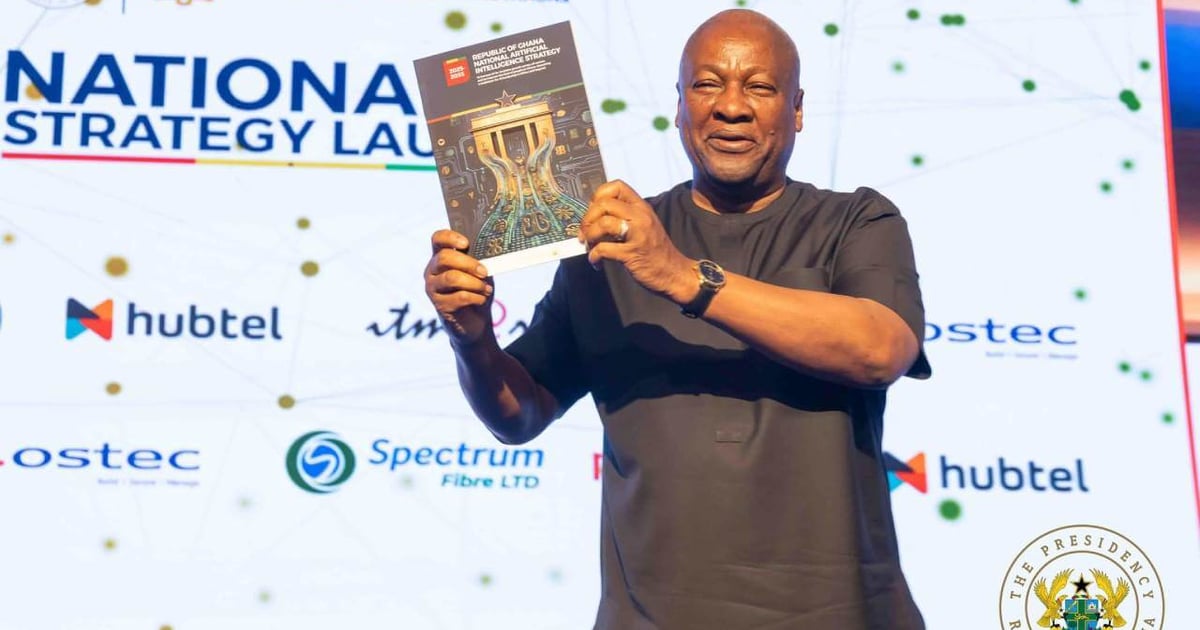
Ghanaian President John Dramani Mahama at the launch of the country’s National AI Strategy in Accra on April 24, 2026.
Ghanaian learners are signing up for AI credentials at a striking pace, but the harder question is what those courses lead to. AI-related micro-credential enrollments in Ghana rose 95% year over year, according to country findings Coursera released on October 19 from its Global Skills Report 2026. Enrollments in critical thinking rose 66% over the same period. Together, the numbers suggest learners are interested in both using AI and judging its output, though neither figure tells us how many people found work.
The report also recorded a 235% rise in AI-security enrollments, a 115% increase in generative-AI enrollments and a 137% rise in agentic-workflow enrollments. Overall AI-course enrollments grew 34%, while micro-credential enrollments across subjects rose 21%. These are growth rates, not counts of trained professionals. Coursera did not provide a starting enrollment total for every Ghanaian category in the release, so a large percentage rise could come from a relatively small base.
Coursera ranks Ghana 89th among 98 countries on its new AI-Human Skills Synergy Index and eighth among the 11 Sub-Saharan African countries it covers. The index combines patterns in AI and human-skills learning with wider national AI-readiness data. That makes it broader than a league table of course registrations, but it is still Coursera’s constructed measure rather than a direct test of every worker’s ability.
The apparent tension between rapid enrolment growth and a low index ranking is the story. People can be motivated to learn while employers still struggle to find experienced staff, reliable computing resources or opportunities to apply new skills. TechBooky has examined the gap between Africa’s AI talent, compute capacity and capital. Ghana’s results offer another reason to ask how those pieces connect in practice.
What the figures do and do not show
The 2026 report draws on learning activity from Coursera and Udemy, which together serve more than 300 million learners worldwide. Its Ghana figures reflect activity on those platforms, not a census of Ghanaian students or workers. Enrollment is also different from completion, assessed competence or employment. A person might register for several courses; another might learn comparable skills through a university, employer or local training programme outside the data set.
That limitation should not erase the signal. An increase in AI-security courses suggests learners are noticing that adoption brings risks as well as productivity claims. Growth in critical thinking and complex problem-solving enrollments, the latter up 39%, points toward abilities employers will need when AI produces plausible but wrong answers. What the report cannot establish is whether those courses changed workplace performance.
Coursera says micro-credentials can help people demonstrate specific assessed skills. Employers, however, still need evidence that applicants can use those skills in real settings. A portfolio project, a supervised placement or a measurable improvement to a business process may say more than a certificate alone. Schools and training providers could make their courses more useful by pairing AI tools with local datasets, clear evaluation standards and projects designed with employers.
Ghana’s broader AI plans make that question timely. The release points to a national strategy, proposed computing investment and the One Million Coders Programme. Those initiatives could support a wider skills pipeline, but targets and course registrations should be tracked separately from funded infrastructure, programme completions and jobs created. TechBooky’s African AI policy tracker provides context for why implementation matters as much as an announced strategy.
The most useful follow-up would be completion rates, the number of unique Ghanaian learners behind the enrollment totals, employer demand by skill and outcomes six or twelve months after training. For now, Coursera’s figures show a substantial rise in learning activity. Turning that interest into useful work is the challenge Ghana’s educators, companies and policymakers still have to meet.
Related Reading
More contextual TechBooky stories selected from tags, categories and article context.
Paul Balo is the founder of TechBooky and a highly skilled wireless communications professional with a strong background in cloud computing, offering extensive experience in designing, implementing, and managing wireless communication systems.
We use cookies to ensure that we give you the best experience on our website. If you continue to use this site we will assume that you are happy with it.