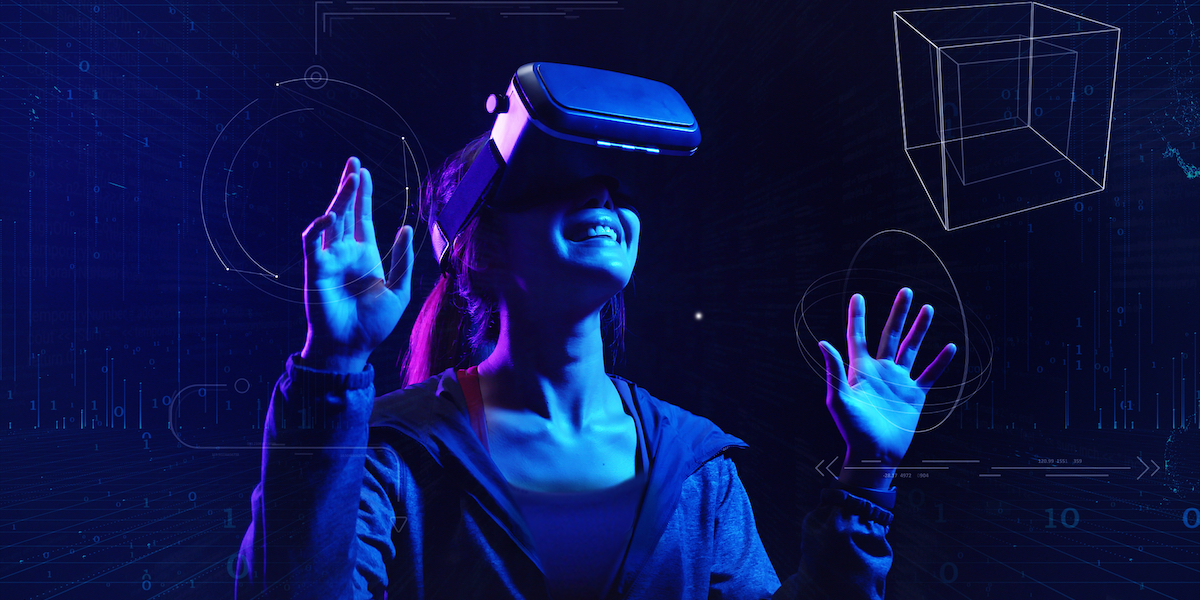
The metaverse did not disappear when artificial intelligence took over the technology conversation. The stronger question is whether AI can provide what the first wave of metaverse products often lacked: places that are easy to build, responsive to people and useful enough to revisit. An AI-powered metaverse could be the next stage of immersive computing, but AI alone will not create one seamless virtual world. Hardware, cost, trust and interoperability still matter.
The old pitch asked people to wear a headset and spend time as avatars in a digital version of a meeting room. The newer possibility is more practical. A student could explore a simulated laboratory with a tutor that responds to mistakes. A designer could inspect a prototype at full scale. A shopper could receive contextual help through glasses while standing in a physical store. In each case, immersion serves a task rather than becoming the task itself.
What is an AI-powered metaverse?
An AI-powered metaverse is a persistent or repeatable digital environment in which AI helps create the space, interpret a user’s intent, animate characters and adapt the experience. It need not be one universal platform or require a headset. A game, an augmented-reality view and a mixed-reality workspace could all use pieces of this approach. The difference from a static 3D scene is that the environment responds meaningfully to what someone says or does.
That definition has limits. A short AI-generated video is not a world people can reliably inhabit. A chatbot inside a game is not necessarily an autonomous character. AI glasses that answer questions about the physical world are not automatically a metaverse. These technologies overlap, but calling them identical would repeat the vagueness that weakened the first metaverse boom.
The clearest near-term change is production. Convincing 3D spaces traditionally demand specialist artists, developers and time. Roblox says its Cube foundation model can generate functional 3D objects, while its newer creator tools aim to reduce technical barriers. Those are evolving capabilities, not proof that a text prompt can replace an entire game studio. They do suggest that more creators could test an idea before paying for a full production pipeline.
Google DeepMind’s Genie 3 research points toward interactive world generation. The model can produce navigable environments in real time, but DeepMind also acknowledges limits in available actions, consistency and duration. A captivating demonstration lasting minutes is different from a dependable education platform or multiplayer world that must work day after day. TechBooky has explored the promise of Project Genie; the open question is how quickly such experiments become robust tools.
Lower production costs could be especially valuable to African creators. A small studio might prototype a virtual museum, a training scenario or a game grounded in local places and languages without first assembling a large 3D team. That is an opportunity, not a guarantee of equal access. Computing bills, connectivity, payment systems and device prices will still decide who can build and participate.
The old metaverse vision focused on where users would go. The next version may depend more on what meets them there. An AI tutor in a science simulation could change a lesson when a student gets stuck. A factory training assistant could react when a worker overlooks a safety step. A virtual shop guide could answer specific questions without pushing visitors through a maze of menus. If these agents remember appropriate context and act reliably, digital environments become services rather than decorated rooms.
Google DeepMind’s SIMA 2 research investigates agents that reason and act in virtual 3D spaces. This is still research, not a finished universal companion. It nevertheless shows why adding language to perception and action matters more than placing a generic chatbot beside an avatar. A useful agent must understand a scene, carry out a task and recover when it gets something wrong. At scale, it also has to be affordable.
The second act may look less like entering a separate world and more like adding a digital layer to the physical one. Google has described Android XR glasses built around Gemini assistance. Meta’s AI glasses work places an assistant in wearable devices. These products do not establish a shared metaverse, but they test whether people value hands-free information, translation and contextual help more than a promise of permanent immersion.
Apple’s continued investment in Vision Pro illustrates a different route through premium mixed reality. Its price and form factor keep it far from an everyday default. Headsets, glasses, phones and conventional screens may coexist for years. The winning experience may be one that can move between them rather than insisting that everyone buy the same device.
A useful shared environment needs more than generated scenery and clever assistants. People must feel comfortable using the hardware. Networks have to keep interactions responsive. Digital objects, identities and purchases need rules for moving between services; otherwise, users face a collection of isolated platforms. The International Telecommunication Union’s work on a trusted metaverse treats governance, identity and interoperability as central questions, not finishing touches.
Privacy is just as fundamental. Glasses with microphones and cameras may collect information about people who never agreed to join an experience. AI characters could imitate real people, while immersive services might gather unusually detailed behavioral data. Meta describes safeguards for its glasses, including a visible capture indicator, but product safeguards cannot replace informed consent and enforceable rules. Children deserve particular care when persuasive agents are designed to keep them engaged.
There is a creative risk as well. Cheap world generation may fill platforms with repetitive spaces. Discovery, moderation and fair payment for artists become more important as supply grows. The lesson from earlier technology hype cycles is not that immersive computing was foolish. Adoption follows genuine utility, not a new label or a dazzling demonstration.
What would count as a real second act?
The meaningful test is whether AI-powered environments help people do something better than a conventional app or video call. Look for repeat use in education, design, entertainment and industrial training. Look for agents that act reliably, creator tools that save measurable time, and devices people willingly wear. Interoperability and business models that reward independent creators would be stronger evidence than another expensive virtual showroom.
The most likely outcome is not a sudden return of the capital-M Metaverse. It is a gradual blending of generative AI, spatial computing and ordinary services. Some experiences will be fully virtual; others will sit lightly over the physical world. AI may finally supply immersive computing with its missing intelligence. Whether that becomes a major platform depends on a less glamorous achievement: making it useful, trustworthy and accessible to people who never asked for a metaverse in the first place.
Related Reading
More contextual TechBooky stories selected from tags, categories and article context.
Paul Balo is the founder of TechBooky and a highly skilled wireless communications professional with a strong background in cloud computing, offering extensive experience in designing, implementing, and managing wireless communication systems.
We use cookies to ensure that we give you the best experience on our website. If you continue to use this site we will assume that you are happy with it.