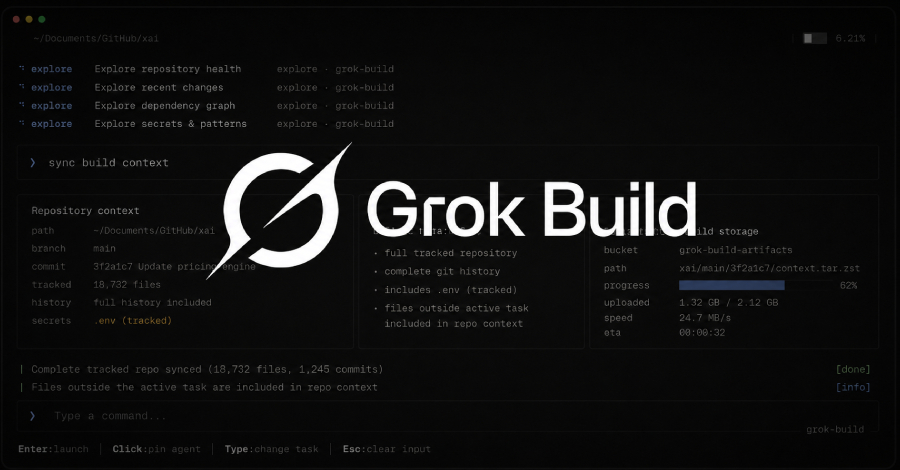
xAI has open-sourced Grok Build, its terminal coding agent and text-based user interface, just as developer trust in AI coding tools is facing another stress test. The company says the source code is now available on GitHub so developers can inspect how the agent loop, tools, context assembly and extension system work.
The timing is hard to ignore. Grok Build had come under criticism after security researchers reported that the coding assistant uploaded much more repository data than users expected, including full Git repositories in some cases. xAI’s official open-source announcement does not dwell on that controversy, but the move clearly speaks to the trust problem around AI coding agents.
AI coding assistants are no longer simple autocomplete tools. They read files, search repositories, run commands, edit code and in some cases interact with remote services. That makes them useful, but it also means they sit close to secrets, source code, customer data and internal architecture. Developers need to know what leaves the machine, where it goes and how long it is retained.
Open-sourcing Grok Build gives developers a way to inspect the harness behind the agent. According to xAI, the published source includes the agent loop, file and command tools, terminal UI, inline diff viewer and extension system for skills, plugins, hooks, MCP servers and subagents. The company also says Grok Build can run in a more local-first way when developers compile it and point it at their own inference setup.
That matters because trust in coding agents is partly architectural. A company can publish a privacy policy, but developers increasingly want to verify behaviour at the code level. Does the tool upload the entire repository or only relevant snippets? Are ignored files respected? Are secrets filtered? Is telemetry optional? What happens when an agent needs context from a private monorepo?
These are not theoretical questions. The rise of AI coding agents means sensitive code is being processed by systems that may combine local tooling with cloud inference. That is why recent coverage of AI workload security is becoming more relevant to software teams, not just cloud administrators.
The Grok Build backlash shows how quickly a coding tool can lose trust if data movement is unclear. Developers are unusually sensitive to this because source code often contains the deepest map of a company’s product. Even when credentials are not present, a repository can reveal infrastructure, business logic, security assumptions and upcoming products.
Open source helps, but it does not automatically solve everything. Users still need to understand the difference between the open-source harness and any hosted model service it connects to. They also need clear defaults, visible controls and documentation that explains what data is sent during real tasks. A local-first option is useful only if teams can realistically configure and audit it.
For xAI, the move is also competitive. OpenAI, Anthropic, Google and smaller developer-tool companies are all trying to win the coding-agent workflow. The winning tool will not simply be the one that writes the best code. It will be the one engineering teams can trust inside private repositories.
Teams experimenting with Grok Build or any similar agent should treat it like a new developer with tool access. Start with non-sensitive repositories. Review network behaviour. Check privacy settings. Use test accounts and scoped tokens. Make sure secrets are not stored in repos. Require approval before commands that touch production systems.
The broader point is that coding agents are becoming part of software infrastructure. That means they need security reviews, procurement checks and internal usage policies, not just enthusiastic adoption by individual developers. Open-sourcing Grok Build gives the community more visibility, but the real test will be whether xAI can turn that visibility into confidence.
If the coding-agent market is going to grow into everyday enterprise software, transparency will have to become a product feature. Grok Build’s open-source release is a step in that direction, but the privacy debate around AI developer tools is only getting started.
Related Reading
More contextual TechBooky stories selected from tags, categories and article context.
Paul Balo is the founder of TechBooky and a highly skilled wireless communications professional with a strong background in cloud computing, offering extensive experience in designing, implementing, and managing wireless communication systems.
We use cookies to ensure that we give you the best experience on our website. If you continue to use this site we will assume that you are happy with it.