OpenAI’s first branded hardware product is not the screenless ChatGPT companion device many people expected. It is a compact US$230 desktop control pad for developers who spend their day managing Codex agents.
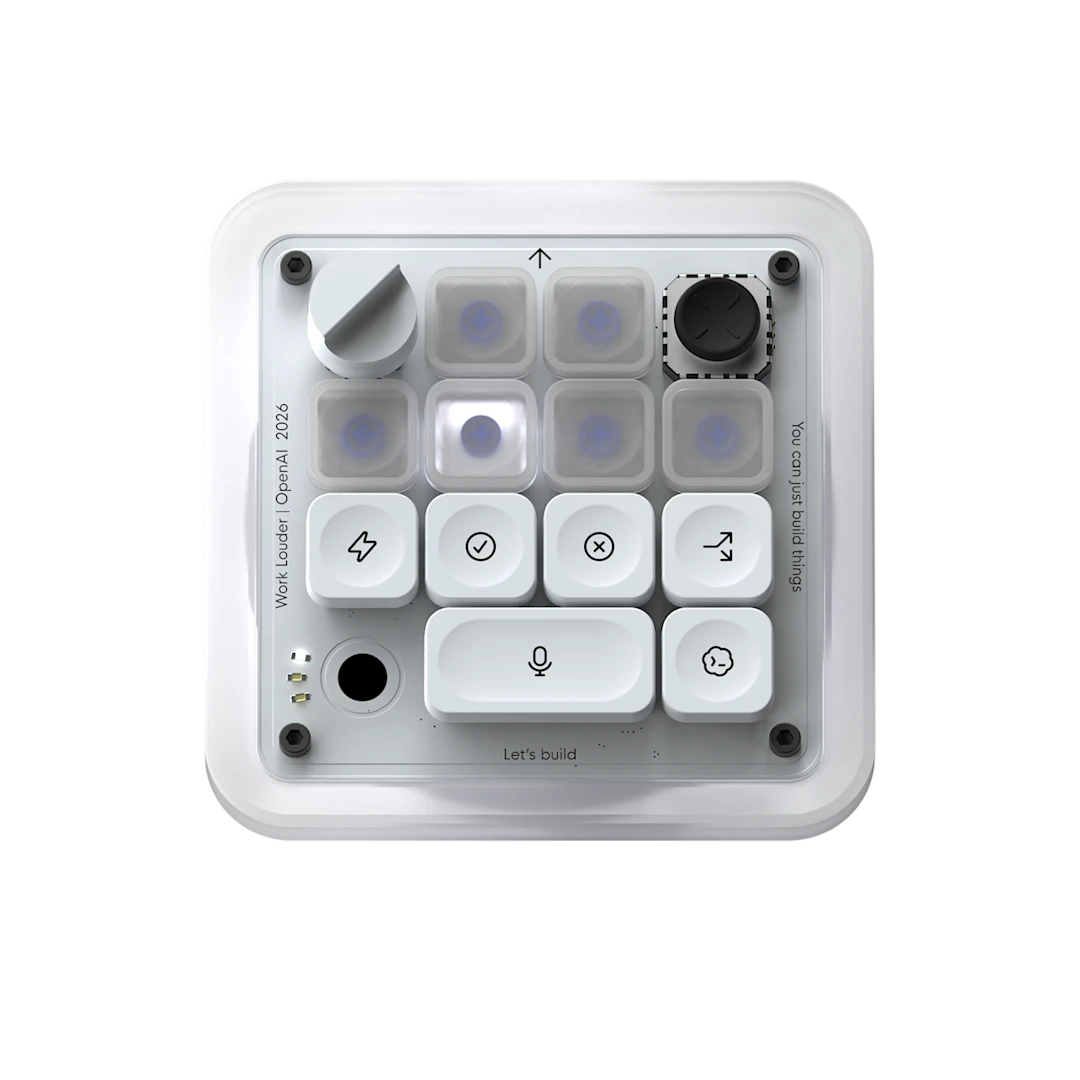
The device, called Codex Micro, was launched in partnership with boutique keyboard maker Work Louder and is aimed at Codex power users rather than mainstream consumers. It is a limited-edition keypad for controlling AI agents, it includes 13 mechanical switches, a joystick, a dial, a touch sensor and six frosted keys that can display live Codex thread status through coloured lights.
The point is not that OpenAI has invented a new category of keyboard. Macro pads already exist. The point is that OpenAI thinks AI agent work is becoming busy enough, repetitive enough and important enough to deserve its own physical controls.
That makes Codex Micro more interesting than its small size suggests. It is a sign that OpenAI sees the future of AI work as parallel and operational. Users will not simply ask one chatbot one question at a time. They will monitor agents, approve changes, reject diffs, speak quick prompts, change reasoning levels and move between several AI-assisted tasks at once.
This also puts OpenAI’s hardware strategy into two lanes. The company still has the more ambitious consumer device reportedly being built with Jony Ive, and recent reporting around a moving ChatGPT speaker points to a broader home-AI vision. Codex Micro is smaller and less glamorous, but it may be closer to how professionals actually use AI today.
Codex Micro is designed to sit beside a developer’s normal keyboard and make frequent Codex actions faster. The status keys can show whether Codex threads are running, completed or in an error state. The push-to-talk control lets users send voice prompts without reaching for another interface. The dial can adjust reasoning intensity, which matters as users move between quick fixes and deeper agent tasks.
The device comes in clicky and silent mechanical key versions and is meant for serious Codex users. The Work Louder connection also matters because the company already makes compact programmable controllers for creators, including the Creator Micro line with layers, rotary controls and shortcut-heavy workflows.
For developers, that kind of physical layer can reduce friction. Approving or rejecting changes, opening a Codex task, recording a prompt, checking status or adjusting an agent’s depth can become a muscle-memory action rather than a menu hunt.
A button sounds old-fashioned in an AI world, but physical controls still have one advantage software interfaces struggle to match: certainty. A user can feel a key, develop muscle memory and act without searching the screen. That is why Stream Decks, macro pads and custom keyboards remain popular among developers, streamers and creative professionals.
AI agents make that idea more useful. Agent work often takes time. One agent may be fixing a bug, another may be writing tests, another may be reviewing a pull request and another may be summarising logs. A physical device that shows live status and gives quick approval controls can make the workflow feel less scattered.
The deeper shift is that software interfaces are being redesigned around agents. Axios has argued before that software will need to evolve for agents, not just humans. Codex Micro is the hardware version of that idea: not a keyboard for typing code, but a control panel for supervising code-writing agents.
The convenience also creates a risk. When an agent can modify files, run tools, touch credentials or propose changes, one-tap approvals must be designed carefully. A physical key that accepts a diff may save time, but it should not become a shortcut around review.
That warning is not theoretical. Reports around GPT-5.6 Sol file-deletion incidents already show how quickly agent autonomy can become operational risk when models act beyond a user’s intent. The more powerful AI coding agents become, the more important permission design, confirmations, sandboxing and audit trails become.
A Codex control pad should therefore be judged not only by how fast it lets users approve actions, but by how clearly it shows what is being approved. Developers need visible context, safe defaults and easy undo paths. Physical buttons should speed up disciplined workflows, not make risky ones feel frictionless.
The same logic applies to security teams. Prompt-injection and agent-manipulation risks are already forcing defenders to think differently, as seen in recent work around context bombing and AI hackers. A hardware layer for agents makes the human approval step more tactile, but it does not remove the need for strong runtime controls.
Codex Micro will not be a mass-market device. It is expensive, specialised and aimed at people already deep inside Codex workflows. Most developers will keep using normal keyboards, IDE shortcuts and on-screen controls.
But niche products often reveal where serious users are heading before the mainstream catches up. The first customers for Codex Micro are likely to be developers who already run multiple AI coding tasks and want faster ways to steer them. If that workflow grows, the idea of a physical agent console may become less strange.
There is also a branding layer. Microsoft added a Copilot key to Windows keyboards. OpenAI is putting Codex controls on a dedicated device. Both moves point to the same belief: AI assistants are no longer occasional tools. They are becoming default work surfaces.
The most important test is whether Codex Micro feels useful after the novelty fades. If it merely maps existing shortcuts to nice keys, it may remain a collector’s accessory. If it gives developers a better way to manage several active agents, track statuses and approve work safely, it could become an early template for agent-era hardware.
Compatibility will matter too. Developers use VS Code, Cursor, JetBrains IDEs, terminals, browsers and custom workflows. The more open and remappable Codex Micro is, the more useful it becomes. If it depends too heavily on one OpenAI interface, its appeal narrows.
The bigger lesson is that OpenAI’s hardware story is no longer only about replacing the smartphone or building an AI companion for the home. The company is also testing hardware for people who already work with AI every day.
Codex Micro may look like a small keyboard, but it points to a larger future: AI agents will need interfaces for supervision, not just prompts for instruction. In that future, the next important button on your desk may not type a letter. It may approve an agent.
Related Reading
More contextual TechBooky stories selected from tags, categories and article context.
Paul Balo is the founder of TechBooky and a highly skilled wireless communications professional with a strong background in cloud computing, offering extensive experience in designing, implementing, and managing wireless communication systems.
We use cookies to ensure that we give you the best experience on our website. If you continue to use this site we will assume that you are happy with it.